

An AI agent identity and access management architecture gives each human, agent, workload, service, tool, and reviewer a distinct identity, then evaluates current delegated authority before every consequential action. The decision combines effective entitlements with runtime policy and human approval. Short-lived credentials limit exposure. Correlated records prove the request, decision, execution, revocation, and recovery.
This reference is vendor-neutral and current to 28 July 2026. It applies to enterprise agent systems that call tools or change external state. It treats the February 2026 NIST NCCoE software and AI agent identity and authorization paper as a draft project concept. The reusable control model below draws from established identity and authorization standards while leaving organization-specific risk, legal, privacy, and sector decisions with the implementing organization.
Separate the seven control boundaries
A successful network connection proves reachability. Authentication verifies an identity. Authorization resolves what that identity may access. Runtime policy evaluates this action and context. Approval gives an eligible person a bounded decision. Execution creates the side effect. Evidence records the complete unit for review.
Keep each boundary explicit in the architecture and the event model. A valid credential can still lack authority for the requested purpose, amount, data, environment, or time. A successful policy evaluation can still require an independent reviewer. An approval can release only the exact request and context it covered.
| Boundary | Question answered | Owner | Evidence |
|---|---|---|---|
| Connectivity | Can this workload reach the endpoint? | Network and platform owner | Route, endpoint, transport, network decision, time |
| Authentication | Which human, agent, workload, service, or tool presented the request? | Identity owner | Issuer, subject, actor, audience, method, issue and expiry time |
| Authorization | Which resource and operation may this identity use? | Resource and IAM owners | Effective grant, role, attributes, relationships, capability, result |
| Policy decision | May this action run here with these parameters and business facts? | Process and policy owners | Policy version, evaluated fields, outcome, reason codes |
| Approval | Does an eligible independent person release this held request? | Business risk owner | Decision Request, reviewer authority, rationale, expiry |
| Execution | What side effect occurred? | Tool and Process owners | Bound request, receipt, before and after state, downstream effect |
| Evidence | Can a reviewer reconstruct and verify the complete decision? | Evidence and audit owners | Population, correlated events, integrity, omissions, retention |
System context and identity classes
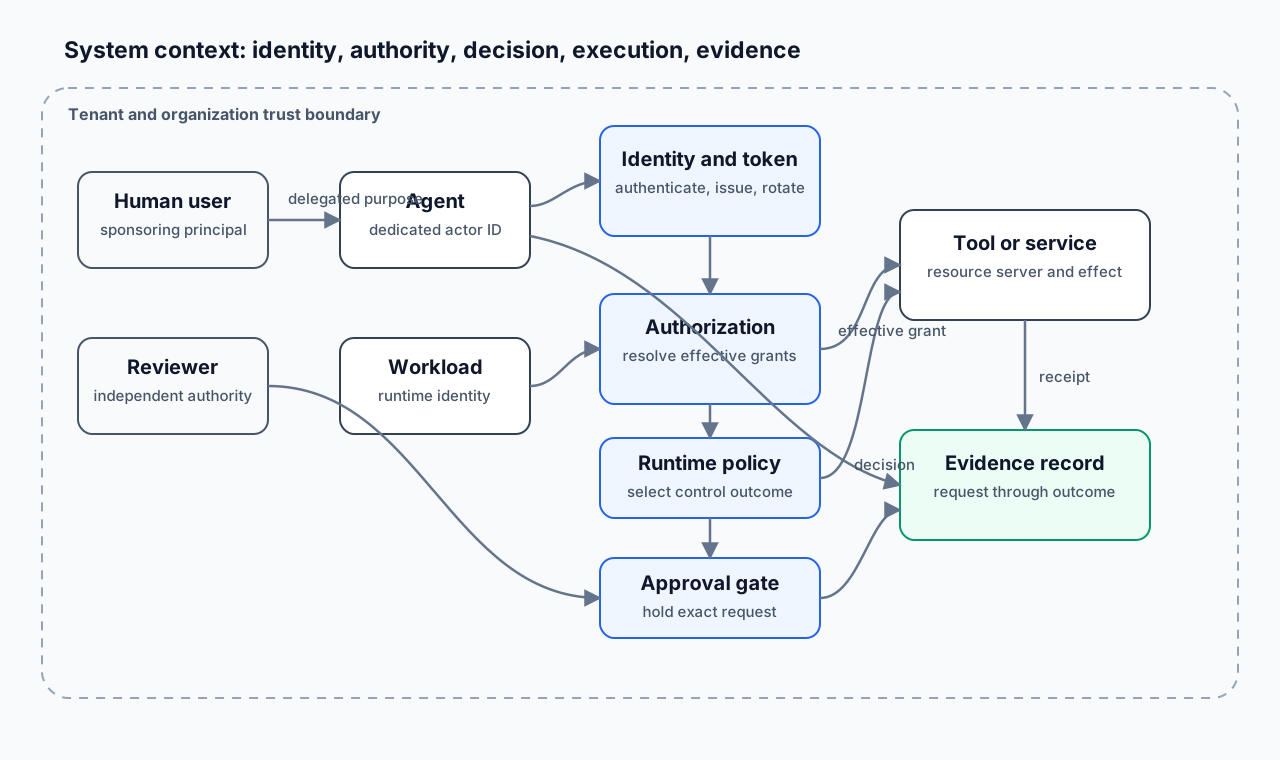
Treat the agent identity as the durable business object and the workload identity as the running software instance. A service identity represents a non-human dependency or gateway. The tool or resource server authenticates the caller and enforces its own authorization. A reviewer uses a human identity with current decision authority.
Text alternative. A human user delegates a bounded purpose to an agent and workload. Identity and token services authenticate the parties. Authorization and policy evaluate the request. A reviewer decides held actions. The tool executes an allowed action. Every stage sends records to the evidence store inside the tenant and organization trust boundary.
Scroll horizontally to inspect the graphic.
Give every actor, decision service, reviewer, and effect a stable identity and one explicit trust boundary.
Open full-size graphic| Identity | Purpose | Lifecycle owner | Required record |
|---|---|---|---|
| Human user | Sponsoring principal or requester | HR, IAM, and business owner | Subject, organization, roles, assignments, status |
| Delegated user | Human subject whose current authority constrains the agent | Business and IAM owners | Subject, actor, delegation, purpose, scope, effective dates |
| Agent | Durable non-human actor for one governed mandate | Agent owner | Agent ID, owner, purpose, Release, state, review date |
| Workload | Attested process that runs the agent | Platform owner | Workload ID, environment, deployment, attestation, credential |
| Service | Gateway, orchestrator, or downstream machine principal | Service owner | Service ID, audience, scopes, credential class, dependency |
| Tool or resource | Protected operation and target data or system | Tool and resource owners | Canonical ID, version, owner, accepted identity and action |
| Reviewer | Human checker for a consequential held action | Business risk owner | Human ID, role snapshot, authority limit, independence, decision |
Choose dedicated, delegated, or hybrid identity
A dedicated identity gives the agent its own enterprise-owned authority. A delegated identity carries one user’s current authority into the task. A hybrid records both parties: the agent remains the actor and the human remains the subject or sponsor. This separation supports accurate policy, revocation, and audit.
Shared service accounts weaken attribution and often carry wide standing access. Keep them behind a service-mediated gateway when a target system cannot issue narrow agent credentials. Record the originating agent, human subject, policy decision, and downstream receipt for every mediated call.
| Pattern | Benefits | Risks | Lifecycle | Select when |
|---|---|---|---|---|
| Dedicated agent identity | Stable ownership, narrow grants, separate review and revocation | Standing privilege, identity sprawl, orphaned agents | Register, attest workload, grant, observe, certify, rotate, revoke | Repeatable production work carries enterprise-owned authority |
| Delegated user identity | User scope and accountability remain attached to the task | Ambient user access, stale assignments, actor and subject confusion | Authenticate user, record assignment, reduce scope, issue, expire, revoke | One named user remains the authority owner for the action |
| Hybrid actor and subject | Agent and human both remain attributable and independently revocable | Token exchange and policy become more complex | Operate both identity lifecycles and bind them per request | The agent has its own identity and the user’s current authority changes the decision |
| Service-mediated execution | Legacy targets gain a central enforcement and credential boundary | Gateway bypass, shared downstream credential, incomplete receipts | Broker credentials, enforce each call, rotate, reconcile, retire | The target cannot issue an agent-specific or delegated credential |
Request and delegated-authority sequence
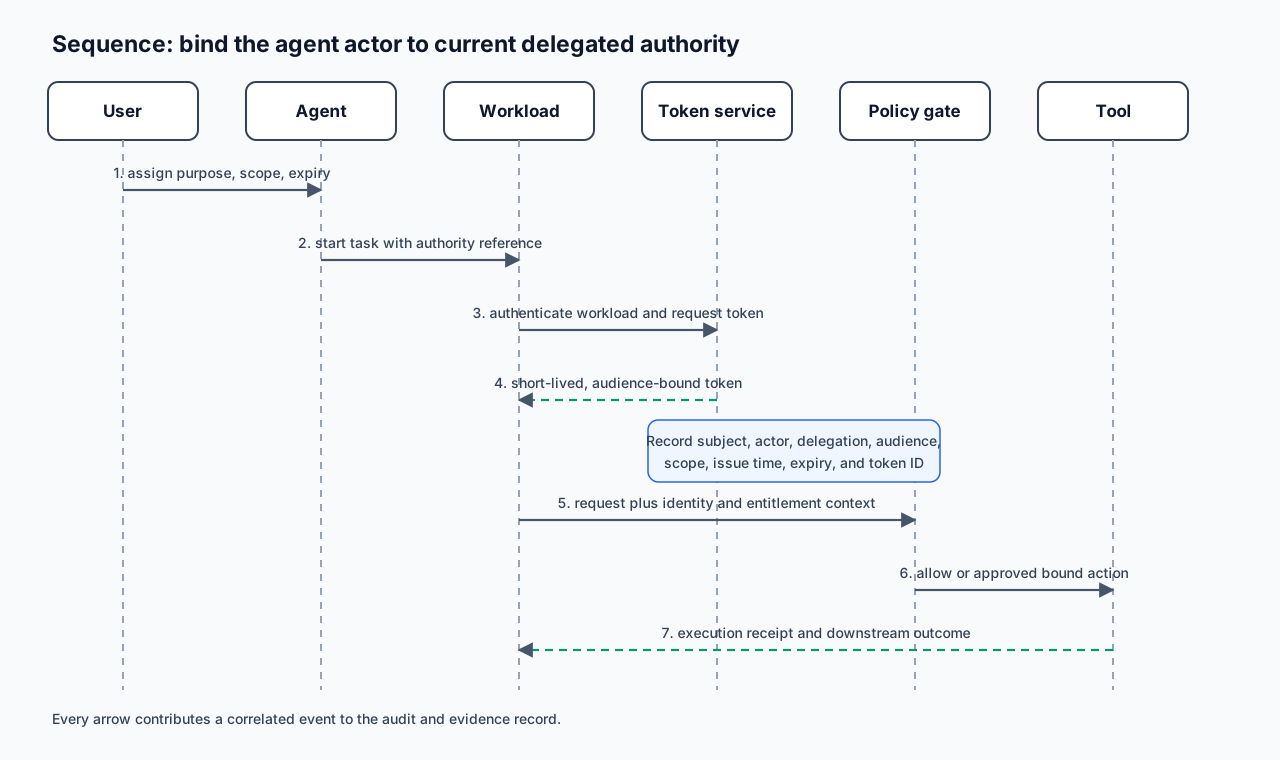
Bind the human subject, agent actor, workload, delegation, purpose, target, and expiry before token issuance. Use an audience-bound short-lived credential for the target resource. Resolve current authority again at the action boundary because roles, assignments, risk facts, and policy can change during a session.
Text alternative. The user assigns a purpose to the agent. The agent starts an attested workload. The workload requests a token. The token service validates the actor and delegated subject, then issues a short-lived audience-bound credential. The workload sends the complete context to policy. The tool receives only an allowed or validly approved request and returns an execution receipt.
Scroll horizontally to inspect the graphic.
Record the human subject and agent actor separately through token issue, policy, execution, and evidence.
Open full-size graphicOwn every entitlement dimension
Least privilege becomes testable when every dimension has an owner, decision point, review path, revocation path, and evidence field. Evaluate the complete tuple for each consequential request. A role can supply a baseline, while purpose, value, data, environment, and time keep the effective grant narrow.
| Dimension | Owner and decision point | Review path | Revocation path | Minimum evidence |
|---|---|---|---|---|
| Agent | Agent owner; identity binding | Inventory and ownership review | Disable agent and deny sessions | Agent ID, owner, Release, state |
| Tool | Tool owner; tool gateway | Tool grant and version review | Remove grant and deny calls | Tool ID, version, grant, result |
| Resource | Resource owner; resource server | Resource ACL and assignment review | Remove resource grant | Resource ID, tenant, authorization result |
| Data | Data owner; query or data gateway | Data Boundary and field review | Remove dataset or field access | Boundary, fields, purpose, result |
| Action | Process owner; pre-side-effect gate | Action matrix and observed-use review | Deny action type | Action, parameters, reason code |
| Purpose | Business owner; delegation and policy | Mandate and lawful-purpose review | End mandate or delegation | Purpose, sponsor, effective dates |
| Amount | Risk owner; transaction policy | Threshold and aggregate review | Lower limit or block band | Value, currency, aggregate, decision |
| Environment | Platform owner; issuer and deployment gate | Trust-domain and production grant review | Remove environment trust or grant | Environment, workload, audience |
| Time | IAM owner; token issue and action gate | Expiry and dormant-access review | Expire token, session, or grant | Issue, effective, expiry, revoke time |
Combine authorization patterns deliberately
Role-based access control supplies a stable job or service baseline. Attribute-based access control evaluates subject, resource, action, and environment facts. Relationship-based access control resolves graph relationships such as assignment, ownership, or case membership. Capability-based access carries a narrow transferable authority object that should remain target-bound, time-bound, and revocable.
Use the smallest combination that expresses the real decision. Record the resolved inputs and final effective grant so reviewers can reproduce the result after groups, attributes, relationships, or capability state changes.
| Pattern | Useful decision | Agent example | Control requirement |
|---|---|---|---|
| Role-based (RBAC) | Which baseline operations belong to this role? | credit-review-agent may draft a memo | Small roles, separation of duties, periodic role engineering |
| Attribute-based (ABAC) | Do current subject, resource, action, and environment facts permit access? | Production read of allowed fields for a low-risk assigned case | Trusted attributes, freshness, policy version, evaluated-field evidence |
| Relationship-based (ReBAC) | Does the actor have the required relationship to this object? | underwriter is assigned to case CR-1842 | Authoritative graph, tenant scoping, relationship expiry and provenance |
| Capability-based | Does this bounded authority object permit the exact operation? | one-use approval capability for a bound payment request | Target, action, holder, constraints, expiry, replay defense, revocation |
Entitlement and approval decision flow
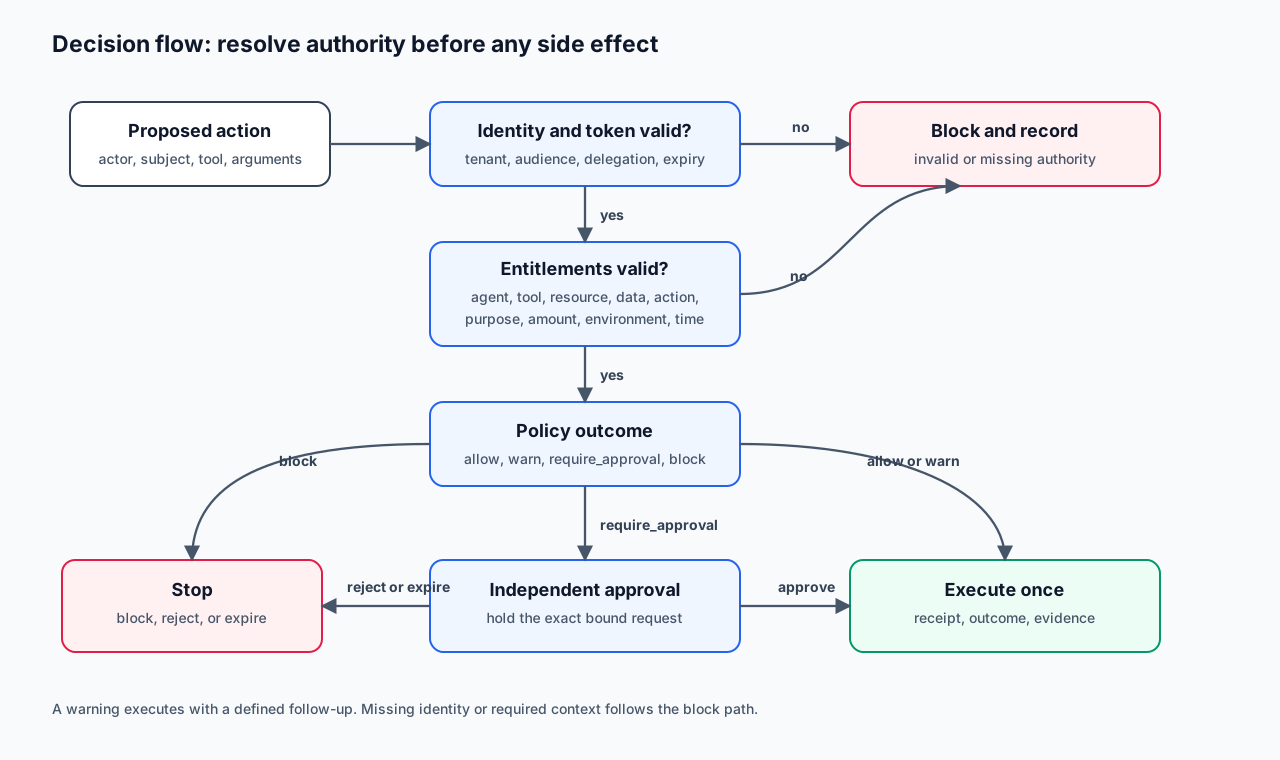
Evaluate identity, tenant, delegation, audience, and expiry before resolving entitlements. Invalid or missing authority stops the request. Runtime policy then selects allow, warn, require_approval, or block. A required approval holds the exact request and releases it only after an eligible independent reviewer decides before expiry.
Text alternative. The flow verifies identity and token context, then all nine entitlement dimensions. Invalid context blocks. Policy selects one of four outcomes. Block stops. Require approval sends the bound request to an independent reviewer. Rejection or expiry stops. Allow, warn, or valid approval executes once and records the receipt and evidence.
Scroll horizontally to inspect the graphic.
Connectivity and authentication lead into authorization, policy, approval, execution, and evidence as separate gates.
Open full-size graphicIssue short-lived credentials and control impersonation
Issue credentials after workload authentication and current authority resolution. Bind each credential to one audience, trust domain, environment, subject or actor relationship, purpose, scope, and short lifetime. Keep refresh and exchange privileges narrower than the original authority.
OAuth 2.0 Token Exchange defines separate subject and actor tokens for delegation. The act claim can express the current actor. Resource Indicators bind a token request to the target resource. Rich Authorization Requests can carry structured action and resource details. Each protocol still relies on the authorization server and resource server to enforce local policy and revocation.
- Just in time: issue access when the task starts, after approval or assignment, and expire it with the task.
- Rotation: automate key and credential replacement, retain generation and overlap evidence, and test the old credential after cutover.
- Impersonation boundary: reserve impersonation for explicit cases where the actor becomes indistinguishable at the target; preserve the original actor in a separate protected record.
- Delegation boundary: keep both subject and actor visible and reduce the delegated authority for the task.
- Token handling: exclude raw secrets from logs; retain issuer, token identifier or digest, audience, scopes, effective time, expiry, and revocation result.
Reusable least-privilege policy
The policy below is a vendor-neutral design example for a credit-review document reader. It covers all nine entitlement dimensions and links missing or expired context to a block. Download the JSON file for workshops and tests. Replace every synthetic identifier and threshold with an approved local contract.
{
  "schema_version": "1.0",
  "policy_id": "credit-review-document-reader",
  "status": "example",
  "subject": {
    "agent_id": "credit-review-agent",
    "workload_id": "spiffe://bank.example/prod/credit-review",
    "delegated_user_required": true
  },
  "entitlements": {
    "tools": [
      "credit_application.read",
      "credit_memo.draft",
      "credit_decision.propose"
    ],
    "resources": [
      "credit-application:{case_id}"
    ],
    "data": {
      "fields": [
        "declared_income",
        "verified_income",
        "existing_exposure",
        "requested_amount"
      ],
      "denied_fields": [
        "special_category_data",
        "unrelated_household_records"
      ]
    },
    "actions": [
      "read",
      "draft",
      "propose_credit_decision"
    ],
    "purposes": [
      "credit_application_review"
    ],
    "amount": {
      "currency": "EUR",
      "approval_threshold": 25000,
      "authorization_ceiling": 100000
    },
    "environments": [
      "production"
    ],
    "time": {
      "maximum_token_lifetime_seconds": 900,
      "access_window": "case_assignment"
    }
  },
  "decision": {
    "allow_when": [
      "case_id matches the assigned case",
      "delegated user remains assigned and active",
      "all requested fields are allowed",
      "purpose equals credit_application_review",
      "requested amount is at or below EUR 25000",
      "token audience matches the target resource"
    ],
    "require_approval_when": [
      "the agent proposes a credit decision",
      "the requested amount exceeds EUR 25000 and is at or below EUR 100000"
    ],
    "block_when": [
      "identity, delegation, tenant, purpose, or audience is missing",
      "the credential, assignment, entitlement, or policy is expired",
      "the request targets an unassigned case or forbidden field",
      "the requested amount exceeds EUR 100000",
      "the destination or purpose differs from the authorized values",
      "the policy decision service cannot produce the required verdict"
    ]
  },
  "evidence": [
    "principal_id",
    "agent_identity_id",
    "workload_identity_id",
    "delegation_id",
    "tenant_id",
    "tool_id",
    "resource_id",
    "data_boundary_ref",
    "action",
    "purpose",
    "amount",
    "environment",
    "requested_at",
    "expires_at",
    "policy_id",
    "policy_version",
    "authentication_event_id",
    "authorization_decision_id",
    "policy_decision_id",
    "approval_decision_id",
    "reason_codes",
    "approval_id",
    "reviewer_id",
    "execution_receipt"
  ]
}
Run the entitlement review as a control
A review starts with a reconciled identity and access population, then tests effective authority and observed use. Download the IAM architecture workbook for the full checklist, decision tables, and review record.
- Reconcile the population. Compare registered agents and service accounts with token issuers, cloud principals, secret stores, gateways, MCP discovery, CI/CD identities, package spend, and observed tool calls.
- Resolve effective access. Include direct grants, roles, attributes, relationships, capabilities, groups, delegations, temporary access, policy rules, and downstream permissions.
- Find control exceptions. Record orphaned, shared, dormant, duplicate, expired, unobserved, cross-tenant, self-approvable, and over-broad authority.
- Test enforcement. Exercise allowed, approval, blocked, expired, missing-context, revoked, and stale-relationship requests.
- Reconcile outcomes. Join each sample to the policy result, reviewer decision, tool receipt, business state, and evidence record.
- Certify the scoped result. Record criteria, population, period, reviewer, exceptions, decision, expiry, next review, and evidence references.
Discover and audit service accounts
Build the non-human identity population from several independent sources. Identity directories alone miss credentials created in cloud projects, CI/CD systems, secret stores, local MCP clients, schedulers, browser automation, and downstream applications. Gateway and network observations reveal identities that bypass the expected catalog.
For each service account, record the owning Process, accountable person, agents and workloads that can use it, credential location, allowed targets, effective grants, last use, expiry, rotation, revocation method, and evidence source. Quarantine or revoke accounts with no current owner or approved use after the defined safety review.
| Source | What it reveals | Reconciliation test |
|---|---|---|
| Identity and token issuers | Registered clients, service principals, tokens, scopes, expiry | Every issued actor maps to an owned agent or service |
| Cloud, cluster, and CI/CD control planes | Workload identities, jobs, deployment principals | Every running workload uses the expected identity and environment |
| Secret stores and key managers | API keys, certificates, owners, rotation state | Every secret maps to one approved consumer and target |
| Tool and MCP gateways | Observed clients, servers, tools, calls, audiences | Observed use is contained by the approved inventory and grants |
| Downstream resource logs | Effective caller and actual side effects | Each effect reconciles to an upstream decision and receipt |
Revoke, stop, roll back, and recover
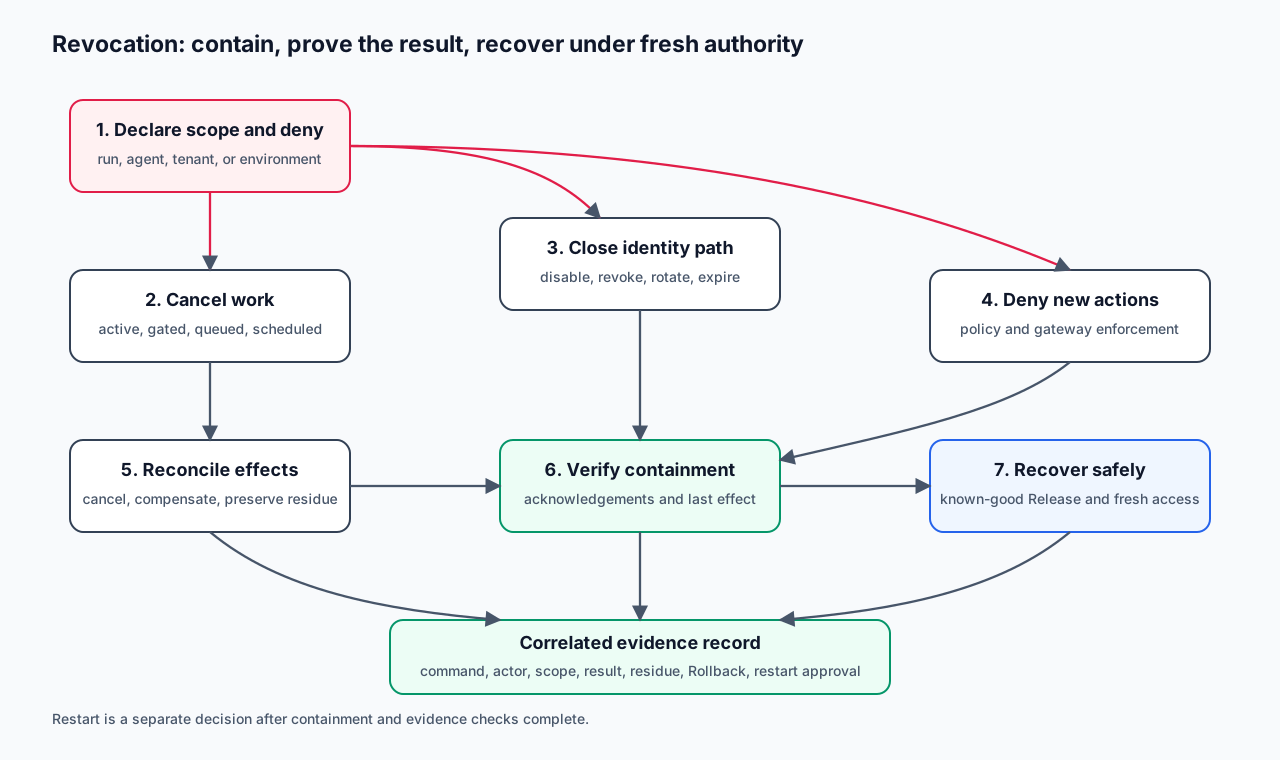
Revocation closes authority for future use. Emergency stop contains active and queued work. Rollback restores a known-good Release or configuration. Incident recovery reconciles downstream effects, issues fresh credentials, tests the safe state, and uses a separate restart decision.
Text alternative. The incident owner records the affected scope and activates a deny state. Workflow controls cancel active and queued work. Identity controls disable the agent and workload, revoke tokens, and rotate credentials. Gateways deny new requests. Tool owners reconcile accepted and committed effects. Evidence records acknowledgements and residual access. Recovery uses a known-good Release, fresh credentials, a narrow allowlist, and restart approval.
Scroll horizontally to inspect the graphic.
Keep the incident open until every required actuator reports its result and residual access is measured.
Open full-size graphic| Control | Effect | Owner | Required evidence |
|---|---|---|---|
| Revocation | Ends a grant, delegation, token, key, session, or identity | IAM and resource owners | Target, actor, authority, command, result, residual lifetime |
| Emergency stop | Cancels work and denies new side effects in the affected scope | Incident and runtime owners | Scope, command, acknowledgements, final accepted side effect |
| Rollback | Restores a verified prior Release, policy, or configuration | Change and service owners | Prior and restored versions, actor, approval, validation |
| Recovery | Reconciles effects and restarts under fresh authority | Incident and business owners | Compensation, canary, fresh credentials, restart decision |
Enforce tenant and organization boundaries
Treat tenant, organization, trust domain, environment, and region as authorization facts with authoritative issuers. Validate them at every external boundary and use them in datastore queries, token audiences, policy context, approval lookup, tool routing, and evidence selection.
Keep production and non-production identities in separate trust domains or equivalent namespaces. Qualify foreign attributes and roles by their issuing authority. Federation establishes which credentials can be authenticated across domains; local authorization still decides which action and resource each foreign identity may use.
- Reject a tenant or organization selector that conflicts with the authenticated token.
- Bind resource identifiers, relationship edges, capabilities, and approvals to one tenant.
- Use target-specific token audiences and avoid bearer tokens accepted by several unrelated resources.
- Test cross-tenant reads, writes, approvals, delegation, cache keys, queues, and evidence exports.
- Record the authoritative tenant and trust domain in every identity, policy, execution, and evidence event.
Assign responsibility across the lifecycle
Name one accountable role for each identity, entitlement, decision, effect, and evidence boundary. Advisory groups can review the design. Operating authority remains assigned to a person or role with a defined delegate, effective period, and escalation path.
| Role | Owns | Decides | Produces |
|---|---|---|---|
| Business Process owner | Purpose, consequences, risk tolerance | Approved mandate and action classes | Purpose record, thresholds, acceptance |
| Agent owner | Agent identity, Release, tool intent | Registration, change, retirement | Agent record, owner review, Release evidence |
| IAM owner | Identity, token, delegation, credential lifecycle | Issuer trust, grant, expiry, rotation, revoke | Identity and credential events |
| Platform owner | Workload identity and enforcement availability | Attestation, environment trust, safe state | Workload, deployment, and control health |
| Tool and data owners | Protected operation, resource, Data Boundary | Accepted identity, action, field, destination | Authorization and execution receipts |
| Policy owner | Runtime rules and four outcomes | Policy publication and exception path | Version, simulation, decision, reason codes |
| Reviewer authority owner | Reviewer eligibility and separation | Role, value limit, delegation, escalation | Authority snapshot and Decision Request record |
| Incident owner | Containment, reconciliation, recovery | Stop scope, compensation, restart | Incident, revocation, Rollback, recovery evidence |
| Internal audit or assurance | Independent criteria and testing | Scope, sampling, finding, certification boundary | Workpapers, exceptions, conclusion, follow-up |
Select a deployment pattern
Choose the pattern from the authority owner, target-system capability, action consequence, identity volume, and required attribution. A single organization can use several patterns across Processes while preserving one evidence model.
| Pattern | Fit | Required controls | Main risk | Selection rule |
|---|---|---|---|---|
| Dedicated agent and workload identities | Modern target accepts workload or client identities | Attestation, narrow grant, short credential, owner, policy gate | Standing privilege and orphaned identity | Default for repeatable production authority |
| Delegated user token | Target evaluates one named user’s authority | Actor and subject binding, scope reduction, expiry, assignment | Ambient user access | Use when the user remains the action authority owner |
| Hybrid token exchange | Target needs both the agent actor and human subject | Subject token, actor token, audience, reduced authority, evidence | Actor and subject confusion | Use when both identities change authorization |
| Gateway with brokered downstream credential | Legacy target accepts one service account | Mandatory gateway, per-call decision, receipt, bypass detection | Shared credential and gateway bypass | Use when the target cannot issue narrow identities |
| Ephemeral task identity | High-scale isolated jobs | Automated attestation, task binding, short life, population evidence | Identity volume and inventory gaps | Use when issuance and review are automated end to end |
| Cross-organization federation | Agent and resource belong to different authorities | Qualified trust, issuer mapping, local policy, tenant binding | Foreign role or attribute over-trust | Use only with explicit bilateral trust and semantics |
Worked example: regulated credit review
A bank assigns a credit-review agent to case CR-1842. The agent has a dedicated identity and runs under an attested production workload. A named underwriter is the delegated subject for this case. The token service issues a 15-minute credential whose audience is the document service.
Authorization permits four approved fields, three actions, and amounts up to EUR 100,000 for the purpose credit_application_review while the assignment remains active. Policy allows reading those fields and drafting a memo. A proposed credit decision or a request above EUR 25,000 creates a Decision Request. A new purpose, a forbidden field, an amount above the authorization ceiling, or missing identity, delegation, tenant, audience, or current policy blocks. Approval operates inside the authorization ceiling.
The requesting underwriter cannot decide the held request. A qualified second reviewer sees the exact action, source evidence, policy reasons, authority requirement, expiry, and expected effect. Approval releases the same bound request once. The downstream receipt and case state join the identity, delegation, entitlement, policy, reviewer, and execution records.
| Stage | Decision | Evidence |
|---|---|---|
| Identity and delegation | Agent, workload, underwriter subject, case assignment, tenant valid | Actor, subject, workload, assignment, effective time, expiry |
| Token | Issue 15-minute document-service credential | Issuer, token digest, audience, scopes, issue and expiry time |
| Authorization and policy | Allow four fields and draft; require approval for decision or higher amount | Effective grants, policy version, values, outcome, reasons |
| Approval | Independent reviewer approves the bound request before expiry | Decision Request, role snapshot, rationale, action digest |
| Execution | Execute once and update case state | Idempotency key, tool receipt, before and after state |
| Revocation | Removing assignment expires delegation and denies later calls | Revocation command, token result, denial, residual access |
How the architecture maps to current KLA contracts
The KLA Control Plane governs instrumented agent actions. The current implementation supplies a runtime policy, approval, execution, lineage, and evidence layer. Enterprise identity providers, resource servers, and credential systems remain the authority for their identities and grants.
The mapping below reflects code present in repository source at commit a4e8087f. Deployment and production behavior remain unverified. Source links are pinned to that commit. Status distinguishes a current contract from a partial mapping or a conceptual abstraction.
| Architecture area | Current KLA mapping | Repository source | Status |
|---|---|---|---|
| Execution identity and tenant authentication | Execution API verifies allowed JWT issuers and audience, derives tenant binding, and records initiator, on-behalf-of subject, and caller client. | auth middleware and execution route | Current with delegated-subject gap |
| Authorization and action context | Policy requests can carry principal, resource, action, actor, environment, tool, destination, data sensitivity, and business context. | policy contracts | Current flexible contract |
| Control-plane authorization and tenant isolation | permissionProcedure authenticates the caller and fails closed when its named permission is absent. protectedProcedure authenticates only; live routes including integrations.list, llmProviders.list, and usage.getQuotaStatus use it without an explicit permission check. Authorization coverage is procedure-specific. Tenant context scopes requests, and tenant-owned database tables use forced row-level security; those layers remain table-specific and service-specific. | procedure definitions, integrations router, provider router, usage router, tenant middleware, and RLS hardening migration | Current layered control; verify each service and table |
| Policy decision | The KLA Policy Engine returns allow, warn, require_approval, or block with policy identity, matched rules, evaluated fields, reasons, and optional approval routing. | policy contracts | Current contract |
| Fail-closed transition gate | The workflow transition gate blocks missing work-item context, unresolved pack contracts, failed output validation, policy evaluation errors, and policy block outcomes before advancing. | transition gate | Current governed workflow contract |
| Human approval | Decision Desk checks decision permission, required role, pending state, maker identity, and due time for control-plane Decision Requests. | approvals router | Current with producer-dependent fields |
| Runtime cancellation | A tenant-scoped cancellation route signals active or gated workflows and records cancellation. Identity-provider token revocation remains an external actuator. | execution cancellation and workflow runner | Current runtime control; partial incident fan-out |
| Audit events and lineage | Worker producers capture identity, policy, approval, execution, hashes, and trace correlation across several authoritative records. | audit events and workflow observability | Current multi-record mapping |
| Evidence | Evidence Room can package selected records into a Sealed Evidence Bundle whose manifest, hashes, signatures, and proofs support offline checks. | evidence contract | Current bundle contract |
Current KLA gaps and conceptual abstractions
KLA evaluates and records authority at the governed action boundary. It is outside several enterprise IAM responsibilities in this reference. Treat the fields and flows below as integration requirements until the stated gap has a current implemented contract.
- Delegated subject. Execution creation currently sets
onBehalfOfSubjectto the initiating subject and records the caller client. The complete public execution contract currently lacks a separately attested end-user subject and delegation chain. - Identity lifecycle. Enterprise identity providers, workload attestation authorities, HR directories, and universal service-account discovery systems remain external dependencies.
- Credential lifecycle. Connectors and target systems own downstream tool credential issuance, rotation, revocation, brokering, and incident actuation.
- Entitlement normalization. Current contracts support principal, resource, action, attributes, tool arguments, environment, and flexible context. Each path can represent purpose, amount, data, and relationship facts through flexible fields; the contract leaves their normalization to the producer.
- Authorization models. RBAC, ABAC, relationship, and capability patterns in this reference are architecture choices. The current KLA policy contract is model-agnostic.
- Certification. The current product records controls and evidence. Universal certification of an agent identity or entitlement population remains outside the current contract.
- Revocation fan-out. Runtime cancellation is implemented. End-to-end identity disablement, token revocation, network isolation, downstream cancellation, and compensation remain coordinated external actions.
- Portable record. The AI Agent Audit Log Schema normalizes several KLA producers into one vendor-neutral event. Current producers emit their authoritative native records, which the reference maps into the public envelope.
Primary sources and freshness
This architecture was checked on 28 July 2026. Identity standards, protocol specifications, draft guidance, and implementation profiles can change. Recheck the live source and local deployment before using a status in an audit, procurement, or security decision.
- NIST NCCoE software and AI agent identity and authorization concept paper (draft, published 5 February 2026)
- NIST SP 800-162, Guide to Attribute Based Access Control
- NIST Role Based Access Control project and current standard reference
- NIST SP 800-207, Zero Trust Architecture
- RFC 8693, OAuth 2.0 Token Exchange
- RFC 8707, Resource Indicators for OAuth 2.0
- RFC 9396, OAuth 2.0 Rich Authorization Requests
- SPIFFE standard 1.15.2 and workload identity specifications
- Model Context Protocol authorization specification, 25 November 2025
- Model Context Protocol security best practices
Frequently Asked Questions
Should an AI agent use its own identity or a user identity?
Use a dedicated agent identity for repeatable enterprise-owned authority. Use delegated user authority when one named user remains the authority owner. Use a hybrid when both the agent actor and human subject change the authorization decision.
What is the difference between an agent identity and a workload identity?
The agent identity is the durable governed business actor. The workload identity identifies the running process, deployment, or task instance that executes the agent.
Which entitlements should an AI agent policy evaluate?
Evaluate agent, tool, resource, data, action, purpose, amount, environment, and time. Assign an owner, decision point, review, revocation path, and evidence field to every dimension.
How does delegated authority differ from impersonation?
Delegation preserves the human subject and agent actor as separate identities with bounded authority. Impersonation presents one identity as another and requires a separate protected record of the original actor and authority.
Does MCP connectivity authorize an AI agent tool call?
MCP connectivity establishes a protocol path. Authentication and token audience checks identify the caller and target. Enterprise authorization, runtime policy, approval, execution, and evidence remain separate controls.
How often should AI agent entitlements be reviewed?
Set a risk-based cadence and trigger an out-of-cycle review after owner, purpose, tool, data, policy, Release, environment, incident, or organization changes. Temporary authority should expire before the next periodic review.
What should an AI agent revocation test cover?
Test identity disablement, token and session revocation, refresh denial, credential rotation, policy denial, active and queued work, approval waits, downstream jobs, committed effects, evidence, and controlled restart.
Is the reusable policy a KLA API contract?
The downloadable policy is a vendor-neutral design example. The KLA mapping section names the current repository contracts and marks partial mappings and conceptual abstractions.
Key Takeaways
A defensible agent authority path keeps the human subject, agent actor, workload, credential, entitlement, policy, reviewer, and tool effect separately attributable. Resolve all nine entitlement dimensions before each consequential action, issue short-lived target-bound credentials, hold approval at the action boundary, and preserve one correlated evidence record. Download the IAM architecture workbook, use the MCP audit guide for tool-call governance, and implement the machine-readable record with the AI Agent Audit Log Schema.