

Most AI teams prepare for the EU AI Act by looking at high-risk classification, technical documentation, human oversight, and post-market monitoring. That is necessary, but it misses the obligation many chatbot, copilot, and AI agent deployments hit first: Article 50 transparency, in force since 2 August 2026. Article 50 is the part of the Act that says people must know when they are interacting with certain AI systems and when certain content has been generated or manipulated by AI. The duty now applies to live deployments; a market-surveillance authority or customer can ask today for proof that the disclosure fired. For enterprises, the practical problem is not only adding an AI disclosure. It is proving that the disclosure appeared in the right place, at the right time, in the right language, for the right Process, and that it kept working after a chatbot became a copilot and the copilot became a tool-using agent. Orientation only; not legal advice.
What Article 50 requires in plain language
Article 50 creates transparency obligations for providers and deployers of certain AI systems. A provider develops or places an AI system or general-purpose AI model on the market under its own name or trademark. A deployer uses an AI system under its authority, except for purely personal non-professional use.
For chatbots, copilots, and agents, the duties usually fall into five practical buckets. The control has to be clear and distinguishable, appear no later than first interaction or exposure, and meet applicable accessibility requirements.
| Trigger | Plain-language requirement |
|---|---|
| Direct AI interaction | Inform people that they are interacting with an AI system unless that is obvious from the context. |
| Synthetic content | Ensure AI-generated or manipulated audio, image, video, or text is marked in a machine-readable and detectable format where technically feasible. |
| Deepfake-like media | Disclose AI-generated or manipulated image, audio, or video that could falsely appear authentic or truthful. |
| Public-interest text | Disclose AI-generated or AI-manipulated text published to inform the public on matters of public interest unless the human editorial-control exception is properly met. |
| Emotion or biometric categorisation | Inform natural persons exposed to those systems and handle the related data protection and sector-specific issues. |
Why chatbots, copilots, and agents need different controls
A basic chatbot can often satisfy Article 50 with a visible first-interaction disclosure, accessible copy, and proof that the disclosure appeared. A copilot is more complicated because it may summarize records, draft customer messages, prepare claims notes, generate code, recommend next actions, or create content that a human later publishes.
An AI agent is harder again. Agents do not only respond. They plan, call tools, create tickets, update systems, trigger Processes, send messages, and hand work to other systems. A disclosure shown once in a product tour will not prove that every AI-mediated interaction, generated output, public message, or publication path was handled correctly.
| System type | What can go wrong | Better control shape |
|---|---|---|
| Chatbot | The user does not realize they are talking to AI. | First-interaction notice, accessible copy, session evidence. |
| Copilot | The user cannot tell what was AI-generated, reviewed, edited, or approved. | Persistent AI indicator, generated-content marking, human-review state. |
| Agent | The system prepares or executes work across tools without a visible transparency trail. | Runtime policy checks, approval gates, action status labels, tamper-evident evidence. |
Start with every AI interaction surface
Article 50 implementation starts with an inventory. List every place where a natural person may interact with the AI system or be exposed to its output. Do not stop at the obvious website chatbot.
For each surface, record the owner, audience, geography, model or system used, whether the system interacts directly with people, whether it generates content, whether generated content can leave the organization, and whether the Process affects customers, employees, patients, applicants, citizens, or other protected groups.
- Website chatbot, in-app support assistant, customer service chat, voice assistant, and AI helpdesk bot.
- Internal employee copilot, CRM sidebar, ticketing assistant, procurement copilot, HR assistant, and claims assistant.
- Slack, Teams, email, browser extensions, embedded widgets, APIs, and agent-to-human escalation messages.
- AI-generated reports, PDFs, images, audio, videos, customer notices, knowledge-base drafts, and public commentary.
- Process agents that request approval, trigger tool calls, route cases, or prepare outbound communications.
Classify the Article 50 trigger before choosing copy
Do not write one generic disclosure and call the problem solved. The right control depends on the trigger. A direct-interaction notice, public-interest text review, deepfake disclosure, and machine-readable provenance strategy are not the same thing.
A practical assessment should be short enough for product teams to use during release review but structured enough for legal, risk, and audit to understand why a Process was in or out of scope.
| Question | If yes, prepare |
|---|---|
| Will a person interact directly with the AI system? | A clear first-interaction notice and proof that it was shown. |
| Does the system generate synthetic text, image, audio, or video? | A generated-content marking and provenance strategy. |
| Can image, audio, or video appear authentic or truthful? | Deepfake disclosure review and downstream distribution controls. |
| Will generated text inform the public on matters of public interest? | Disclosure or documented human review and editorial responsibility. |
| Does the Process infer emotion or biometric categories? | Exposure notice, data protection review, and sector/legal checks. |
Separate provider obligations from deployer obligations
Do not assume the same team owns every Article 50 duty. A software company offering a chatbot platform may be the provider for the disclosure capability. An enterprise using that chatbot in its customer journey may be the deployer responsible for where the disclosure appears, how the Process publishes content, and what evidence is kept.
For agentic systems, the split can be even less obvious. A model provider, orchestration vendor, tool vendor, enterprise deployer, and downstream publisher may each control different parts of the final user experience.
- Assign ownership for first-interaction notice, wording, UI placement, localization, and accessibility testing.
- Assign ownership for generated-content provenance, machine-readable marking, export behavior, and publication review.
- Assign ownership for deepfake disclosure, public-interest text controls, biometric/emotion notices, and exception approval.
- Keep a RACI, vendor terms, architecture record, disclosure owner, approval owner, and control owner.
Put the AI notice at the point of interaction
Article 50 does not say to bury the disclosure in the terms of service. The person must be informed clearly and distinguishably, at the latest at the time of first interaction or exposure.
For chatbots, the disclosure should appear before or during the first exchange. For copilots, it should appear where the user invokes the AI feature. For agents, it should appear wherever a person is exposed to the agent action: chat, email, Slack, Teams, portal notification, approval inbox, generated report, or outbound customer message.
| Process | Better disclosure pattern |
|---|---|
| Customer chatbot | You are interacting with an AI assistant. It can answer questions and draft responses, but it may make mistakes. |
| Employee copilot | This copilot uses AI to summarize records and prepare draft actions. A human remains responsible for review and approval. |
| Tool-using agent | This Process uses an AI agent to prepare recommendations and call approved tools. High-impact actions may require human approval. |
| AI-assisted outbound message | This message was prepared with assistance from an AI system and reviewed before sending. |
Make the disclosure persistent enough for the Process
A first-interaction disclosure may be enough for some simple chatbot sessions. It is usually not enough for complex copilots and agents.
For higher-impact Processes, keep an AI indicator visible during use. It does not need to be intrusive, but it should prevent confusion about whether the person is dealing with a human, a deterministic workflow, or an AI system. For agents, also disclose status transitions: drafting, recommending, waiting for approval, executing, completed, or blocked.
- Use persistent disclosure when the AI drafts external communications, recommends actions, calls tools, escalates cases, or routes decisions.
- Use persistent disclosure when a human may mistakenly attribute the output to another human.
- Use stronger disclosure when Processes affect rights, eligibility, pricing, access, health, employment, claims, credit, or public services.
- Keep evidence of UI states, status labels, approval states, interaction telemetry, and user testing notes.
Label AI-generated content before it leaves controlled systems
Article 50 requires providers of AI systems that generate synthetic audio, image, video, or text to ensure outputs are marked in a machine-readable format and detectable as artificially generated or manipulated, as far as technically feasible.
Do not overclaim. Machine-readable marking for images, video, and structured files may be more straightforward than robust marking of free-form text after copy-paste, editing, screenshots, or format conversion. A practical implementation usually combines metadata, provenance records, content hashes, output logs, publication Process controls, and detectable marking where technically feasible.
| Field | Why it matters |
|---|---|
| System and version | Identifies which AI system produced or transformed the content. |
| Model or model family | Keeps the output tied to the model lineage used at generation time. |
| Output identifier and timestamp | Lets teams reconstruct the exact generation event later. |
| Process and content type | Separates draft customer email, report summary, image, audio, video, or code output. |
| Transformation type | Distinguishes generated, summarized, translated, edited, reformatted, or human-edited content. |
| Human reviewer and approval state | Shows whether publication relied on human review or editorial control. |
| Hash or stored-output reference | Connects the provenance record to the final content artifact. |
| Applicable disclosure rule | Explains why the output was labelled, reviewed, blocked, or exempted. |
Handle exceptions and special media deliberately
Article 50 includes an exception for AI systems that perform an assistive function for standard editing or do not substantially alter the input data provided by the deployer or the semantics of that data. Handle that exception carefully.
Low-risk standard editing may include spelling correction, grammar suggestions, formatting, resizing, compression, or other narrow transformations that do not substantially change meaning. Many copilot features go further: summarization, rewriting, tone transformation, recommendation generation, automated classification, risk scoring, synthetic customer messaging, and agentic drafting can change meaning, emphasis, context, or downstream decisions.
| Path | Control to define |
|---|---|
| Standard editing exception | Document examples that qualify, examples that do not, legal sign-off, and regression tests. |
| Public-interest text | Capture reviewer identity, factual/legal checks, editorial responsibility, approval time, and published version. |
| Deepfake-like media | Attach visible disclosure, metadata/provenance, publication approval, and downstream distribution logs. |
| Emotion recognition or biometric categorisation | Confirm legal basis, DPIA needs, notice timing, contestability, and whether the intended use is prohibited, high-risk, or separately regulated. |
Make disclosures accessible and localized
The AI notice should not exist only as small grey text, a hover tooltip, or an image without screen-reader support. Article 50 requires the information to conform to applicable accessibility requirements.
For voice agents, the disclosure must be spoken early enough that the person understands they are interacting with AI before they provide sensitive information or rely on the system. For internal tools, do not assume employees need less clarity. Employees are natural persons too, and internal copilots can create reliance, automation bias, privacy exposure, and accountability gaps.
- Check screen-reader compatibility, keyboard navigation, contrast, mobile layout, voice interface disclosure, and readability.
- Prepare translated notices for supported languages and test disclosure timing in fast Processes.
- Make generated-content labels accessible in exported PDFs, documents, emails, and embedded views.
- Keep accessibility test results, localization review, voice transcripts, screen-reader evidence, and design approval.
Capture proof that the disclosure was actually shown
A policy saying "we disclose AI use" is not evidence that a disclosure appeared. Capture a lightweight event when an Article 50 disclosure is presented, acknowledged where appropriate, or attached to generated content.
This is where Article 50 connects to runtime governance. The control should fire when the system runs, not only when someone fills in a spreadsheet during procurement. KLA is built around that operating model: runtime policy checks, human approval routing, and audit-ready evidence logs between AI agents and critical systems.
| Event | Useful fields |
|---|---|
| article50.disclosure.presented | Timestamp, system ID, system version, workflow ID, surface, audience, jurisdiction, disclosure ID, language, trigger, user role, session ID, policy decision. |
| article50.generated_content.marked | Timestamp, system ID, output ID, content type, generation type, marking method, human-review requirement, human-review status, final action. |
Add approval gates for high-impact paths
Not every Article 50 event needs human approval. Some Processes should not proceed without review. The approval should include the content, system output, disclosure state, applicable policy, reviewer identity, and final decision.
Use approval gates where the transparency failure would be hard to unwind after publication, sending, execution, or customer exposure.
- Require approval before publishing AI-generated public-interest text.
- Require approval before sending AI-generated legal, financial, healthcare, insurance, employment, or regulatory messages.
- Require approval before publishing synthetic image, audio, or video that could be mistaken for authentic content.
- Require approval before removing or weakening an AI disclosure, changing Article 50 classification, bypassing generated-content review, or changing marking behavior.
- Require approval before turning a chatbot into a tool-using agent or launching in a new country, language, or regulated domain.
Test Article 50 controls like product features
Article 50 controls can break like any other production feature. Test them across new and returning sessions, anonymous and logged-in users, mobile and desktop, embedded widgets, API responses, Slack or Teams bots, email Processes, voice workflows, exports, PDFs, copy-paste flows, localization, accessibility modes, human handoff, agent escalation, public publishing, and deletion or redaction workflows.
The acceptance test should prove what the user saw and what the system logged, not merely that a component exists somewhere in the codebase.
- The AI notice appears before or at first interaction and is not hidden behind a collapsed element.
- The notice survives redesigns, A/B tests, embedded deployments, and all supported languages.
- Generated-content labels appear before publication and machine-readable metadata is present where expected.
- Human review status is recorded and the evidence export reconstructs what happened.
- Exceptions require approval and a failed disclosure blocks launch or routes to review.
Monitor transparency drift after launch
Article 50 compliance can drift as systems evolve. The chatbot gains tools but the disclosure still describes a simple assistant. The copilot starts drafting external communications without content labels. The agent moves from recommendation to execution. A new channel launches without the AI notice. A generated-content export strips metadata.
Set recurring checks. Article 50 should be part of release review, model change review, Process expansion, vendor change review, and incident response.
| Evidence area | Keep this current |
|---|---|
| Applicability | System description, provider/deployer role analysis, trigger assessment, interaction-surface inventory. |
| Experience | Approved copy, first-interaction screenshots, accessibility test results, localization review. |
| Generated content | Marking design, metadata/provenance schema, public-interest review process, deepfake disclosure process. |
| Operations | Exception register, approval Process, release checklist, test results, disclosure telemetry, generated-content logs. |
| Monitoring | Change history, drift findings, remediation records, model update records, and control dashboard evidence. |
Use a five-layer implementation pattern
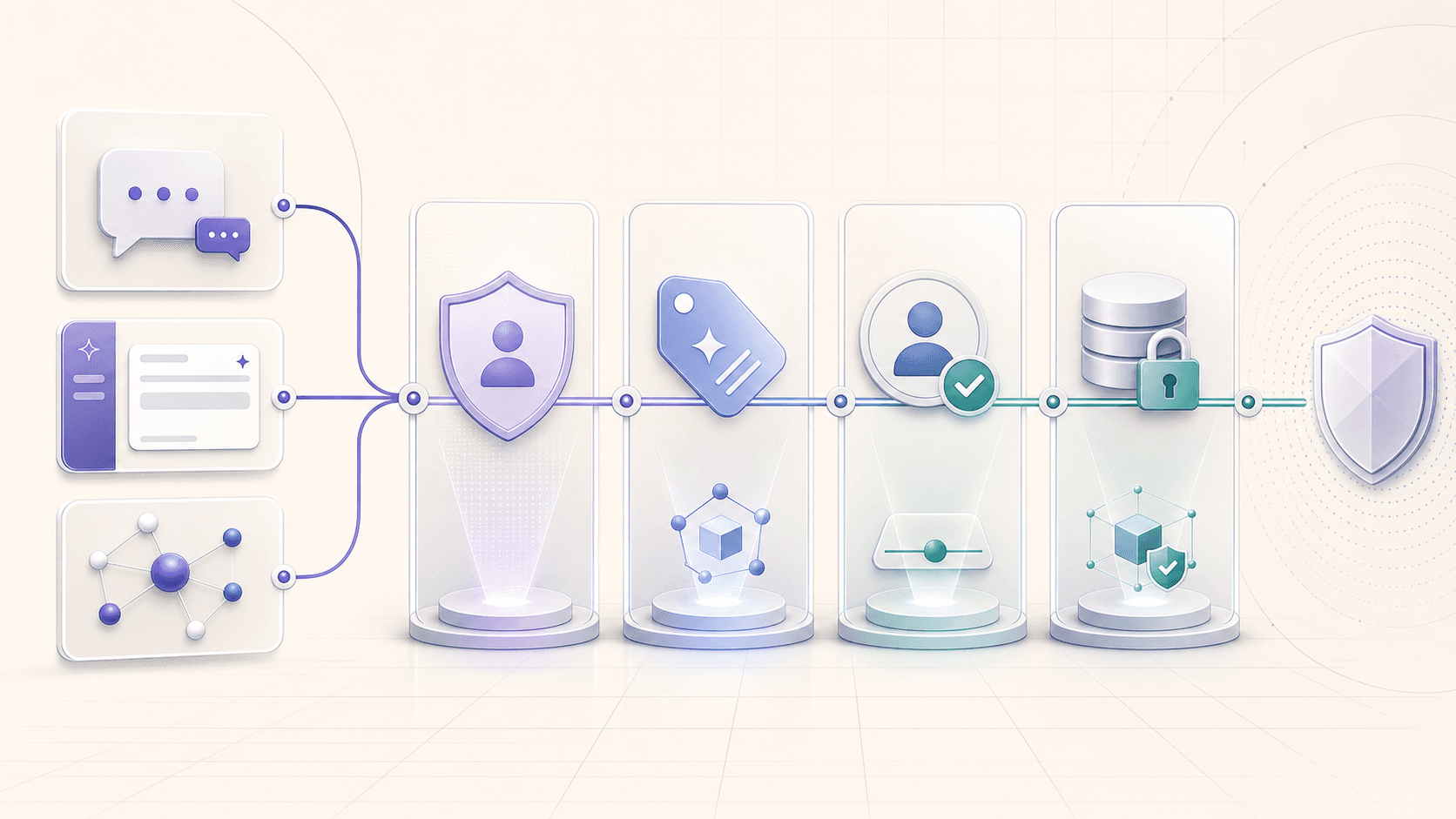
A strong Article 50 implementation is not a banner. It is a control stack that starts in policy and ends in evidence. The key shift is moving from "we have an AI transparency policy" to "we can prove the right control fired during the actual AI workflow."
| Layer | What it does |
|---|---|
| Policy layer | Defines which Processes require disclosure, generated-content marking, public-interest review, deepfake disclosure, or biometric/emotion notice. |
| Product layer | Places clear, accessible notices in the actual user experience. |
| Runtime layer | Detects when a Process triggers Article 50 and enforces the right disclosure, label, approval, or block. |
| Evidence layer | Records what happened: the user saw the notice, the output was marked, the reviewer approved, the exception was justified. |
| Assurance layer | Monitors whether controls still work after releases, model changes, channel expansion, and Process drift. |
Ask these questions before the next release
Use these readiness questions before shipping a chatbot, copilot, or agent. If the answer to any of them is unclear, the system is not ready for production review.
- Does a natural person interact directly with the AI system, and is that disclosed clearly before or at first interaction?
- Does the disclosure remain visible, understandable, accessible, and accurate if the system calls tools or takes actions?
- Does the system generate synthetic text, image, audio, or video, and are outputs marked in a machine-readable way where technically feasible?
- Can generated content be exported, copied, published, emailed, or attached to a customer record?
- Does the Process create deepfake-like content, publish public-interest text, or involve emotion recognition or biometric categorisation?
- Is there human review and editorial responsibility where the team relies on that exception?
- Are disclosure events logged, can evidence be reconstructed later, and who owns the control after launch?
- What happens if the disclosure fails?
Frequently Asked Questions
Does Article 50 apply only to customer-facing chatbots?
No. Customer chatbots are an obvious case, but internal employee copilots, Process agents, voice assistants, generated-content tools, and agentic approval Processes can also require Article 50 analysis.
Is a single AI disclosure enough?
Sometimes, for a simple chatbot. For copilots and agents, teams usually need persistent indicators, generated-content labels, approval states, and evidence that the right control fired in the actual Process.
What is the biggest Article 50 mistake?
Treating Article 50 as copywriting. The copy matters, but the control is the combination of placement, timing, accessibility, generated-content marking, human review, monitoring, and proof.
What evidence should an audit-ready Article 50 program keep?
Keep the trigger assessment, approved disclosure copy, screenshots, accessibility and localization checks, generated-content marking design, metadata schema, approval logs, disclosure telemetry, generated-content logs, change history, and remediation records.
Key Takeaways
Article 50 is not the hardest part of the EU AI Act, but it is one of the easiest to underestimate. For simple chatbots, it may look like a disclosure problem. For copilots, it becomes a generated-content and human-review problem. For AI agents, it becomes a runtime control problem: who or what is the user interacting with, what content did the system generate, what action did it prepare, who approved it, and what evidence proves the control worked?
The teams that handle Article 50 well will not bolt a banner onto the interface at the end. They will build transparency into the execution path: disclose, label, route, approve, log, and prove. That is the difference between AI transparency as paperwork and AI transparency as an operating control.