

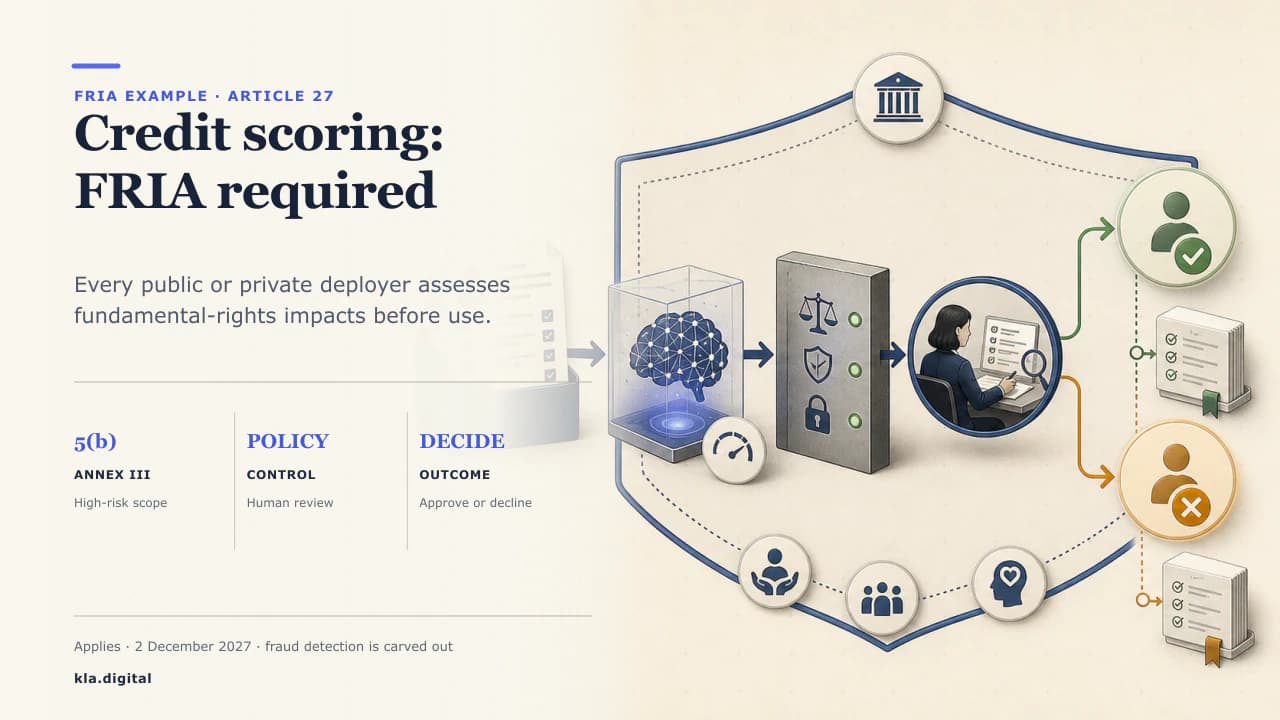
This is a complete, worked Fundamental Rights Impact Assessment for an AI credit-scoring system: all six Article 27(1) sections filled in for one concrete bank scenario, with the consumer-credit depth that a generic template leaves out. It builds directly on our FRIA template guide, which explains what a FRIA is, the six-section structure, and how a FRIA differs from a DPIA. An AI system that evaluates the creditworthiness of natural persons or establishes their credit score is high-risk under Annex III point 5(b) of the EU AI Act, and its deployer owes a FRIA under Article 27 regardless of whether the deployer is public or private. The binding date is 2 December 2027, moved from 2 August 2026 by the Digital Omnibus on AI. You can draft a structured version of the assessment below with the free FRIA generator.
Why credit scoring triggers a FRIA, regardless of public or private status
Article 27(1) opens: "Prior to deploying a high-risk AI system referred to in Article 6(2), with the exception of high-risk AI systems intended to be used in the area listed in point 2 of Annex III, deployers that are bodies governed by public law, or are private entities providing public services, and deployers of high-risk AI systems referred to in points 5 (b) and (c) of Annex III, shall perform an assessment of the impact on fundamental rights that the use of such system may produce." The sentence defines two groups of deployers who owe the assessment.
The first group is public bodies and private entities providing public services deploying Annex III high-risk systems. The second group is deployers of the systems referred to in Annex III points 5(b) and (c): credit scoring, and life or health insurance pricing. That second clause carries no public-or-private qualifier. It binds every deployer of a 5(b) creditworthiness system and every deployer of a 5(c) life or health insurance-pricing system, commercial banks and consumer lenders included.
One reading trap is worth naming directly. The phrase "with the exception of … point 2 of Annex III" removes critical-infrastructure systems from the first group only. Point 2 of Annex III covers critical infrastructure; credit scoring sits in point 5(b). A 5(b) credit-scoring deployer is pulled in through the second clause, and the point-2 exception does not touch that clause.
Annex III point 5(b) covers "AI systems intended to be used to evaluate the creditworthiness of natural persons or establish their credit score, with the exception of AI systems used for the purpose of detecting financial fraud." A probability-of-default model that drives consumer-credit decisions sits squarely inside that definition. The FRIA template guide summarises this trigger; the rest of this article works it through in full. For the wider classification picture, including how Article 6 and Annex III decide what counts as high-risk, see the high-risk AI classification guide.
One further classification step makes the trigger airtight. Under Article 6(3), an Annex III system can fall outside high-risk where it does not pose a significant risk of harm to the health, safety, or fundamental rights of natural persons, for instance where it performs a narrow procedural task. That derogation does not reach credit scoring: Article 6(3) states that an Annex III system shall always be considered high-risk where it performs profiling of natural persons, and a creditworthiness model that evaluates a person's economic situation is profiling within the meaning of GDPR Article 4(4). A credit-scoring system that materially drives credit decisions therefore stays high-risk, and its deployer keeps the Article 27 FRIA duty.
The fraud-detection carve-out: what is in and what is out
The 5(b) definition expressly excepts AI "used for the purpose of detecting financial fraud." A pure fraud-detection model is therefore outside the 5(b) creditworthiness category, and it does not inherit the credit-scoring FRIA trigger through 5(b). A fraud model can still be high-risk on other grounds and carry its own governance duties; it simply does not inherit the 5(b) credit-scoring FRIA hook. Where the same institution runs fraud and AML models alongside its credit engine, the governance approach for those is covered in governing AML and payments agents.
Two adjacent cases round out the boundary. Solely pricing non-life insurance (motor, home, travel) is outside point 5(c); a non-life line would need a separate Annex III or Annex I route to be high-risk. Only life and health insurance risk assessment and pricing falls in under point 5(c), which carries its own FRIA duty.
| AI use | In Annex III 5(b)? | FRIA under Art 27 by 5(b)? |
|---|---|---|
| Evaluating creditworthiness / setting a credit score | Yes | Yes |
| Detecting financial fraud | No (expressly excepted) | No (not triggered by 5(b)) |
| Pricing non-life insurance (motor, home) | No (only life & health is 5(c)) | No |
| Pricing life or health insurance | Yes (via point 5(c)) | Yes: see the insurance FRIA example |
Three legal layers on one AI credit decision
A single automated decline does not sit under the AI Act alone. Three bodies of EU law layer onto the same decision, and a credible FRIA has to account for all of them. This consumer-credit depth is what separates a worked credit-scoring assessment from the generic template.
| Layer | What it requires for a credit decline | Source |
|---|---|---|
| AI Act FRIA | A six-part fundamental-rights assessment before deployment; notify the market surveillance authority of the results. | AI Act Art 27(1)–(3) |
| AI Act explanation right | On request, a clear and meaningful explanation of the AI system's role in the decision and the main elements of the decision taken, to the extent that right is not otherwise provided under Union law. | AI Act Art 86(1), 86(3) |
| GDPR automated-decision rules | A separate Article 6 lawful basis for the processing plus an Article 22(2) exception (contract, authorising law, or explicit consent) to the prohibition on solely-automated decisions; for the contract and explicit-consent routes, the Article 22(3) safeguards (human intervention, the right to express a view, and to contest). | GDPR Art 22(1)–(3) |
| GDPR transparency | "Meaningful information about the logic involved," plus the significance and the envisaged consequences of the processing. | GDPR Art 13(2)(f) / 14(2)(g) / 15(1)(h) |
| GDPR DPIA | A data-protection risk assessment whose overlapping parts feed into, and are complemented by, the FRIA. | GDPR Art 35; AI Act Art 27(4) |
The Article 86 explanation right and the GDPR hooks
AI Act Article 86 is the explain-the-decline hook inside the Act itself. It gives "any affected person subject to a decision which is taken by the deployer on the basis of the output from a high-risk AI system listed in Annex III … and which produces legal effects or similarly significantly affects that person in a way that they consider to have an adverse impact on their health, safety or fundamental rights … the right to obtain from the deployer clear and meaningful explanations of the role of the AI system in the decision-making procedure and the main elements of the decision taken." The right is conditional on that threshold: the decision has to produce legal effects or similarly significantly affect the person. A credit decline meets that threshold, because it governs access to a loan, card, or overdraft, so a declined applicant is an affected person who can invoke Article 86. Article 86(3) keeps the right a gap-filler: it applies only to the extent that an equivalent right is not otherwise provided for under Union law, so where the GDPR transparency and Article 22 rights already cover the explanation, those provisions govern and Article 86 fills what they leave open. On the GDPR side, the binding hooks are Articles 13 to 15 (meaningful information about the logic involved) and Article 22(3) (human intervention, the right to express a view, and to contest). Recital 71 also describes an explanation of the decision reached, though it is a non-binding recital, so the explanation duty is best anchored in those binding articles plus Article 86. The United States term "adverse-action notice" is useful shorthand for these duties, though it is not an EU statutory term.
The scenario: the bank and the system
The worked example uses one deployer throughout. The bank is a mid-sized EU retail bank and consumer lender, acting as the deployer of a high-risk AI system. The system is a machine-learning creditworthiness model (provider "ScoreCo", model v2.3) that outputs a probability-of-default score used to decide consumer-credit applications: personal loans, credit cards, and arranged overdrafts.
The decisioning design is a three-band cut-off. Scores above the upper threshold are auto-approved; scores below the lower threshold are auto-declined; the middle band is referred to human underwriters. A separate, independent fraud-screening model runs first and is out of scope of this FRIA under the Annex III 5(b) carve-out. Use is continuous and indefinite from the deployment date, with real-time scoring at the point of application, around 3,000 decisions a week (roughly 150,000 a year) across the bank's EU retail markets, online and in-branch. The system is Annex III point 5(b), so the FRIA is required under Article 27(1) whatever the bank's public or private status.
The worked FRIA, section by section (Article 27(1)(a)-(f))
Article 27(1) lists six mandatory components. The two paragraphs below set out what each one is doing for the credit-scoring case, and the table that follows completes all six for the worked example.
Sections 1 to 3 fix the facts the rest of the assessment reasons over. Section 1 records the system and its intended purpose (the ScoreCo probability-of-default model, the origination Process it sits in, and the three-band cut-off design) and states plainly that fraud screening is a separate model outside this FRIA. Section 2 records duration and frequency: continuous production use, real-time scoring at the point of application, and the weekly decision volume. Section 3 identifies the affected persons, with particular attention to thin-file and vulnerable applicants and to third parties such as joint applicants and guarantors.
Sections 4 to 6 carry the analysis. Section 4 is the risk register set out in full below: each fundamental right, the harm scenario, a likelihood and severity rating, the mitigation, and the residual risk. Section 5 documents the human-oversight measures: the named officers who can override an auto-decline, the mandatory review of declines in flagged groups, and the second-line model-risk function. Section 6 records what happens when a risk materialises: the complaint route, the GDPR Article 22(3) and Article 86 rights an applicant can invoke, model rollback and threshold adjustment, and the Article 27(3) notification to the market surveillance authority.
| FRIA section | What the bank documents for the credit-scoring case | Basis |
|---|---|---|
| 1. System & intended purpose | ScoreCo model v2.3; intended purpose is to predict probability of default to inform consumer-credit decisions; used in the origination Process with auto-approve and auto-decline cut-offs and a human-underwriting middle band; fraud screening handled by a separate model and excluded. | Art 27(1)(a) |
| 2. Duration & frequency | Continuous, indefinite production use from the deployment date; real-time scoring at application; ~3,000 decisions/week, ~150,000/year; EU retail markets, online and in-branch. | Art 27(1)(b) |
| 3. Affected persons & groups | Credit applicants (natural persons), with special attention to thin-file and vulnerable cohorts (young adults, recent migrants, people recently widowed or divorced re-entering credit in their own name), low-income applicants, applicants whose proxies correlate with protected characteristics, and applicants with limited digital literacy; plus third parties (joint applicants, guarantors, dependents). | Art 27(1)(c) |
| 4. Specific risks to fundamental rights | The risk register below: each right, harm scenario, likelihood, severity, risk level, mitigation, and residual risk. | Art 27(1)(d) |
| 5. Human-oversight measures | Named credit-risk officers and underwriters with authority to override auto-declines; mandatory human review of all declines in flagged groups; low-confidence scores routed to human review; a second-line model-risk function; oversight training and logging. | Art 27(1)(e) |
| 6. Measures if risks materialise | Complaint mechanism; GDPR Art 22(3) human-review and contest route; AI Act Art 86 explanation of the decline; alternative manual-assessment pathway; model rollback and threshold adjustment; incident escalation; Art 27(3) notification to the market surveillance authority. | Art 27(1)(f) |
Section 4 in full: the credit-scoring risk register
Section 4 is where a FRIA becomes concrete. Article 27(1)(d) requires the assessment to set out the specific risks of harm likely to affect the categories of natural persons identified in section 3; a right-by-right register (each fundamental right at stake, a specific harm scenario, a likelihood and severity rating, the mitigation, and the residual risk) is a defensible way to document those risks. The register below does that for the credit-scoring case. The likelihood, severity, and residual values are a sample assessment, internally consistent with the scoring matrix that follows. They illustrate a defensible method; the specific figures are not prescribed by any regulator.
| Fundamental right | Harm scenario | Likelihood | Severity | Risk | Mitigation | Residual |
|---|---|---|---|---|---|---|
| Non-discrimination (Charter Art 21) | Proxy features (postcode, occupation, device, nationality-linked variables) correlate with protected characteristics (ethnicity, gender, age), producing disparate decline rates: indirect discrimination. | Possible | Major | High | Quarterly disparate-impact / adverse-impact-ratio testing across protected groups; proxy-feature audit with removal or transformation; fairness constraints; human review of all declines in flagged groups; documented reasons. | Medium |
| Access to essential private services / consumer protection | An erroneous low score wrongly declines credit, restricting access to essential services such as a work vehicle, housing finance, or essential purchases, and risking cumulative exclusion from the credit market. Refusal of new credit is not normally a deprivation of existing property under Charter Article 17, which is engaged only where an existing possession is affected. | Unlikely | Major | Medium | Alternative manual-assessment pathway; human override; clear adverse-action reasons; ability to submit additional evidence (e.g. rent or utility payment history for thin files). | Low |
| Protection of personal data (Charter Art 8) | Inaccurate, outdated, or excessive bureau or transaction data degrades accuracy and fairness; special-category traits inferred from transaction data. | Possible | Moderate | Medium | Data-minimisation review; DPIA integration (Art 27(4)); data-quality controls aligned with AI Act Art 10; ban on special-category inputs and monitoring for their proxies; bureau-data correction process (GDPR Art 16). | Low |
| Effective remedy (Charter Art 47) / consumer protection | Applicant cannot understand or challenge an automated decline; a "computer says no" outcome with no human route or meaningful reasons. | Possible | Major | High | GDPR Art 22(3) safeguards (guaranteed human intervention, the right to express a view and to contest); AI Act Art 86 clear, meaningful explanation of the AI's role and the main decision factors; principal-reason codes; logged, auditable decisions. | Medium |
| Non-discrimination / thin-file & vulnerable applicants | Applicants with sparse or no credit history (young adults, recent migrants, people newly credit-active in their own name) are scored on thin data and systematically declined or mispriced; the model under-performs on under-represented segments. | Likely | Moderate | High | Segment-level performance monitoring (accuracy by file-thickness and age cohort); consented alternative data (rental, utility, open-banking cash-flow) with manual review for thin files; route low-confidence scores to human review. | Medium |
| Solely-automated decision-making (GDPR Art 22) | Auto-decline at the score cut-off is a decision based solely on automated processing with significant effect (SCHUFA, C-634/21), made without an Article 6 lawful basis and an Article 22(2) exception, or without the Article 22(3) safeguards. | Possible | Major | High | Rely on the Art 22(2)(a) contract-necessity exception together with a separate Article 6 lawful basis and the Art 22(3) safeguards; meaningful human review on request for every auto-decline; logging; the lawful basis and exception documented in the DPIA. | Low |
Scoring the register: likelihood x severity
The risk levels in the register come from a likelihood-by-severity matrix applied consistently across the whole assessment. Recording the matrix, and the reasoning behind each rating, matters as much to a regulator as the final risk level.
| Likelihood / Severity | Negligible | Minor | Moderate | Major | Catastrophic |
|---|---|---|---|---|---|
| Rare | Low | Low | Low | Medium | Medium |
| Unlikely | Low | Low | Medium | Medium | High |
| Possible | Low | Medium | Medium | High | High |
| Likely | Medium | Medium | High | High | Critical |
| Almost certain | Medium | High | High | Critical | Critical |
Mitigations in depth
Disparate-impact testing. Run quarterly adverse-impact-ratio testing across protected groups, comparing approval rates, decline rates, and pricing outcomes. The four-fifths (80%) screen is a starting signal; document the test, the populations, and the action taken when a disparity appears.
Proxy-feature handling. Audit input features for correlation with protected characteristics. Postcode, occupation, device type, and nationality-linked variables are common proxies for ethnicity, gender, or age. Remove or transform the features that carry proxy signal, and re-test after each change.
Human review of declines. Route every decline in a flagged group to a named underwriter before it is communicated, and give that underwriter genuine authority to override the model. Low-confidence scores go to human review.
Adverse-action reasons and the Article 86 explanation. Give the applicant the principal reasons for the decline in plain language, plus the Article 86 explanation of the AI system's role in the decision and the main elements of the decision taken. Principal-reason codes mapped to the model's drivers make this repeatable and auditable.
Alternative manual pathway. Offer a route to a full manual assessment for applicants who contest an automated decline or who can supply additional evidence, such as rental or utility payment history.
Thin-file and alternative data. For applicants with sparse credit history, use consented alternative data (rental, utility, or open-banking cash-flow) under manual review, and monitor model performance by file-thickness and age cohort to detect segment-level failure.
Each of these controls needs an owner, evidence, and a place in the bank's control framework; mapping them to the relevant AI Act articles is what the control mapping view is for.
GDPR Article 22, SCHUFA, and the DPIA
An auto-decline at a score cut-off is a decision based solely on automated processing with a significant effect, which puts it under GDPR Article 22. The CJEU set that threshold lower than many lenders assumed. In SCHUFA Holding (Scoring), Case C-634/21 (judgment 7 December 2023), the Court held that a credit reference agency producing an automated credit-score probability value is itself carrying out automated individual decision-making under Article 22(1) where a third party such as a lender draws strongly on that value to grant or refuse credit; the Court noted that an insufficient probability value leads, in almost all cases, to a refusal. A score can itself fall under Article 22 where a third party draws strongly on it to grant or refuse credit, so a bank that auto-declines at its own cut-off is more directly making such a decision.
That means the bank needs both a separate Article 6 lawful basis for the processing and an Article 22(2) exception to the prohibition on solely-automated decisions. The usual exception is Article 22(2)(a) contract-necessity (the decision is necessary for entering into a credit contract) which, like the explicit-consent route in Article 22(2)(c), carries the Article 22(3) safeguards: the right to obtain human intervention, to express a point of view, and to contest the decision. The Article 22(2)(b) route, a decision authorised by Union or Member State law, instead requires those safeguards to be laid down in the authorising law. Article 22(4) also restricts the use of special-category data, which is why the risk register bans special-category inputs and monitors for their proxies. The remaining option is to keep a human in the loop on every decline so the decision is not solely automated.
The data-protection analysis overlaps heavily with a GDPR DPIA. Article 27(4) of the AI Act provides that where an obligation is already met through a DPIA, the FRIA complements that DPIA. Reuse the DPIA's data-flow, lawful-basis, and data-quality work as input, and extend it to the Charter rights a DPIA does not cover. For the DPIA side, see DPIA for AI systems, and to draft both together use the DPIA and FRIA generator.
After the FRIA: notification and ongoing monitoring
Article 27 also requires notification and updates after the assessment. Under Article 27(3), once the FRIA is performed the deployer notifies the relevant market surveillance authority of its results, using the Article 27(5) template. The AI Office has not yet published that template as of June 2026, so document against the Article 27(1) criteria in the meantime; the template's absence does not excuse the obligation. The only exemption from notification is the narrow Article 46(1) case.
The FRIA is also a living document. Article 27(2) requires an update whenever its elements change or are no longer up to date. For a credit-scoring model the practical update triggers are a model retrain or version change, a threshold or cut-off adjustment, performance or distribution drift, a new applicant cohort or market, and any change to the data sources feeding the score. A deployer may rely on a previously conducted FRIA for a sufficiently similar system, and it has to keep the assessment current. The French-supervision angle for banks deploying this kind of model is covered in ACPR AI governance for French banks.
Frequently Asked Questions
Does a private bank have to do a FRIA for AI credit scoring?
Yes. Article 27(1) requires a FRIA from "deployers of high-risk AI systems referred to in points 5(b) and (c) of Annex III," and that clause has no public-or-private qualifier. A creditworthiness or credit-scoring system is Annex III point 5(b), and because it performs profiling of natural persons the Article 6(3) derogation does not take it out of the high-risk category, so every deployer, public or private, must conduct the FRIA. The only thing 5(b) excludes is AI used to detect financial fraud.
Is AI fraud detection covered by the credit-scoring FRIA?
No. Annex III point 5(b) expressly excepts "AI systems used for the purpose of detecting financial fraud." A pure fraud-detection model is therefore not part of the 5(b) creditworthiness category and is not pulled into the FRIA by 5(b). It can still be high-risk on other grounds, and it does not inherit the credit-scoring trigger.
Is an automated credit score a decision under GDPR Article 22?
It can be. In SCHUFA Holding (Scoring), Case C-634/21 (judgment 7 December 2023), the CJEU held that producing an automated credit-score probability value is automated individual decision-making under Article 22(1) where a lender draws strongly on that value to grant or refuse credit. A bank that auto-declines at a score cut-off is therefore making a solely-automated decision, and it needs a separate Article 6 lawful basis and an Article 22(2) exception, plus (on the contract and explicit-consent routes) the Article 22(3) safeguards: human intervention, the right to express a view, and to contest.
What explanation must a declined applicant receive?
Under AI Act Article 86, the applicant can obtain a clear and meaningful explanation of the AI system's role in the decision and the main elements of the decision taken; Article 86(3) makes that a gap-filler that applies only where an equivalent right is not otherwise provided under Union law. Under GDPR Articles 13 to 15 the bank must give meaningful information about the logic involved and the significance and envisaged consequences, and under Article 22(3) the applicant can obtain human intervention and contest the decision. The term "adverse-action notice" is United States terminology; in the EU these binding duties are the functional equivalent.
Can our existing DPIA cover the FRIA for credit scoring?
Only in part. Article 27(4) says that where an obligation is already met through a GDPR DPIA, the FRIA complements that DPIA. Reuse the overlapping data-protection analysis, and treat the FRIA as broader: it covers all Charter rights, including non-discrimination, access to essential services, and effective remedy, beyond data protection alone.
When is the credit-scoring FRIA legally required?
The binding date is 2 December 2027. The Digital Omnibus on AI, adopted on 29 June 2026, moved stand-alone Annex III high-risk obligations, including the Article 27 FRIA, from 2 August 2026 to that date.
Do we have to tell a regulator after completing the FRIA?
Yes. Under Article 27(3) the deployer notifies the relevant market surveillance authority of the FRIA results, submitting the Article 27(5) template. The AI Office has not yet published that template as of June 2026, so use your own documentation against the Article 27(1) criteria until it appears. The only exemption is the narrow Article 46(1) case.
Key Takeaways
An AI creditworthiness or credit-scoring system is high-risk under Annex III point 5(b), and its deployer owes a full Article 27 FRIA whatever its public or private status. The worked assessment above shows a defensible level of specificity under Article 27(1): all six sections completed, a right-by-right risk register, the GDPR Article 22 exception-and-safeguards analysis, the Article 86 explanation duty, and the DPIA reuse mechanics. The binding date is 2 December 2027. Start a draft credit-scoring assessment with the free FRIA generator. This article is for general information only and is not legal advice; confirm your obligations under Article 27 with qualified counsel, and re-check the regulatory status before relying on any deadline.