

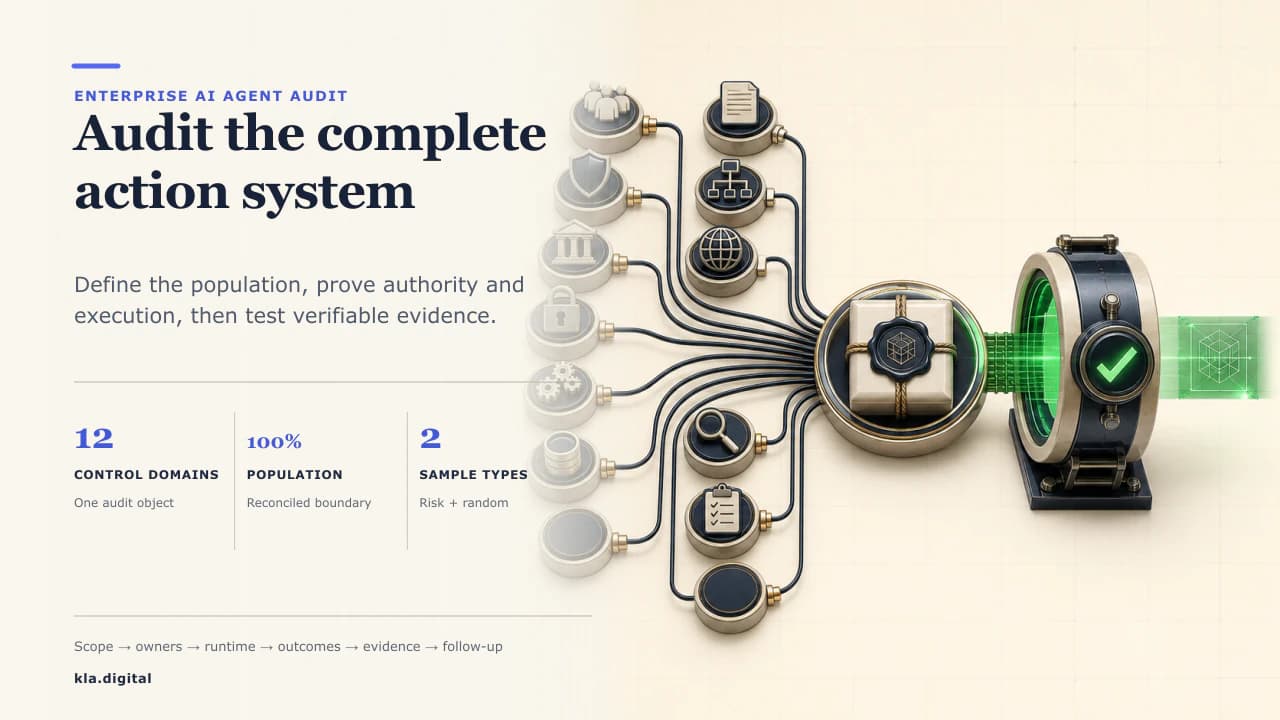
Unternehmensweite Prüfung von Verantwortung, Autorität, Ausführung, Aufsicht und Beweisen über KI-Agentensysteme hinweg. Eine Produktionsprüfung folgt dem gesamten Betriebssystem rund um einen Agenten: Geschäftszweck, Modell und Orchestrierung, menschliche und nichtmenschliche Identitäten, delegierte Autorität, Daten und Tools, Richtlinienentscheidungen, Genehmigungen, Zustandsänderungen, Geschäftsergebnisse, Überwachung, Vorfälle, Releases, Rollback, Aufbewahrung und unabhängige Überprüfung. Die folgende Methode gibt den Teams für interne Revision, Compliance, Modellrisiko, Sicherheit und Betrieb eine einheitliche Feldarbeitsstruktur und behält gleichzeitig ihre getrennten Verantwortlichkeiten bei.
Das 12-Domänen-AI-Agent-Audit-Framework für Unternehmen
Verwenden Sie diese Tabelle, um das Prüfuniversum festzulegen, Beweisanforderungen zuzuweisen und Verfahren zu schreiben. Jede Zeile benötigt eine definierte Grundgesamtheit, einen benannten Eigentümer, eine testbare Kontrolle, einen Wahrheitsquellendatensatz und eine explizite Fehlerbedingung, bevor die Feldarbeit beginnt.
| Prüfdomäne | Frage des Abschlussprüfers | Verantwortlicher Eigentümer | Kontrolle zum Testen | Nachweis erforderlich | Fehlersignal | Wo in KLA / tieferer Leitfaden |
|---|---|---|---|---|---|---|
| 1. Inventar und Umfang | Welche Agenten, Releases, Umgebungen, Prozesse, Entscheidungen und Abhängigkeiten sind in der Population vorhanden? | Geschäftsinhaber | Bestandsabgleich und Grenzgenehmigung | Agenteninventar, Prozesskarte, Datenfluss, Abhängigkeitsregister, Bevölkerungszahlen | Unbekannter Agent, fehlende Umgebung, nicht versöhnte Bevölkerung | Agentenregister; Compliance-Leitfaden |
| 2. Verantwortung und Rechenschaftspflicht | Wem gehören die Ergebnisse, der Kontrollbetrieb, die Risikoakzeptanz und die Behebung? | Geschäftsinhaber | Benannte Eigentümer- und Genehmigungsbehörde | Verantwortungsmatrix, Rollencharta, Freigaben, Issue-Eigentümer | Geteilte Verantwortung, vakante Rolle, Eigentümer ohne Autorität | Agentenregister; Kontrollzuordnung |
| 3. Identität und Delegation | Kann jede Aktion an einen Agenten, einen Sponsor und eine Delegation gebunden werden? | Identitätsinhaber | Einzigartige Identität und umfassende Delegation | Identitätsdatensätze, Tokenansprüche, Delegationskette, Sitzungsumfang | Gemeinsame Anmeldeinformationen, verwaiste Identität, ungebundener Prinzipal | Agentenregister; Berechtigungsleitfaden |
| 4. Berechtigungen, Tools und Datengrenzen | Könnte der Agent Ressourcen lesen oder ändern, die über seinen genehmigten Zweck hinausgehen? | Anwendungseigentümer | Richtlinie der geringsten Privilegien zum Zeitpunkt der Aktion | Effektive Zuschüsse, Eintrag im Werkzeugkatalog, Datengrenzen, Richtlinienurteile | Breiter Anwendungsbereich, direkte Umgehung, nicht registriertes Tool, toxische Zuschusskombination | Werkzeugkatalog; Datengrenzen; KLA-Richtlinien-Engine |
| 5. Risikoklassifizierung und Vorproduktionssicherung | Wurde die Verwendung klassifiziert und anhand ihrer tatsächlichen Auswirkungen und ihres Kontexts getestet? | Risikoeigentümer | Dokumentierte Klassifizierung und Freigabetor | Folgenabschätzung, Bedrohungsmodell, Bewertungsplan, Akzeptanzschwellen | Nicht unterstützte Klassifizierung, fehlender Test, aufgehobener Schwellenwert für nicht bestanden | Kontrollzuordnung; Versicherungszentrum |
| 6. Durchsetzung von Laufzeitrichtlinien | Wurde die genehmigte Richtlinie vor jeder Folgemaßnahme bewertet? | Kontrolleigentümer | Inline-Entscheidung zum Zulassen, Ablehnen oder Eskalieren | Richtlinienversion, übereinstimmende Regeln, Entscheidungsanfrage, Aktionsbeleg | Taten gehen dem Urteil, veralteten Richtlinien und der Umgehung der Durchsetzung voraus | Richtlinienersteller; KLA-Richtlinien-Engine; Prüfpfad; Leitfaden zum Regieren eines Agenten |
| 7. Menschliche Zustimmung und Eskalation | Hat ein autorisierter Gutachter genügend Beweise erhalten und ein Urteilsvermögen ausgeübt? | Betriebsinhaber | Risikobasierte Genehmigung und Eskalation | Entscheidungsanfrage, Momentaufnahme der Behörde, vorgelegte Beweise, Begründung, Zeitstempel | Stempel, abgelaufene Vollmacht, verspätete Genehmigung, fehlende Begründung | Entscheidungsschalter; verantwortungsvolle Autonomie |
| 8. Ausführungsherkunft und Geschäftsergebnisse | Kann der Prüfer die Absicht anhand der Werkzeugwirkungen und des Endergebnisses nachvollziehen? | Prozessinhaber | End-to-End-Korrelation und Ergebnisabgleich | Abstammungsdatensatz, Reise, Toolaufrufe, Vorher-/Nachher-Status, Ergebnisdatensatz | Defekte Korrelation, nicht erfasste Nebenwirkung, Ergebnisinkongruenz | Abstammungs-Explorer; Audit-Trail-Leitfaden |
| 9. Kontinuierliche Sicherung und Änderungsmanagement | Haben Änderungen eine Neubewertung, Überwachung und einen kontrollierten Rollout ausgelöst? | Ingenieur-Inhaber | Freigabegenehmigung, Abweichungserkennung, durch Änderungen ausgelöste Tests | Release-Differenz, Testergebnisse, Rollout-Datensatz, Assurance-Warnungen, Behebung | Nicht genehmigte Änderungen, stille Drift, ungelöste fehlgeschlagene Kontrolle | Agenten; Versicherungszentrum; Überwachungsleitfaden |
| 10. Reaktion, Widerruf und Rollback auf Vorfälle | Könnte die Organisation den Agenten eindämmen und die betroffenen Maßnahmen rückgängig machen? | Eigentümer des Vorfalls | Kill-, Widerruf-, Eindämmungs-, Benachrichtigungs- und Rollback-Verfahren | Zeitleiste des Vorfalls, Sperrung von Zugangsdaten, Rollback, Liste der betroffenen Fälle | Fortsetzung der Ausführung, unvollständiger Umfang, fehlgeschlagenes Rollback | Sicherheitszentrum; Agenten; Beweisraum |
| 11. Beweisintegrität, Aufbewahrung und unabhängige Überprüfung | Sind die Beweise vollständig, manipulationssicher, aufbewahrt und unabhängig überprüfbar? | Eigentümer der Aufzeichnungen | Bevölkerungsabgleich, Versiegelung, Aufbewahrung, Verifizierertest | Manifest, Hashes, Signaturen, Aufbewahrungskette, Aufbewahrungsrichtlinie, gesetzliche Aufbewahrungspflicht | Hash-Fehler, fehlender Datensatz, veränderbare Quelle, abgelaufene Aufbewahrung | Beweisraum; Versiegeltes Beweisbündel; Kontrollpaket; manipulationssicherer Beweis; Beispielpaket |
| 12. Multi-Agent- und Drittanbieter-Abhängigkeiten | Befinden sich delegierte Agenten, Modelle, Tools, Protokolle und Anbieter innerhalb der Prüfgrenzen? | Dienstinhaber | Abhängigkeitsgenehmigung und authentifizierte Übergabe | Lieferanteninventar, Verträge, Versionen, Nachrichten zwischen Agenten, Kontrollberichte | Undurchsichtiger Subagent, nicht authentifizierte Nachricht, nicht unterstützte Komponente | Agentenregister; Werkzeugkatalog; OWASP Zebrastreifen |
Definieren Sie die Systemgrenze vor der Probenahmeaktivität
Beginnen Sie mit dem Geschäftsergebnis und verfolgen Sie es nach innen. Die Grenze umfasst jede Komponente, die eine Aktion oder ihren Nachweis beeinflussen kann: Agentenkonfiguration, Modell-, Eingabeaufforderungs- und Orchestrierungsversionen, Speicher, Abrufquellen, Benutzer- und Dienstidentitäten, Delegation, Richtlinien, Tools, nachgelagerte Systeme, menschliche Prüfer, Überwachung, Vorfallprozesse und Beweisspeicher. Beziehen Sie Subagenten und Dritte immer dann ein, wenn ihre Ergebnisse die endgültige Entscheidung, die verfügbare Autorität oder die Vollständigkeit der Aufzeichnungen ändern können.
Bauen Sie eine Bevölkerung auf, die versöhnt werden kann. Das NIST AI RMF 1.0 ist ein endgültiger freiwilliger Rahmen für KI im Allgemeinen, und GOVERN 1.6 unterstützt die Führung eines KI-Systeminventars für das Risikomanagement. Erweitern Sie dieses Inventar für Audit-Feldarbeiten auf Releases, Rollouts, Entscheidungstypen, Umgebungen, Tools, Datenquellen, Eigentümer, Risikostufen, Vorfallverlauf und Beweisorte.
Schreiben Sie die Grenzerklärung als Prüfartefakt und holen Sie die Genehmigung des Geschäftsinhabers ein. Eine nützliche Anweisung benennt den geprüften Prozess, Start- und Endereignisse, eingeschlossene Agenten und Releases, Produktionszeitraum, Entscheidungspopulation, Gerichtsbarkeiten, ausgeschlossene Komponenten mit Gründen, vorgelagerte Daten, nachgelagerte Aktionen, menschliche Rollen und jede externe Abhängigkeit. Änderungen des Umfangs während der Feldarbeit erfordern eine datierte Änderung und eine Folgenabschätzung für die Probe.
- Populationsschlüssel: Agenten-ID, Release-ID, Umgebung, Prozess-ID, Entscheidungstyp, Ergebnis, Risikostufe und Datumsbereich.
- Autoritätsgrenze: Sponsoring-Prinzipal, Agentenidentität, delegierte Bereiche, zulässige Tools, Ressourcenlimits, Zweck, Dauer und Genehmigungsschwellenwerte.
- Ausführungsgrenze: jeder Modellaufruf, Toolaufruf, Inter-Agent-Übergabe, Richtlinienurteil, Entscheidungsanfrage, Statusänderung, Benachrichtigung und Geschäftsergebnis.
- Beweisgrenze: Aufzeichnungssystem für jedes Artefakt, jede Aufbewahrungsklasse, jede Versiegelungsmethode, jeden Prüfer, jede gesetzliche Aufbewahrungsfrist und jede bekannte Sammlungslücke.
Legen Sie Verantwortlichkeiten fest und trennen Sie vier Assurance-Disziplinen
Weisen Sie einen verantwortlichen Geschäftsinhaber für das Agentensystem und seine Ergebnisse zu. Benennen Sie technische Eigentümer für den Agenten, das Modell, die Integrationen, die Identität, die Daten und die Beweisinfrastruktur. Benennen Sie Kontrollverantwortliche für Richtlinien, Genehmigung, Überwachung, Reaktion auf Vorfälle und Aufbewahrung. Jeder Eigentümer benötigt die Befugnis, einen Rollout zu stoppen, ein definiertes Risiko innerhalb der delegierten Grenzen zu akzeptieren, Abhilfemaßnahmen zu finanzieren und auf eine Ausnahme zu reagieren.
Das IIA-Drei-Linien-Modell ordnet Risikoverantwortung und -management den Rollen der ersten Linie, Fachwissen und Herausforderungen den Rollen der zweiten Linie und unabhängige und objektive Sicherheit der internen Revision zu. Wenden Sie diese Rollen auf die Agentenprüfung an, ohne sie in drei feste Abteilungen umzuwandeln. Die interne Revision wahrt die Unabhängigkeit, indem sie Kontrolleigentums- und Genehmigungsentscheidungen des Managements für das System, das sie später prüft, vermeidet.
Vier Disziplinen liefern unterschiedliche Beweise. Ihre Arbeit kann wiederverwendet werden, wenn Umfang, Zeitraum, Kriterien, Kompetenz und Unabhängigkeit dokumentiert sind. Ihre Schlussfolgerungen bleiben eindeutig.
| Disziplin | Primäres Ziel | Vorgehensweise | Beweise | Fazit |
|---|---|---|---|---|
| Modellbewertung | Messen Sie das Verhalten anhand definierter Aufgaben und Risikokriterien | Benchmark-, Szenario-, Red-Team-, Untergruppen- und Regressionstests | Datensatz/Version, Methode, Schwellenwerte, Ergebnisse, Einschränkungen | Leistung unter getesteten Bedingungen |
| Sicherheitstests | Finden Sie ausnutzbare Pfade über Ziele, Tools, Identität, Speicher, Code und Abhängigkeiten hinweg | Bedrohungsmodellierung, gegnerische Tests, Konfigurationsüberprüfung, Exploit-Validierung | Bedrohungsmodell, Testfälle, Exploit-Trace, Schweregrad, erneuter Test zur Behebung | Sicherheitsrisiko für getesteten Bereich |
| Compliance-Audit | Bewerten Sie definierte rechtliche, regulatorische, vertragliche und politische Kriterien | Konstruktionstest, Funktionstest, Beweisprüfung, Nachführung | Kriterienmatrix, Grundgesamtheit, Stichprobe, Arbeitspapiere, Ausnahmen, Reaktion des Managements | Konformität oder Ausnahme gegenüber den angegebenen Kriterien |
| Betriebliche Sicherheit | Überprüfen Sie, ob die Kontrollen auch bei Produktionsänderungen weiterhin funktionieren | Kontinuierliche Signale, Schwellenwertwarnungen, Abstimmungen, gezielte Überprüfung, Nachverfolgung von Abhilfemaßnahmen | Kontrollereignisse, Sicherheitswarnungen, Eigentümerüberprüfung, Nachweise zum Abschluss von Problemen | Aktueller Kontrollzustand und ungelöste Exposition |
Führen Sie Entwurfszeit-, Releasezeit-, Laufzeit- und periodische Prozeduren aus
Behandeln Sie das Auditprogramm als Lebenszyklus. Das endgültige freiwillige NIST Generative AI Profile schlägt vor, den Test-, Bewertungs-, Validierungs- und Verifizierungsverlauf aufzubewahren, messbare Freigabekriterien zu verwenden, die Genehmigung zu dokumentieren, eine laufende Bewertung durchzuführen und Deaktivierungsverfahren zu definieren. Wenden Sie die Praktiken an, bei denen der Agent generative KI verwendet, und fügen Sie dann agentenspezifische Identitäts-, Delegations-, Tool-, Richtlinien-, Genehmigungs- und Multiagentenverfahren hinzu.
Singapurs IMDA Model AI Governance Framework for Agentic AI v1.5 ist eine veröffentlichte freiwillige Lebensberatung. Es unterstützt die Definition von Betriebsgrenzen und Berechtigungsrichtlinien vor der Bereitstellung, die Bewertung von Komponenten und End-to-End-Verhalten, die Überwachung nach der Bereitstellung, die Behandlung von Vorfällen und die Neubewertung von Änderungen an Modellen, Tools, Berechtigungen und Prozessen.
| Bühne | Erforderliche Verfahren | Evidenzpopulation | Bestehenskriterium |
|---|---|---|---|
| Entwurfszeit | Grenze, Zweck, Eigentum, Risikoklassifizierung, Folgenabschätzung, Bedrohungsmodell, Identitätsmodell, Tool- und Datengrenzen, Genehmigungsdesign, Beweisschema | Konstruktionsunterlagen und genehmigte Kontrollspezifikation | Jedes wesentliche Risiko ist einem Eigentümer-, Kontroll-, Test- und Beweisfeld zugeordnet |
| Veröffentlichungszeit | Regressions- und kontradiktorische Tests, Richtliniensimulation, Berechtigungsüberprüfung, Abhängigkeitsüberprüfung, Beweisvollständigkeitstest, Rollback-Probe, Genehmigung | Release Candidate, Testsuite, Ausnahmen, Freigaben | Schwellenwerte werden überschritten; Akzeptierte Ausnahmen sind genehmigt, datiert und begrenzt |
| Laufzeit | Inline-Richtliniendurchsetzung, Entscheidungsweiterleitung, Identitätsbindung, Beweiserfassung, Anomalieerkennung, Raten- und Wertgrenzen, Eindämmung | Alle Produktionsaktionen und Kontrollereignisse | Folgemaßnahmen erfordern ein vorheriges Urteil und eine vollständige Abstammungsaufzeichnung |
| Periodisch | Bevölkerungsabgleich, risikobasierte Stichprobe, erneute Zugriffszertifizierung, Überprüfung der Genehmigungsqualität, Abweichungs- und Ergebnisanalyse, Nachverfolgung von Vorfällen, Aufbewahrungs- und Verifizierungstests | Definierter Zeitraum plus alle obligatorischen Ausnahmeschichten | Ausnahmen werden quantifiziert, erkannt, behoben und in der Audit-Schlussfolgerung berücksichtigt |
Wählen Sie Proben nach Risiko, Entscheidungstyp, Anomalie, Genehmigungspfad und Systemänderung aus
Stellen Sie die Vollständigkeit sicher, bevor Sie Fälle auswählen. Gleichen Sie ursprüngliche Geschäftsereignisse, Agentenläufe, Richtlinienentscheidungen, Entscheidungsanfragen, nachgelagerte Auswirkungen und versiegelte Beweisaufzeichnungen ab. Unterschiede werden zu Ausnahmen oder einer Einschränkung des Umfangs; sie können nicht durch Stichprobenauswahl verschwinden.
Verwenden Sie eine reproduzierbare, risikobasierte Stichprobe mit einer zufälligen Basislinie. Notieren Sie die Bevölkerungsabfrage, die Extraktionszeit, die Quellsysteme, Filter, den Zufallsstartwert, die Auswahllogik, Ersetzungen und den Prüfer. Bewahren Sie die eingefrorene Population mit Hashes auf, damit ein zweiter Prüfer dieselbe Stichprobe neu generieren kann.
- Risiko: umfassen die höchsten Auswirkungen, Werte, Privilegien, Sensibilitäten, Irreversibilitäten und Fälle betroffener Personen.
- Entscheidungstyp: deckt jedes Material ab, das zulässt, verweigert, eskaliert, überschreibt, zurücksetzt und keine Aktion ausführt.
- Anomalie: umfassen Kontrollumgehungen, Richtlinienverweigerungen mit anschließender Ausführung, wiederholte Wiederholungsversuche, ungewöhnliche Werkzeugsequenzen, Abweichungswarnungen, Latenzspitzen und Ausreißerergebnisse.
- Genehmigungspfad: umfasst autonome Aktionen, normale Genehmigungen, Eskalationen, Außerkraftsetzungen, Break-Glass-Nutzung, abgelaufene Anfragen und die Neuzuweisung von Prüfern.
- Systemänderung: umfasst den ersten und letzten Fall rund um Modell-, Eingabeaufforderungs-, Richtlinien-, Berechtigungs-, Tool-, Daten-, Orchestrator-, Release- und Rollout-Änderungen.
- Zufällige Basislinie: Wählen Sie aus der verbleibenden Population aus, um gewöhnliche Fehler zu erkennen, die Risikofilter möglicherweise übersehen.
Ausgearbeitete Prüfung: eine regulierte Aktion des Kreditentscheidungsagenten
Angenommen, eine Privatkundenbank in der EU setzt einen Agenten ein, um Antragsdaten zusammenzustellen, ein Kreditrisikomodell aufzurufen, Kreditvergaberichtlinien anzuwenden, Grenzfälle an einen Underwriter weiterzuleiten und das Genehmigungs- oder Ablehnungsergebnis zu verfassen. Ein KI-System, das dazu bestimmt ist, die Kreditwürdigkeit einer natürlichen Person zu bewerten oder einen Kredit-Score zu ermitteln, fällt unter Anhang III Punkt 5(b) des EU-KI-Gesetzes und gilt gemäß Artikel 6(2) als hochriskant, vorbehaltlich der spezifischen Vorschriften des Artikels 6(3); Profiling im Rahmen einer Annex-III-Nutzung bleibt weiterhin ein hohes Risiko. Bei der Prüfung werden die faktenspezifische Bereitstellungsrolle der Bank und die Anbieterrolle des Modellanbieters gemäß Artikel 3, erfasst und dann die anwendbaren Kontrollen jeder Partei getestet.
Für ein Hochrisikosystem erfordert Artikel 12 des EU-KI-Gesetzes technische Fähigkeiten zur automatischen Ereignisprotokollierung über die Systemlebensdauer, um Rückverfolgbarkeit, Überwachung nach dem Inverkehrbringen und Untersuchungen zu unterstützen. Artikel 14 erfordert eine wirksame menschliche Aufsichtsfähigkeit, die im Verhältnis zu Risiko, Autonomie und Kontext steht, während Artikel 26(2) vom Betreiber verlangt, die Aufsicht Personen zu übertragen, die über die erforderliche Kompetenz, Schulung, Autorität und Unterstützung verfügen. Die exemplarische Vorgehensweise wandelt diese bedingten Pflichten in Beweisprüfungen für eine Entscheidung um.
| Schritt | Erwartete Kontrolle | Artefakt | Auditor-Verfahren | Fehlerzustand |
|---|---|---|---|---|
| 1. Stellen Sie den Fall fest | Der Antrag tritt in den genehmigten Ausleihprozess ein und erhält eine eindeutige Journey-ID | Anwendungsereignis, Journey-ID, Zweckcode, Entscheidungstyp, Risikostufe | Verfolgen Sie das Geschäftsereignis im Agentenbestand und in der versiegelten Aufzeichnung | Fehlende Groß-/Kleinschreibung, doppelte ID, Zweckkonflikt |
| 2. Identität und Autorität binden | Agentenidentität, Sponsoring Principal, Sitzung und Delegation sind aktuell und haben einen Gültigkeitsbereich | Identitätsansprüche, Delegationsdatensatz, Autoritäts-Snapshot, Ablauf | Führen Sie die wirksame Autorität zum Zeitpunkt des Ereignisses erneut aus | Gemeinsame Identität, abgelaufene Berechtigung, überschüssiger Umfang |
| 3. Erlaubte Daten abrufen | Datengrenzen begrenzen Quellen, Datensätze, Felder, Geografie und Zweck | Quellverweise, Abfrage-Hash, Grenz-ID/-Version, Schwärzungsdatensatz | Vergleichen Sie Zugriffsdatensätze mit den genehmigten Grenz- und Quellprotokollen | Nicht genehmigte Quelle, zu viel Feld, fehlende Herkunft |
| 4. Modell und Tools aufrufen | Genehmigte Modell-, Eingabeaufforderungs-, Orchestrator- und Tool-Versionen werden mit begrenzten Eingaben ausgeführt | Release-IDs, Eingabe-/Ausgabe-Hashes, Tool-Katalogversionen, Aufrufbestätigungen | Lösen Sie jede Version auf und vergleichen Sie die Aufrufreihenfolge mit dem genehmigten Release | Nicht genehmigte Version, verstecktes Tool, veränderbare Eingabe |
| 5. Richtlinie erzwingen | Die KLA Policy Engine wertet die Aktion vor der Ausführung aus | Richtlinien-ID/-Version, übereinstimmende Regeln, Urteil zulassen/verweigern/eskalieren, Zeitstempel | Führen Sie die Richtlinienentscheidung mit den aufgezeichneten Eingaben und der Version erneut aus | Urteil folgt Aktion, Regelinkongruenz, Umgehung |
| 6. Erhalten Sie eine menschliche Entscheidung | Bei Grenz- oder Ausnahmefällen erfolgt der Weg zu einem autorisierten Underwriter | Entscheidungsantrag, vorgelegte Beweise, Autorität des Gutachters, Begründung, Entscheidungszeitpunkt | Prüfen Sie, ob die Beweise ausreichend sind, und validieren Sie die Autorität des Gutachters unabhängig | Stempel, fehlende Begründung, nicht autorisierter Rezensent |
| 7. Ergebnis festschreiben | Die genehmigte Werkzeugaktion entspricht der Richtlinie und der menschlichen Entscheidung | Tool-Anfrage/-Antwort, Vorher/Nachher-Status-Hashes, Kreditsystemreferenz | Verfolgen Sie den endgültigen Schreibvorgang im Banksystem und vergleichen Sie Betrag, Konditionen und Status | Ergebnis unterschiedlich, zusätzlicher Nebeneffekt, fehlender Beleg |
| 8. Benachrichtigen und Abhilfe schaffen | Erforderliche Benachrichtigung, Überprüfungsweg, Eskalation und Korrekturpfad bleiben mit dem Fall verknüpft | Benachrichtigungsdatensatz, Ursachencodes, Einspruchs- oder manuelle Überprüfungsereignis, Korrekturdatensatz | Überprüfen Sie die Lieferung und verfolgen Sie eventuelle spätere Probleme bis zur Lösung | Nicht zugestellte Benachrichtigung, unterbrochener Überprüfungspfad, ungelöste Korrektur |
| 9. Beweise versiegeln und prüfen | Der Evidence Room besiegelt die vollständige Integrität der Aufzeichnungen und Prüftests | Versiegeltes Beweisbündel, Manifest, Hashes, Signatur, Chain of Custody | Berechnen Sie Hashes neu, validieren Sie die Signatur und gleichen Sie das Manifest mit den Quellereignissen ab | Hash-Fehler, ausgelassenes Artefakt, unbekannter Schlüssel |
| 10. Wiederholen Sie die Entscheidung | Lineage Explorer löst Versionen, Eingaben, Richtlinien, Genehmigungen und Effekte auf | Wiedergabeaufzeichnung, Versionsarchiv, deterministische Ergebnisse oder dokumentierte Toleranz | Führen Sie Richtlinien und Werkzeugsequenzen in einer kontrollierten Umgebung erneut aus | Fehlende Version, ungeklärte Abweichung, unsicherer Live-Nebeneffekt |
Verantwortungsmatrix für Kontrolleigentum und unabhängige Sicherheit
Halten Sie die Matrix kompakt und entscheidungsspezifisch. Ein verantwortlicher Geschäftsinhaber unterzeichnet den Umfang, die Risikoakzeptanz und den Sanierungsplan. Verantwortliche Technik- und Steuerungseigentümer bedienen die Steuerungen. Risiko-, Compliance-, Sicherheits-, Datenschutz-, Rechts- und Modellrisikofunktionen fordern innerhalb ihrer Mandate heraus. Die interne Revision legt ihren eigenen Umfang fest, führt unabhängige Verfahren durch und berichtet die Schlussfolgerungen an das zuständige Leitungsgremium.
| Aktivität | Verantwortlich | Verantwortlich | Konsultiert/herausgefordert von | Nachweis der Verantwortlichkeit |
|---|---|---|---|---|
| Genehmigen Sie Zweck, Risikobereitschaft und Produktionsnutzung | Geschäftsinhaber | Produkt- und Prozessbesitzer | Risiko, Compliance, Recht, Sicherheit | Unterzeichnete Nutzungsgenehmigung und Bedingungen |
| Design-Agent, Modell, Tools und Datenkontrollen | Technischer Eigentümer | Technik, Modell, Identität, Daten, Plattformbesitzer | Risiko-, Sicherheits-, Datenschutz- und Kontrollinhaber | Genehmigte Design- und Kontrollspezifikation |
| Betreiben Sie Richtlinien, Genehmigungen, Überwachungen und Vorfälle | Betriebsinhaber | Kontrollieren Sie Eigentümer und Bereitschaftsteams | Risiko, Compliance, Sicherheitsvorgänge | Kontrollieren Sie Ereignisse, überprüfen Sie Protokolle und Vorfallaufzeichnungen |
| Genehmigen Sie Release, Rollout, Ausnahme und Rollback | Geschäftsinhaber | Release Manager und technischer Eigentümer | Besitzer von Kontrolle, Risiko, Sicherheit und Modellvalidierung | Entscheidungsprotokoll mit Testergebnissen und Bedingungen |
| Beweise aufbewahren und überprüfen | Eigentümer der Aufzeichnungen | Eigentümer von Evidenzplattformen und Quellsystemen | Rechtliches, Datenschutz, interne Kontrollen | Aufbewahrungsplan, Prüfergebnisse, gesetzliche Aufbewahrungsfristen |
| Geben Sie unabhängige Audit-Schlussfolgerungen ab | Leitender Prüfungsleiter oder Delegierter des Prüfungsausschusses | Internes Audit-Engagement-Team | Fachspezialisten mit Unabhängigkeitsgarantie | Genehmigter Auditplan, Arbeitspapiere, Bericht, Nachverfolgung |
Mindestbeweisschema für KI-Agent-Überwachungsprotokolle, Wiedergabe und Aktionsnachweis
Für einen wiederholbaren Trail sind stabile Identifikatoren, versionierter Kontext, Kontrollergebnisse, menschliche Autorität, geschäftliche Auswirkungen und Integritätsmetadaten erforderlich. Das herunterladbare Audit-Log-Schema für KI-Agenten stellt den herstellerneutralen Maschinenvertrag und signierte Beispiele bereit. Der AI-Agent-Audit-Trails-Leitfaden erläutert die Beweisebenen, die Methodik für manipulationssichere Beweise befasst sich mit der Integrität und das Beispiel für den Beweisraum zeigt die Exportform.
Speichern Sie sensible Werte gemäß genehmigten Datenschutz- und Sicherheitskontrollen. Das Prüfschema kann je nach Feldzweck einen geschützten Wert, eine stabile Referenz oder einen Hash behalten. Der Prüfer prüft, ob die Darstellung die dargelegte Behauptung stützt und im Rahmen einer autorisierten Prüfung geklärt werden kann.
| Feldgruppe | Mindestfelder | Audit-Test |
|---|---|---|
| Aufzeichnung und Korrelation | record_id, occurred_at, environment, tenant_id, process_id, journey_id, correlation_id | Einzigartigkeit, Reihenfolge der Zeitstempel, Bevölkerungsabgleich |
| Agent und Freigabe | agent_id, agent_release_id, model_id, model_version, orchestrator_version, prompt_template_version | Lösen Sie jede Version in ein genehmigtes unveränderliches Artefakt auf |
| Schulleiter und Delegation | agent_identity_id, sponsoring_principal_id, delegated_by, session_id, authority_snapshot_id, expires_at | Führen Sie zum Zeitpunkt des Ereignisses wirksame Befugnisse aus |
| Zweck und Risiko | purpose_code, decision_type, risk_tier, regulatory_classification, classification_basis_version | Vergleichen Sie Zweck und Klassifizierung mit dem genehmigten Geltungsbereich |
| Datenherkunft | input_reference[], source_hash[], retrieval_query_hash, data_boundary_id, redaction_profile_id | Verfolgen Sie jede Materialeingabe bis zu einer zulässigen Quelle und Grenze |
| Werkzeugaktion | tool_id, tool_version, action, resource_scope, requested_args_hash, response_hash, effect_id | Ordnen Sie die angeforderte Autorität, den tatsächlichen Anruf, die Antwort und den Nebeneffekt zu |
| Richtlinienentscheidung | policy_id, policy_version, policy_decision, matched_rule_ids[], exception_id, evaluated_at | Führen Sie das Urteil noch einmal aus und bestätigen Sie es vor der Hinrichtung |
| Menschliche Entscheidung | decision_request_id, reviewer_id, reviewer_role, presented_evidence_hash, decision, rationale, decided_at | Überprüfen Sie die Autorität, die vorgelegten Beweise, den Zeitpunkt und die Begründung |
| Ergebnis und Genesung | outcome, before_state_hash, after_state_hash, external_reference, incident_id, rollback_id, revocation_event_id | Gleichen Sie die aufgezeichneten Ergebnisse mit dem Geschäftssystem und dem Wiederherstellungsverlauf ab |
| Integrität und Aufbewahrung | evidence_hash, previous_record_hash, bundle_manifest_hash, signature_key_id, sealed_at, retention_class, legal_hold_id | Berechnen Sie Hashes neu, validieren Sie Signatur und Kette, überprüfen Sie die Aufbewahrung und Aufbewahrung |
Testen Sie Zugriffsrechte, Delegation und Multi-Agent-Abhängigkeiten
Die AI Agent Standards Initiative von NIST ist eine aktive Roadmap, die Standards, Protokolle, Identität, Autorisierung, Sicherheit, Interoperabilität und Bewertung abdeckt. Es handelt sich nicht um einen endgültigen Standard. Das zugehörige NCCoE-Identitäts- und Autorisierungskonzeptpapier bleibt ein Entwurf und untersucht nichtmenschliche Identität, bereichsbezogene Delegation, geringste Privilegien, Aktionsprotokollierung, Herkunft, Nichtabstreitbarkeit und manipulationssichere Aufzeichnungen. Verwenden Sie es, um Prüfungsfragen zu schärfen und die Kriterien als organisationsdefinierte Kontrollen zu kennzeichnen.
Testen Sie die gesamte Autoritätskette: den sponsernden menschlichen oder organisatorischen Auftraggeber, die Identität des Agenten, den delegierten Umfang, den Zweck, das Zeitfenster, die Toolfähigkeit, die Ressourcen- und Aktionsgrenzen, die Genehmigungsschwellen, den Ausnahmepfad, den Widerrufspfad und die tatsächlich bei der Ausführung beobachtete Autorität. Das AI-Agent-Berechtigungshandbuch bietet das tiefergehende Steuerungsmodell.
Bei Systemen mit mehreren Agenten authentifizieren und autorisieren Sie jede Übergabe, bewahren die sendenden und empfangenden Identitäten, validieren die Nachrichtenintegrität und -semantik, verbreiten Zweck und Einschränkungen, begrenzen die Subagentendelegierung und gleichen das Endergebnis mit jeder beitragenden Komponente ab. Das OWASP Top 10 für Agentenanwendungen 2026 ist eine veröffentlichte Anleitung für Praktiker und eine Sicherheitstaxonomie; Es deckt Identitäts- und Privilegienmissbrauch, Werkzeugmissbrauch, Speicher, Kommunikation zwischen Agenten, kaskadierende Fehler und betrügerische Agenten ab. Es handelt sich nicht um einen formalen Standard oder eine Zertifizierung.
- Identitätstest: Jeder nichtmenschliche Akteur ist einzigartig, aktiv, besitzt und unterscheidet sich von Menschen und Peer-Agenten.
- Delegierungstest: Die delegierte Autorität ist mit einem genehmigten Prinzipal, Zweck, Umfang, Dauer und Widerrufsereignis verknüpft.
- Effektiver Zugriffstest: Quellengenehmigungen, Richtlinieneinschränkungen, Tool-Durchsetzung und beobachtete Aktionen werden zum Ereigniszeitstempel abgeglichen.
- Test durch Dritte: Verträge, Serviceinventar, Versionen, Zugriffspfade, Vorfallpflichten, Beweisverfügbarkeit und Beendigungskontrollen decken die Abhängigkeit ab.
- Multi-Agent-Test: Jede Nachricht enthält den authentifizierten Absender, den beabsichtigten Empfänger, Integritätsnachweise, Kontextgrenzen und eine Korrelation zur endgültigen Journey.
Legen Sie den Prüfrhythmus und die kontinuierliche Sicherung per Auslöser fest
Im Abschlussbericht des NIST Challenges to the Monitoring of Deployed AI Systems wird erläutert, dass die Überwachung nach der Bereitstellung Zuverlässigkeitsprobleme, Abweichungen und unbeabsichtigte Folgen erkennen kann, während Überwachungsziele und -methoden vom System, Kontext, verfügbaren Signalen und Akteuren abhängen. Es schreibt keine bestimmte Kadenz, kein Mindestschema oder keinen universellen Schwellenwert vor. Legen Sie den Rhythmus anhand von Auswirkung, Autonomie, Umfang, Änderungsrate, Vorfallhistorie, Erkennbarkeit, rechtlichen Pflichten und Beweisqualität fest.
Continuous Assurance liefert Kontrollsignale für die gesamte Bevölkerung an das Management und gezielte Bevölkerungsgruppen an Second-Line- und interne Revisionsteams. Die interne Revision überprüft weiterhin die Vollständigkeit der Quelle, das Kontrolldesign, die Alarmlogik, die Überprüfung durch den Eigentümer, die Behebung und die Unabhängigkeit, bevor sie sich auf diese Signale verlässt. Der Leitfaden zur Überwachung nach dem Inverkehrbringen bietet die tiefere Überwachungsstruktur.
| Trigger oder Intervall | Vorgehensweise | Haupteigentümer | Prüfungsnachweise |
|---|---|---|---|
| Vor dem ersten Produktionseinsatz | Vollständige 12-Domain-Design- und Bereitschaftsüberprüfung | Geschäfts- und Technikinhaber | Genehmigte Grenzen, Kontrollen, Tests, Beweise, Rollback |
| Jede Materialfreigabe oder Grenzänderung | Regression, Richtliniensimulation, Berechtigungs- und Abhängigkeitsprüfung, Evidenztest | Besitzer freigeben | Release-Diff, Testergebnisse, Genehmigung, Rollout-Bedingungen |
| Kontinuierliche Laufzeit | Richtlinien-, Genehmigungs-, Identitäts-, Anomalie-, Ergebnis- und Beweisintegritätssignale | Kontrolleigentümer | Kontrollereignisse, Sicherheitswarnungen, Vorfallverknüpfung |
| Wöchentliche oder monatliche Betriebsüberprüfung | Ausnahmen, Außerkraftsetzungen, Ablehnungsmuster, ungelöste Warnungen, Rollbacks | Betriebsinhaber | Überprüfen Sie Aufzeichnungen, Entscheidungen und Sanierungspläne |
| Vierteljährliche Risikoüberprüfung | Zugriff auf Rezertifizierung, Ergebnisanalyse, Probentests, Lieferantenänderungen | Unternehmer und Risikoinhaber | Rezertifizierung, Musterarbeitspapiere, Risikoakzeptanz |
| Jährlicher oder risikobasierter Auditzyklus | Unabhängige Umfangs-, Design- und Betriebswirksamkeitsprüfung, Nachverfolgung | Internes Audit | Auditplan, Arbeitspapiere, Bericht, überprüfter Abschluss |
| Vorfall oder Materialkontrollversagen | Eindämmung, vollständig betroffene Bevölkerung, Grundursache, Rollback, Kontrollwiederholungstest | Eigentümer des Vorfalls | Vorfalldatei, Liste der betroffenen Fälle, Wiederherstellungs- und Wiederholungstestnachweise |
Wenden Sie regulatorische und standardisierte Kriterien mit dem aktuellen Status an
Zum Zeitpunkt der 14-Quellenüberprüfung im Juli 2026 wurde kein endgültiger, agentenspezifischer End-to-End-Prüfbarkeitsstandard verifiziert. NIST AI RMF 1.0 ist ein endgültiger freiwilliger Rahmen für das KI-Risikomanagement über Technologien und Sektoren hinweg. Die NIST AI Agent Standards Initiative ist eine Roadmap, und ihre Identitäts- und Autorisierungsarbeit bleibt ein Entwurf eines Konzeptpapiers. Prüfteams benötigen daher einen dokumentierten Kriterienstapel, der auf das System und den Auftrag zugeschnitten ist.
Das IMDA Model AI Governance Framework for Agentic AI v1.5 ist eine veröffentlichte freiwillige Lebensberatung. Der OWASP Agentic Top 10 ist eine veröffentlichte Sicherheitsrichtlinie für Praktiker und eine Risikotaxonomie. Beide stellen nützliche agentenspezifische Kriterien bereit und keiner ist ein Zertifizierungsstandard.
ISO/IEC 42001:2023 spezifiziert Anforderungen an ein organisatorisches KI-Managementsystem. Durch ein Zertifizierungsaudit kann die Konformität des AIMS innerhalb seines erklärten Geltungsbereichs beurteilt werden. Das Zertifikat bescheinigt nicht ein einzelnes Modell, einen Agenten, eine Entscheidung, eine Ausgabe oder einen Datensatz als sicher, genau, fair, sicher, ethisch oder rechtmäßig; Überprüfen Sie die Zertifizierungsstelle, Akkreditierung, Standorte, Ausschlüsse, Gültigkeit und Anwendbarkeitserklärung.
Das EU-KI-Gesetz gilt je nach Betreiberrolle, Verwendungszweck und Risikoklassifizierung. Anbieter und Bereitsteller sind unterschiedliche, faktenabhängige Rollen gemäß Artikel 3, und Artikel 25 kann die Verantwortung des Anbieters nach einem Rebranding, einer wesentlichen Änderung oder einer Zweckänderung, die ein System zu einem hohen Risiko macht, verlagern. KI-Agenten sind nicht automatisch risikoreich; Artikel 6 und Anhang I oder III auf das tatsächliche System, den Zweck und die Fakten anwenden.
Für Systeme mit hohem Risiko erfordert Artikel 12 die technische Fähigkeit zur automatischen Ereignisprotokollierung über die Systemlebensdauer. Artikel 19 verpflichtet Anbieter, automatisch generierte Protokolle mindestens sechs Monate lang unter ihrer Kontrolle aufzubewahren, sofern nicht ein anderes geltendes Gesetz etwas anderes vorsieht. Artikel 26(6) gibt den Betreibern die gleiche Sechsmonatsregel für Protokolle unter ihrer Kontrolle, während Artikel 26 auch die Befolgung von Anweisungen, die Erteilung einer kompetenten und autorisierten Aufsicht, die Überwachung des Betriebs und das Handeln bei Risiken oder schwerwiegenden Vorfällen umfasst. Diese Pflichten führen nicht zu einer universellen sechsmonatigen Aufbewahrungsregel für jeden Agenten oder jedes Protokoll.
Die EU-Gesetzgeber verabschiedeten im Juni 2026 den Digital Omnibus zur KI: Das Europäische Parlament billigte den Text am 16. Juni 2026 und der Rat erteilte am 29. Juni 2026, die endgültige Genehmigung, die in der Mitteilung über die endgültige Annahme durch den Rat vermerkt ist. Der endgültig angenommene Text setzt 2. Dezember 2027 für Artikel 6(2)/Anhang III eigenständige Hochrisikosysteme und 2. August 2028 für Artikel 6(1)/Anhang I produktintegrierte Systeme. Artikel 50 Transparenzpflichten behalten ihr 2. August 2026 Datum.
Behandeln Sie unvollständige Beweise und qualifizieren Sie die Prüfungsschlussfolgerung
Für eine ausreichende Evidenz sind Relevanz, Verlässlichkeit, Vollständigkeit, Integrität, Aktualität und Rückverfolgbarkeit auf die Bevölkerung und Behauptung erforderlich. Dokumentieren Sie, welche Partei jedes Artefakt erstellt hat, welches System maßgeblich ist, wie es extrahiert wurde, ob es geändert werden kann, wie die Stichprobe mit der Population verknüpft ist und ob ein unabhängiger Gutachter das Verfahren wiederholen kann.
Klassifizieren Sie jede Lücke, bevor Sie zu einer Schlussfolgerung kommen: ein Kontrollfehler, ein fehlender Datensatz, ein Integritätsfehler, ein nicht verfügbares Artefakt eines Drittanbieters, ein Ablauf der Aufbewahrungsfrist, eine Populationsbeschränkung oder ein Ausschluss vom Prüfumfang. Führen Sie alternative Verfahren durch, wenn sie sich mit derselben Behauptung befassen. Beispiele hierfür sind die erneute Leistung des Quellsystems, der Abgleich nachgelagerter Zustände, die Validierung unabhängiger Signaturen, die Bestätigung durch eine externe Partei oder das Testen einer größeren betroffenen Population.
Geben Sie im Bericht die Einschränkung mit der betroffenen Domäne, dem Zeitraum, der Population, der Behauptung, den versuchten Alternativen, der Restunsicherheit, dem Risiko, dem verantwortlichen Eigentümer, der Behebung und dem Fälligkeitsdatum an. Eine qualifizierte Schlussfolgerung identifiziert die zuverlässigen Bereiche und die genaue Grenze der nicht unterstützten Sicherheit. Ein Haftungsausschluss oder eine Managementzusicherung können fehlende Betriebsnachweise nicht ersetzen.
| Beweisbedingung | Alternatives Verfahren | Abschlussbehandlung |
|---|---|---|
| Bevölkerung versöhnt sich nicht | Wiederherstellung von Ursprungs- und nachgelagerten Systemen; Testen Sie alle nicht übereinstimmenden Fälle | Umfangsbeschränkung über Vollständigkeit bis zur Abstimmung |
| Richtlinien- oder Releaseversion nicht verfügbar | Untersuchen Sie das Archiv, das Bereitstellungsartefakt, das signierte Manifest und den Quellverlauf | Für betroffene Fälle gibt es keine Schlussfolgerung zur erneuten Leistung, wenn die Version ungelöst bleibt |
| Genehmigungsgrund oder Autorität fehlen | Überprüfen Sie Identitätsdatensätze, den Verlauf des Decision Desk und die Bestätigung des Prüfers | Kontrollausnahme; Die Bestätigung allein beweist kein zeitgleiches Urteil |
| Die Hash-, Signatur- oder Kettenvalidierung schlägt fehl | Berechnen Sie anhand maßgeblicher Artefakte neu und überprüfen Sie die Schlüssel- und Verwahrungshistorie | Integritätsausnahme im gesamten betroffenen Bundle- oder Kettensegment |
| Beweise von Subagenten Dritter nicht verfügbar | Untersuchen Sie Verträge, unabhängige Berichte, Gateway-Datensätze, Eingabe-/Ausgabebelege und Ergebnisabgleich | Qualifizierte Schlussfolgerung über die undurchsichtige Abhängigkeit und die betroffenen Behauptungen |
| Die Aufbewahrung ist vor der Prüfung abgelaufen | Überprüfen Sie genehmigte Zeitpläne, gesetzliche Aufbewahrungsfristen, verbleibende Quelldatensätze und nachgelagerte Ergebnisse | Zeitraumbegrenzung plus Aufbewahrungskontrolle, um herauszufinden, wo Kriterien eine Aufbewahrung erfordern |
Häufig gestellte Fragen
Was deckt ein AI-Agent-Audit ab?
Es deckt das gesamte Produktionssystem rund um den Agenten ab: Inventar, verantwortliche Eigentümer, Identitäten, Delegation, Berechtigungen, Daten und Tools, Risikoklassifizierung, Release-Tests, Laufzeitrichtlinien, menschliche Entscheidungen, Ausführungslinie, Ergebnisse, Änderungen, Vorfälle, Beweisintegrität, Aufbewahrung und Dritte. Bei der Prüfung werden sowohl das Kontrolldesign als auch die betriebliche Wirksamkeit anhand einer abgeglichenen Grundgesamtheit getestet.
Wie kann ich KI-Agentenentscheidungen mithilfe von Unternehmensdatenprotokollen prüfen und wiedergeben?
Korrelieren Sie Geschäftsereignisse, Agenten- und Modellversionen, Datenreferenzen, Toolaufrufe, Richtlinienurteile, Genehmigungen und nachgelagerte Statusänderungen unter stabilen IDs. Frieren Sie die Versionen und Eingabeverweise ein, überprüfen Sie das Beweismanifest, führen Sie die Richtlinienentscheidung erneut durch und spielen Sie die Auswirkungen des Tools in einer kontrollierten Umgebung ab. Der Lineage Explorer-Workflow zeigt die geregelte Sequenz.
Wie erstelle ich Audit-Trails für KI-Agentenaktionen?
Erfassen Sie Datensätze synchron bei Identitäts-, Abruf-, Richtlinien-, Genehmigungs-, Tool-, Ergebnis-, Vorfall- und Rollback-Ereignissen. Versiegeln Sie sie in einem Manifest mit Hashes, Signaturen, Chain-of-Custody-Daten und Aufbewahrungsmetadaten und gleichen Sie dann jede Aktion mit den Ursprungs- und nachgelagerten Systemen ab. Weitere Informationen finden Sie im AI-Agent-Audit-Trails-Leitfaden.
Welche Prüfpfade benötige ich für die Compliance von KI-Agenten gemäß dem EU-KI-Gesetz?
Die Anforderung hängt von der Rolle und der Klassifizierung ab. Für Systeme mit hohem Risiko erfordert Artikel 12 des EU-KI-Gesetzes die technische Fähigkeit für automatische Ereignisprotokolle über die Systemlebensdauer; Die Artikel 19 und 26(6) verlangen von Anbietern bzw. Bereitstellern, automatisch generierte Protokolle mindestens sechs Monate lang unter ihrer Kontrolle aufzubewahren, sofern nicht ein anderes geltendes Recht etwas anderes vorsieht. Diese Regel gilt nicht allgemein für jeden KI-Agenten oder jedes Protokoll.
Wie überprüfe und zertifiziere ich die Zugriffsrechte von KI-Agenten?
Überprüfen Sie den Auftraggeber, die Agentenidentität, die Delegation, die effektiven Zuschüsse, die Grenzen von Werkzeugen und Ressourcen, den Zweck, die Dauer, die Genehmigungsbedingungen, die beobachtete Nutzung, den Widerruf und die Rezertifizierungsnachweise. Das Identitäts- und Autorisierungspapier von NIST ist noch ein Entwurf, und ISO/IEC 42001 zertifiziert ein bereichsübergreifendes Organisationsmanagementsystem durch eine Zertifizierungsstelle; Keiner stellt ein universelles Zertifikat für die Zugriffsrechte eines einzelnen Agenten bereit.
Wie oft sollte ein KI-Agentensystem überprüft werden?
Audit vor dem ersten Produktionseinsatz, nach Materialänderungen, in einem risikobasierten periodischen Zyklus und nach Vorfällen oder Materialkontrollfehlern. Continuous Assurance sollte die gesamte Population zwischen den Audits überwachen; Der endgültige NIST-Überwachungsbericht bestätigt, dass die Überwachung vom Systemkontext abhängt und keine universelle Kadenz vorschreibt.
Was passiert, wenn die Prüfungsnachweise von KI-Agenten unvollständig sind?
Klassifizieren Sie die Lücke, quantifizieren Sie die betroffene Population, führen Sie alternative Verfahren durch und zeichnen Sie die verbleibende Unsicherheit auf. Der Bericht sollte die betroffene Behauptung, den betroffenen Zeitraum oder die betroffene Abhängigkeit qualifizieren und eine Behebung zuweisen. Die Darstellung des Managements ersetzt nicht den aktuellen Betriebsnachweis.
Die wichtigsten Erkenntnisse
Ein vertretbares KI-Agenten-Audit beginnt mit einer vollständigen Grenze und Population, weist einen verantwortlichen Geschäftsinhaber zu, testet Kontrollen über den gesamten Lebenszyklus, prüft Folge- und Anomalienaktionen, spielt die Ausführungslinie nach und qualifiziert jede Schlussfolgerung, für die es an ausreichenden Beweisen mangelt. Verwenden Sie die Bewertung der Audit-Bereitschaft von KI-Agenten, um die 12-Domänen zu bewerten, und überprüfen Sie dann das Beispielpaket für versiegelte Beweise, um Ihre Aufzeichnungen mit einem unabhängig überprüfbaren Beweispaket zu vergleichen.