

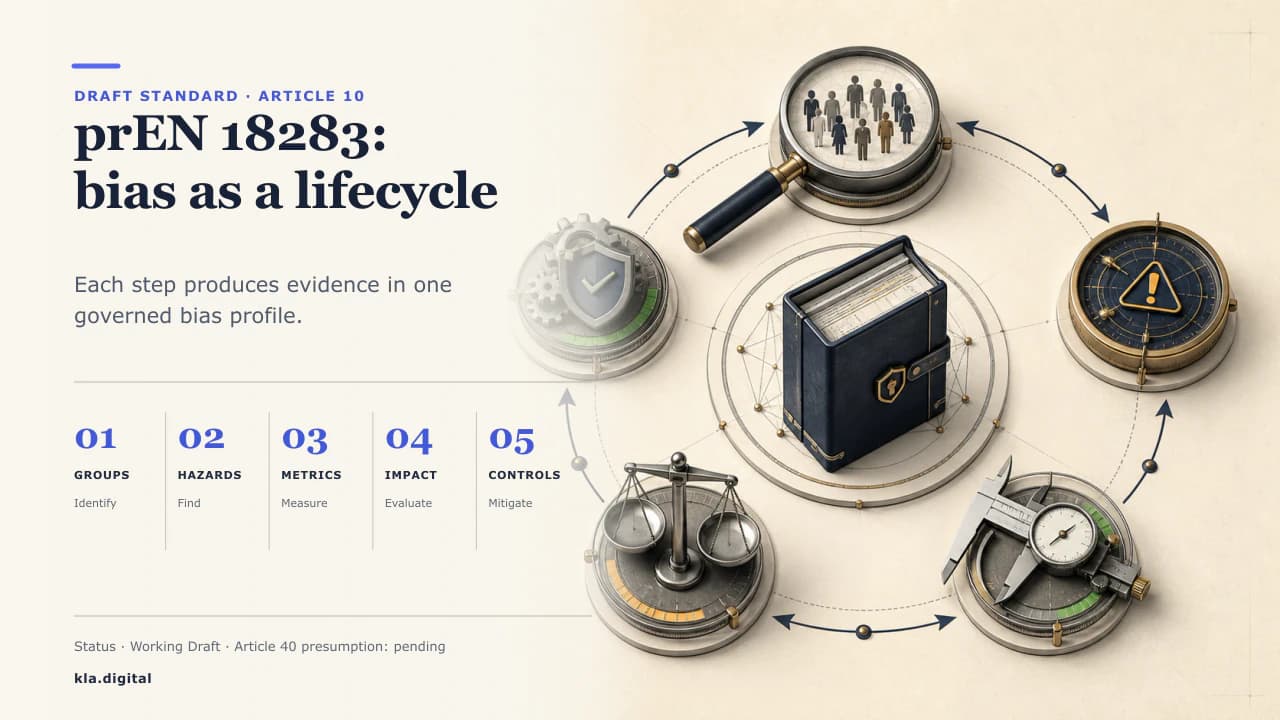
prEN 18283 is the draft European standard for managing bias in AI systems, and it is the bias-governance counterpart to the quality-management work covered in EN 18286. Both are written by the same CEN-CENELEC committee to support the EU AI Act, and both turn high-level legal obligations into structured, auditable process. DIN reports that EN 18286 passed Formal Vote. BSI reports national publication as BS EN 18286:2026 on 24 July, while the Commission page last updated on 27 July still describes final CEN/CENELEC publication as pending. prEN 18283 remains in development. prEN 18283 takes on one of the hardest parts of the Regulation: the Article 10 duty to examine datasets for bias, mitigate the bias you find, and keep data relevant and representative for the people a high-risk system affects. This post explains what prEN 18283 is, who is writing it, its current Working Draft status, which AI Act articles it operationalizes, how its clauses are organized, and how it relates to the wider prEN 18xxx family. Most high-risk obligations apply from 2 December 2027, moved from 2 August 2026 by the Digital Omnibus on AI adopted on 29 June 2026. That date covers stand-alone Annex III high-risk obligations, including the Article 27 fundamental-rights impact assessment. Teams have reason to read the draft now even though it is not yet a finished standard.
What prEN 18283 Is and Who Writes It
The full title of the draft is Artificial Intelligence: Concepts, measures and requirements for managing bias in AI systems, registered as Work Item JT021036. It is drafted inside CEN-CENELEC JTC 21, the Joint Technical Committee responsible for European AI standards, by Working Group 3 (Engineering aspects), with the committee secretariat held by Danish Standards (DS). JTC 21 is the same committee that developed EN 18286 for quality management and is developing the wider AI Act standards portfolio. Its work can be followed through JTC 21 and CEN-CENELEC.
prEN 18283 is being produced under the AI Act standardisation request M/593, as amended by M/613. Through that request the European Commission asked CEN and CENELEC to develop AI Act standards across ten areas, including governance and quality of datasets, risk management, accuracy, robustness, quality management, and conformity assessment. The Commission standardisation page lists those areas, and CEN-CENELEC has set out acceleration measures intended to deliver the key AI Act standards by the end of 2026.
Which EU AI Act Articles prEN 18283 Operationalizes
The legal heart of prEN 18283 is Article 10 of the AI Act, which governs data and data governance for high-risk systems. The AI Act Service Desk summary of Article 10 sets out the relevant duties. Under Article 10(1), the data-governance requirements in paragraphs 2 to 5 apply to the training, validation, and testing datasets of high-risk systems developed with techniques that involve training AI models. Under Article 10(6), for high-risk systems not developed with model training, paragraphs 2 to 5 apply only to the testing datasets. Within that scope, Article 10(2)(f) requires examination of datasets for possible biases that are likely to affect health and safety, have a negative impact on fundamental rights, or lead to discrimination prohibited under Union law. Article 10(2)(g) requires appropriate measures to detect, prevent, and mitigate the biases that examination identifies. Article 10(3) requires datasets to be relevant, sufficiently representative, and to the best extent possible free of errors and complete in view of the intended purpose, with appropriate statistical properties: including, where applicable, as regards the persons or groups of persons in relation to whom the high-risk system is intended to be used.
prEN 18283 reaches beyond Article 10. The draft also connects bias work to Article 9 risk management, to Article 11 and Annex IV(3) technical documentation, to Article 13(3)(b) accuracy information, and to Article 15 accuracy and robustness. The effect is that each bias finding flows into the risk file under Article 9, the technical documentation under Article 11 and Annex IV, and the accuracy claims a provider has to stand behind under Articles 13 and 15.
The applied operating model that turns these articles into day-to-day governance is covered in the companion piece on Article 10 and bias scenarios. This explainer describes what the standard is. The companion piece describes how to operate it across a product lifecycle, using bias profiles, relevant-group analysis, and the bias scenario as the unit of management.
| AI Act provision | What it requires | How prEN 18283 supports it |
|---|---|---|
| Article 10(1) and 10(6) | Data governance applies to training, validation, and testing datasets where models are trained; to testing datasets only where they are not. | Scopes the bias-management process to the datasets the Regulation actually covers for a given system. |
| Article 10(2)(f) | Examination of datasets for possible biases likely to affect health and safety, harm fundamental rights, or lead to prohibited discrimination. | A structured way to identify relevant groups and bias-related hazards before any metric is chosen. |
| Article 10(2)(g) | Appropriate measures to detect, prevent, and mitigate identified biases. | Defined process steps for bias estimation, evaluation, and mitigation. |
| Article 10(3) | Datasets that are relevant, sufficiently representative, and to the best extent possible free of errors and complete for the intended purpose, with appropriate statistical properties for the affected persons or groups where applicable. | Connects the statistical properties of data to the groups a high-risk system is intended to serve. |
| Articles 9, 11, 13, 15 | Risk management, technical documentation (Annex IV(3)), accuracy information, and robustness. | Feeds bias findings into the risk file, the technical documentation, and accuracy claims. |
Status: a Working Draft, Earlier in the Process Than EN 18286
prEN 18283 is currently a Working Draft (WD). It was circulated for a five-week consultation with a comment deadline of 30 April 2026, which gathered input from national mirror committees before the text moves toward the formal Enquiry stage. That places it earlier in the standards process than EN 18286, which entered CEN Enquiry on 30 October 2025 and passed Formal Vote. BSI reports national publication as BS EN 18286:2026 on 24 July, while the Commission’s 27 July page still describes final CEN/CENELEC publication as pending.
CEN-CENELEC adopted acceleration measures in October 2025, including direct publication after a positive Enquiry vote, with the aim of delivering the key AI Act standards by the end of 2026. Whether prEN 18283 keeps pace with that target depends on how quickly its open clauses are completed. Statuses and dates move quickly, so confirm the current stage against the JTC 21 standards tracker and the standards timeline before relying on any single date.
| Draft standard | Subject | Indicative stage (mid-2026) |
|---|---|---|
| EN 18286 | AI quality management system (Article 17) | Formal Vote passed; BSI national publication reported 24 July; CEN/CENELEC publication status to verify; no OJEU reference located as of 28 July |
| prEN 18283 | Managing bias in AI systems (Article 10) | Working Draft; consultation closed 30 April 2026 |
| prEN 18284 | Quality and governance of datasets | In development; stage evolving |
| prEN 18228 | AI risk management integration (Article 9) | In development; stage evolving |
| prEN 18285 | Conformity assessment framework | In development; stage evolving |
Draft, Harmonised, and Presumption of Conformity
A Working Draft carries no legal presumption of conformity. The AI Act is Regulation (EU) 2024/1689, and its Article 40 mechanism gives a presumption of conformity only to harmonised standards cited in the Official Journal of the European Union, and only for the requirements those standards cover. prEN 18283 is not on that route: CEN's own project record for the work item currently indicates that no Official Journal citation is expected for it in connection with the AI Act. Its value is operational, giving providers a structured way to organise Article 10 bias work and the evidence behind it, separate from any presumption mechanism.
The practical posture is to treat the draft as an implementation blueprint for Article 10 while keeping conformity claims grounded in the legal text. A control mapping that ties each Article 10 duty to a named control and a piece of evidence holds up even if a clause is renumbered or the standard's status changes, because each control maps back to the Regulation.
How the Working Draft Is Structured
The March 2026 Working Draft reviewed for this article is organized as a lifecycle for bias management. After the usual front matter, scope, normative references, and a terms-and-definitions clause that imports AI Act terms, risk terms, and the language of groups and their identification, it moves through a sequence of process clauses. The structure below paraphrases the clause headings; the normative text itself is copyright-protected and is not reproduced here.
The center of gravity is the bias profile introduced in Clause 6. The same artifact anchors the applied operating model described in the bias scenarios guide: a versioned record that ties at-risk groups, hazards, metrics, thresholds, and mitigations to a specific AI system and release.
| Clause | Focus | What it addresses |
|---|---|---|
| Scope, references, terms | Foundations | AI Act-aligned terms, risk terms, and the language of groups and their identification. |
| Clause 6: Bias profile | Core artifact | A governed record tying groups, hazards, metrics, and mitigations to an AI system. |
| Clause 7: Bias management | Process | Identifying relevant groups, identifying bias-related hazards, and determining metrics. |
| Clause 8: Bias estimation | Measurement | Data analysis, model and component analysis, and technical and socio-technical analysis. |
| Clause 9: Bias evaluation | Judgement | Comparing estimated bias against explicit acceptability criteria. |
| Clause 10: Metrics | Toolbox | A catalogue of bias metrics, still being completed for several task types. |
| Clause 11: Bias mitigation | Intervention | Measures to reduce confirmed bias, with concrete measures still being drafted. |
| Clause 12: Consultation | Stakeholders | Consultation of interested parties during the bias-management process. |
| Annex A and bibliography | Back matter | An informative annex and the bibliography that close the document. |
How prEN 18283 Relates to EN 18286 and prEN 18284
prEN 18283 is one corner of a triangle. EN 18286 defines the quality management system that holds all of this work together for Article 17. prEN 18284 governs the quality and governance of the datasets that feed an AI system. prEN 18283 sits between them and defines how bias in those datasets and models is identified, measured, and reduced. A provider that adopts the JTC 21 standards will usually map all three together: the management system to run the process, the dataset standard to control the inputs, and the bias standard to govern the fairness of the outputs. The standards are voluntary; the binding duties sit in the AI Act itself.
Treating any one of these as a complete solution leaves gaps. The standards ecosystem guide maps how the prEN 18xxx family and the adopted ISO/IEC standards (such as ISO/IEC 42001 for AI management systems) fit together, and how to sequence adoption when you cannot implement everything at once.
| Standard | What it governs | Primary AI Act anchor |
|---|---|---|
| EN 18286 | How the management system runs | Article 17 (QMS) |
| prEN 18283 | How bias is identified, measured, and mitigated | Article 10 (data and bias) |
| prEN 18284 | How datasets are governed and documented | Article 10 (data governance) |
Known Gaps in the Current Draft
In the March 2026 Working Draft reviewed for this article, two clauses are visibly unfinished. Clause 10, the metrics catalogue, still lacks bias metrics for regression, natural-language processing, and computer-vision tasks, and the metrics that are present lean toward classification. Clause 11, bias mitigation, still lacks the concrete measures that would tell a team what to do once a bias is confirmed.
These gaps matter for planning. A team that hard-codes its fairness program around the current metric set will have to revise it as the catalogue fills in. The durable part of the draft is its process structure, which holds steady while the metric and mitigation clauses are completed. The applied lifecycle that sits on top of that structure is the subject of the companion bias scenarios guide.
How to Use prEN 18283 Before It Is Final
You can use the draft now to structure Article 10 work without waiting for a finished standard. Start from a legally grounded scope: confirm which of your systems are high-risk using the high-risk classification guide and the broader EU AI Act requirements, then map each in-scope system to the bias-management lifecycle the draft describes. The applied operating model for that lifecycle, including bias profiles, relevant-group analysis, and managing each disparity as a bias scenario, is the subject of the companion bias scenarios guide; this section stays at the level of how to position the draft itself.
- Confirm scope first: identify which systems fall under Annex III high-risk before applying any bias-management work.
- Tie each Article 10 duty to a named control and an evidence artifact so the record survives a change of standard status.
- Keep conformity claims anchored to Article 10 of the Regulation, because a Working Draft confers no presumption under Article 40.
- Track stage changes through the standards portfolio and the JTC 21 tracker; CEN does not currently expect prEN 18283 to be cited in the Official Journal, so plan to use it as operational guidance rather than as a presumption route.
Frequently Asked Questions
What is prEN 18283?
prEN 18283 is a draft European standard titled Artificial Intelligence: Concepts, measures and requirements for managing bias in AI systems. It is being written by CEN-CENELEC JTC 21 to help providers meet the data and bias duties in Article 10 of the EU AI Act. It defines a lifecycle for identifying, measuring, evaluating, and mitigating bias in high-risk AI systems.
Is prEN 18283 mandatory?
prEN 18283 is optional guidance. The binding requirements sit in Article 10 of the AI Act, which obliges providers of in-scope high-risk systems to examine their datasets for bias, mitigate the biases they find, and keep data relevant and representative, for training, validation, and testing data where models are trained, and for testing data where they are not. prEN 18283 offers a structured method for that work and adds no legal obligation of its own.
What is the difference between prEN 18283 and EN 18286?
EN 18286 defines the quality management system under Article 17, the management machinery that runs across the whole lifecycle. prEN 18283 defines the bias-management method under Article 10. A high-risk provider adopting these standards typically uses both: the QMS standard to operate the process, and the bias standard to govern fairness within it.
Which EU AI Act article does prEN 18283 support?
Primarily Article 10, specifically the dataset bias-examination duty in 10(2)(f), the mitigation duty in 10(2)(g), and the representativeness and statistical-property requirements in 10(3). The scope of those duties is set by 10(1) and 10(6): training, validation, and testing data where models are trained, and testing data where they are not. It also links to Article 9 (risk management), Article 11 and Annex IV (technical documentation), and Articles 13 and 15 (accuracy and robustness).
When will prEN 18283 be published?
No firm publication date is fixed. As of 28 July 2026 it is a Working Draft whose five-week consultation closed on 30 April 2026. EN 18286 has passed Formal Vote; BSI reports its national publication, while final CEN/CENELEC publication status should be verified. CEN-CENELEC aims to deliver the key AI Act standards by the end of 2026, and bias-specific clauses are still being completed, so confirm the current stage through JTC 21 before relying on a date.
Does prEN 18283 give presumption of conformity?
No. Under Article 40, a presumption of conformity attaches only to harmonised standards cited in the Official Journal, and only for the requirements those standards cover. A Working Draft has not reached that stage, and CEN's project record currently indicates that no Official Journal citation is expected for prEN 18283 in connection with the AI Act. Treat it as operational guidance that helps you build Article 10 evidence, separate from any presumption mechanism.
Who is writing prEN 18283?
It is being drafted by Working Group 3 (Engineering aspects) of CEN-CENELEC JTC 21, with the committee secretariat held by Danish Standards (DS), under the AI Act standardisation request M/593 as amended by M/613.
Key Takeaways
prEN 18283 is the bias-management half of the AI Act standards effort, paired with EN 18286 on quality management and prEN 18284 on datasets. It is still a Working Draft with open clauses, and CEN does not currently expect it to be cited in the Official Journal, so it confers no presumption of conformity. Its lasting value is the operating model it sets out for Article 10: profile bias as a governed artifact, identify relevant groups, estimate and evaluate disparities against explicit thresholds, and mitigate with an auditable record. Teams that build that process now will hold defensible Article 10 evidence and a method that adapts as the draft matures, whether or not a harmonised version is ever cited for it.
This article is general information and is not legal advice. Confirm your obligations and the current status of prEN 18283 and the EU AI Act with qualified counsel before acting.