

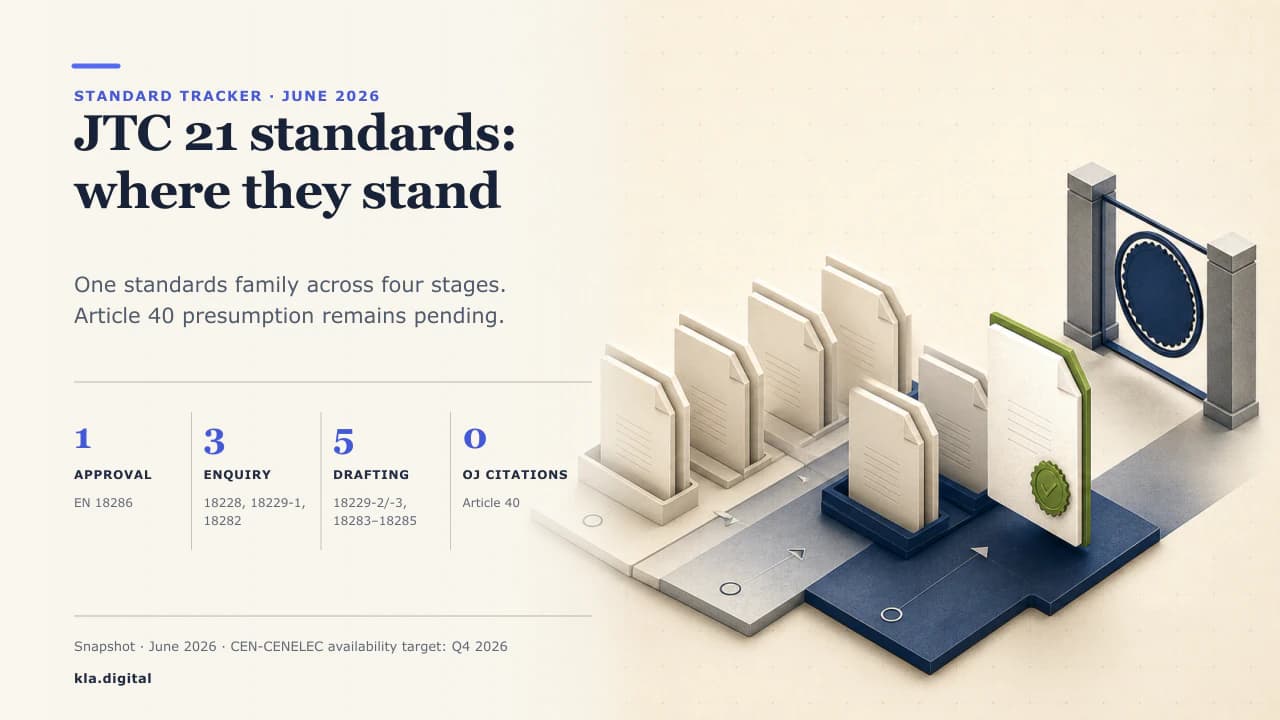
CEN-CENELEC JTC 21 is the joint technical committee writing the European standards that operationalize the EU AI Act for high-risk AI systems. This page is a living tracker of that committee and its work programme, with a status snapshot taken in June 2026. Stages and target dates move as drafts pass through Enquiry and Approval, so treat the tables below as a point-in-time view and verify the live work programme before relying on a stage or date. It sits alongside the cluster explainer what prEN 18286 is (the QMS standard for Article 17), the companion explainer what prEN 18283 is (managing bias), the standards ecosystem prioritization guide, and the AI Act standards timeline. The focus here is the committee itself: who writes the standards, what the deliverables are, what stage each has reached, and how a finished standard becomes legally load-bearing under Article 40.
What CEN-CENELEC JTC 21 Is
CEN-CENELEC Joint Technical Committee 21 'Artificial Intelligence' (CEN/CLC/JTC 21) was established on 1 June 2021 by CEN and CENELEC, following the CEN-CENELEC Focus Group road map on AI. Its secretariat is held by DS (Danish Standards / Dansk Standard), and it unites more than 300 experts from 20 European countries. Committee identity and membership are documented on the JTC 21 site and through CEN-CENELEC.
JTC 21 produces the European and harmonised standards that sit behind the EU AI Act conformity regime. Once a standard is finalized and its reference is published in the Official Journal, conformity with it carries a legal presumption of conformity with the corresponding AI Act requirements, the mechanism set out in Article 40.
The committee is organized into five working groups:
- WG1: Strategic Advisory Group (SAG): programme coordination and strategic direction
- WG2: Operational aspects: management-system deliverables, including risk management (prEN 18228), quality management (EN 18286), and conformity assessment (prEN 18285)
- WG3: Engineering aspects: engineering methods, including bias management (prEN 18283) and dataset quality and governance (prEN 18284)
- WG4: Foundational and societal aspects: the AI trustworthiness framework (the prEN 18229 parts covering logging, transparency, human oversight, accuracy, and robustness) and cross-cutting societal considerations
- WG5: Cybersecurity for AI systems: cybersecurity specifications for AI systems (prEN 18282)
The Standardisation Request: M/593 and Amendment M/613
The AI Act work programme is defined by a formal standardisation request from the European Commission. The original request is M/593, issued as Commission Implementing Decision C(2023)3215 and adopted on 22 May 2023. M/593 asked CEN and CENELEC to deliver the harmonised standards supporting the AI Act, with an original delivery deadline of 30 April 2025. JTC 21 did not meet that deadline.
M/613 is Amendment 1 to that request, issued as Commission Implementing Decision C(2025)3871 and adopted on 23 June 2025. C(2025)3871 repealed and replaced the original C(2023)3215, continuing the same scope and deliverables under an extended timeline; the amended request expires on 28 February 2027, with progress reports due every three months. CEN-CENELEC continues to describe the deliverables as those 'requested under Standardization Request M/593 (and its Amendment M/613)'.
The Commission's AI Act standardisation page frames the request around ten areas: risk management, governance and quality of datasets, record-keeping, transparency, human oversight, accuracy, robustness, cybersecurity, quality management, and conformity assessment. Each prEN deliverable in the work programme maps onto one or more of these areas.
In October 2025, CEN and CENELEC adopted an exceptional package of measures so the prioritized deliverables are made available by Q4 2026 at the latest. This Q4 2026 figure is the CEN-CENELEC programme-level availability target and is distinct from the Commission request expiry of 28 February 2027. The CEN-CENELEC acceleration notice sets out two mechanisms. First, after a positive Enquiry result a draft can move directly toward publication under the CEN-CENELEC Internal Regulations, shortening the path. Second, a small drafting group of already-active experts was tasked with finalizing the most delayed drafts. Individual Enquiry and Approval windows still move.
The Work Programme: Status Snapshot
The table below is the work-programme tracker: the prEN 18xxx family, the AI Act articles each operationalizes, the responsible working group, the stage reached, and the target. Stages are as of June 2026: verify the live CEN-CENELEC work programme before relying on a stage or date. As of that snapshot, one deliverable (EN 18286) is at Approval, three (prEN 18228, prEN 18229-1, prEN 18282) are at Enquiry, and the remaining drafts are still in drafting; none is yet published or cited in the Official Journal.
| Deliverable | Title | AI Act articles | Working group | Stage (June 2026) | Target |
|---|---|---|---|---|---|
| EN 18286 | Quality management system for EU AI Act regulatory purposes | Article 17 | WG2 Operational aspects | Approval (Formal Vote); Enquiry ran 30 Oct 2025 to January 2026 | CEN-CENELEC Q4 2026 availability |
| prEN 18228 | AI risk management | Article 9 | WG2 Operational aspects | Enquiry | Q4 2026 availability target |
| prEN 18229-1 | AI trustworthiness framework: Part 1: Logging | Article 12 | WG4 Foundational and societal aspects | Enquiry | Q4 2026 availability target |
| prEN 18282 | Cybersecurity specifications for AI systems | Article 15 | WG5 Cybersecurity for AI | Enquiry | Q4 2026 availability target |
| prEN 18229-3 | AI trustworthiness framework: Part 3: Transparency and human oversight | Articles 13, 14 | WG4 Foundational and societal aspects | Drafting | Date evolving |
| prEN 18229-2 | AI trustworthiness framework: Part 2: Accuracy and robustness | Article 15 | WG4 Foundational and societal aspects | Drafting | Date evolving |
| prEN 18284 | Quality and governance of datasets in AI | Article 10 | WG3 Engineering aspects | Drafting | Date evolving |
| prEN 18283 | Concepts, measures and requirements for managing bias in AI systems | Article 10 (10(2)(f),(g),(3)) | WG3 Engineering aspects | Drafting; five-week WD consultation closed 30 April 2026 | Earliest-stage; after Q4 2026 |
| prEN 18285 | Conformity assessment framework | Article 43 / Annex VII | WG2 Operational aspects | Drafting | Date evolving |
How to Read a Stage, and Which Article Each Draft Operationalizes
One deliverable is near completion. EN 18286 (QMS) reached the Approval (Formal Vote) stage first; prEN 18228, prEN 18229-1, and prEN 18282 are at Enquiry, and the rest are still drafting. The CEN-CENELEC Q4 2026 date is an availability target for the prioritized deliverables, and it is not a guaranteed per-item publication date. Zero of these standards are published or cited in the Official Journal as of June 2026, so none yet grants Article 40 presumption of conformity.
Working-group attribution follows the JTC 21 working-group listing. Bias work (prEN 18283) and dataset governance (prEN 18284) sit in WG3 Engineering aspects; the AI trustworthiness framework parts (prEN 18229-1, prEN 18229-2, prEN 18229-3) sit in WG4 Foundational and societal aspects; cybersecurity (prEN 18282) sits in WG5; and the management-system and conformity-assessment standards (prEN 18228, EN 18286, prEN 18285) sit in WG2. For prEN 18283 specifically, the circulated working draft went out for a five-week consultation whose comment deadline was 30 April 2026, an earlier maturity stage than EN 18286.
CEN-CENELEC drafts move through a numbered stage ladder. The higher the stage, the closer the text is to publication. National mirror committees shape the drafts throughout, and debate inside them can be substantive, as the France prEN 18286 debate illustrates.
| Stage code | Phase | What it means | Example deliverable |
|---|---|---|---|
| 10–20 | Drafting / Working Draft (WD) | Experts draft text inside the working group | prEN 18283 (bias; WD consultation closed 30 Apr 2026) |
| 20.60–30 | Committee Draft (CD), comment period | Internal WG and national consensus building | prEN 18229-3, prEN 18284 (drafting) |
| 40 | Public Enquiry (prEN) | Open consultation; national bodies and public comment | prEN 18228, prEN 18229-1, prEN 18282 (Enquiry) |
| 49–50 | Approval / Formal Vote (FprEN) | National bodies vote on or ratify the finalized text | EN 18286 (QMS; Under Approval) |
| 60 | Publication (EN) → OJ citation | Published; Article 40 presumption only after Official Journal citation | none yet |
Article-to-Deliverable Map
Mapping the deliverables back to the regulation shows which AI Act requirement each draft is meant to operationalize. This is the inverse of the status table and is the quickest way to find the standard attached to an obligation you already have to meet.
| AI Act requirement | Primary JTC 21 deliverable |
|---|---|
| Article 9: Risk management | prEN 18228 |
| Article 10: Data and data governance / bias | prEN 18284 (datasets) + prEN 18283 (bias) |
| Article 12: Record-keeping (logging) | prEN 18229-1 |
| Articles 13, 14: Transparency, human oversight | prEN 18229-3 |
| Article 15: Accuracy, robustness | prEN 18229-2 |
| Article 15: Cybersecurity | prEN 18282 |
| Article 17: Quality management system | EN 18286 |
| Article 43 / Annex VII: Conformity assessment | prEN 18285 |
How JTC 21 Uses ISO/IEC Standards
European standardisation preferentially relies on existing international standards from ISO/IEC where they fit the regulatory objective. JTC 21 uses ISO/IEC foundational work as input across the prEN family. The Commission explains this logic in its understanding standardisation FAQ.
Where an international framework does not align with an AI Act requirement, JTC 21 writes a bespoke European standard. The clearest case is quality management. The Commission found that the goals and definitions of ISO/IEC 42001:2023 are not aligned with the quality management system required under the AI Act, so prEN 18286 was developed as a dedicated European standard. For a deeper comparison of the QMS frameworks, see prEN 18286 vs ISO 9001 and ISO 42001.
| ISO/IEC standard | Subject | Role in JTC 21 work |
|---|---|---|
| ISO/IEC 22989:2022 | AI concepts and terminology | Foundational vocabulary referenced across the prEN family |
| ISO/IEC 23894:2023 | Guidance on AI risk management | Input to prEN 18228 (Article 9 risk management) |
| ISO/IEC 23053:2022 | Framework for AI systems using ML | Reference framework for engineering deliverables |
| ISO/IEC 42001:2023 | AI management system | Input to QMS work; not adopted directly because the Commission found its goals and definitions not aligned with the AI Act QMS, so prEN 18286 was written bespoke |
- Does an EN ISO/IEC adoption give Article 40 presumption today?
- Not yet. JTC 21 may adopt some international standards as EN ISO/IEC texts, and teams already running an ISO/IEC 42001 management system have transferable structure they can reuse. No EN ISO/IEC text has yet been cited in the Official Journal as a harmonised standard granting Article 40 presumption. A statement-of-applicability layer can be built with the ISO 42001 SoA tool while the bespoke European deliverables remain in progress.
Article 40: From Draft to Presumption of Conformity
Article 40 of the EU AI Act is the legal payoff of the standardisation programme. A high-risk AI system that conforms to harmonised standards whose references have been published in the Official Journal of the European Union is presumed to conform with the requirements set out in Chapter III, Section 2 (the Article 8 to 15 requirements), and a general-purpose AI model with the corresponding Chapter V obligations, to the extent those standards cover the requirements. The AI Act Service Desk summary of Article 40 sets out the mechanism.
Article 17 (quality management system) sits in Chapter III, Section 3, outside the Section 2 requirements that Article 40(1) names. prEN 18286 operationalizes that Article 17 duty and is the deliverable nearest to citation, and quality management is within the standardisation request, so confirm the precise legal effect of any QMS citation against the published reference rather than assuming an automatic Article 40 presumption for Article 17. The interaction is set out in Article 17 mapping to prEN 18286.
Two conditions gate the presumption. The standard must be finalized and harmonised, and its reference must be cited in the Official Journal. Until both hold, a draft standard (prEN or working draft) gives no presumption of conformity; aligning to a draft builds readiness and audit evidence. The Commission FAQ states that the first harmonised standards are expected to be published by CEN and CENELEC in 2026, after which the Commission begins its review of whether the references can be cited in the Official Journal. OJEU citation follows that review.
For every entry in the status table, this means the same thing today. As of June 2026 none of the JTC 21 deliverables grants presumption, because none has been cited in the Official Journal. EN 18286, at Approval, is the most advanced and the most likely to be cited first.
How to Use This Tracker Now
The standards remain in draft while the high-risk obligations move toward application. Articles 9 to 15 and Article 17 apply from 2 December 2027 under Article 113, with the Article 6(1) classification rule for Annex I product-embedded systems applying from 2 August 2028. The Digital Omnibus on AI, adopted on 29 June 2026, moved stand-alone Annex III high-risk obligations (including the Article 27 FRIA) from 2 August 2026 to 2 December 2027. The defensible posture is to build the legally required controls now on the 2 December 2027 basis and absorb the harmonised standards quickly once cited.
- Maintain a standards-delta map: track each prEN against your existing controls so you can adopt the harmonised text quickly when it is cited.
- Build the legally required controls now (Articles 9-15 covering risk, data, transparency, oversight, accuracy, and robustness; the Article 17 QMS) with auditable evidence, using the EU AI Act requirements guide and high-risk classification guide to scope correctly.
- Watch the Enquiry and Approval moves, since those stages signal which standard is about to become citable; EN 18286 at Approval is the near-term one to track (see Article 17 mapping to prEN 18286).
- Treat your standards inventory as a controlled artifact with a named owner and a review cadence, kept next to your control library on the standards landing page.
Frequently Asked Questions
What is CEN-CENELEC JTC 21?
It is the CEN-CENELEC Joint Technical Committee 21 'Artificial Intelligence', established on 1 June 2021, with its secretariat held by DS (Danish Standards). It brings together more than 300 experts from 20 European countries across five working groups and writes the European and harmonised standards that support the EU AI Act.
What is standardisation request M/593, and what is M/613?
M/593 is the European Commission's original AI Act standardisation request to CEN and CENELEC (Commission Implementing Decision C(2023)3215, adopted 22 May 2023, originally due 30 April 2025). M/613 is Amendment 1, issued as Commission Implementing Decision C(2025)3871 and adopted 23 June 2025; it repealed and replaced C(2023)3215 while continuing the same scope under an extended timeline, with the request expiring 28 February 2027. CEN-CENELEC refers to the deliverables as those requested under M/593 and its Amendment M/613.
When will the AI Act harmonised standards be ready?
After missing the original April 2025 deadline, CEN and CENELEC agreed in October 2025 to accelerate work so the prioritized deliverables are available by Q4 2026 at the latest, while the amended Commission request runs to 28 February 2027. The Commission expects the first harmonised standards to be published in 2026, after which it reviews whether their references can be cited in the Official Journal. As of June 2026 none has been published or cited; EN 18286, the QMS standard, is the furthest along, at Approval (Formal Vote).
Which prEN standard is closest to publication?
EN 18286, the quality-management-system standard for Article 17, was the first AI Act harmonised standard to reach public Enquiry (which ran from 30 October 2025 to January 2026) and has since advanced to the Approval (Formal Vote) stage. The bias standard prEN 18283 is much earlier, at the drafting stage, with its five-week working-draft consultation having closed 30 April 2026.
Does JTC 21 just adopt ISO/IEC standards like ISO/IEC 42001?
Not automatically. European standardisation prefers to leverage international ISO/IEC standards where they fit, but the Commission requires AI Act-specific content. For the QMS, it found ISO/IEC 42001's goals and definitions were not aligned with the AI Act's quality-management requirement, so JTC 21 wrote a bespoke European standard (prEN 18286) rather than adopting 42001 directly.
Does following a prEN draft give presumption of conformity?
A prEN draft does not give presumption of conformity. Under Article 40, presumption attaches only to harmonised standards whose references have been published in the Official Journal of the European Union, and only for the requirements those standards cover (the Chapter III, Section 2 requirements, and Chapter V for general-purpose AI models). Aligning to a draft builds readiness and evidence.
How does a harmonised standard deliver presumption of conformity?
Once CEN-CENELEC finalizes a standard and the Commission cites its reference in the Official Journal, a high-risk AI system that conforms to that standard is presumed to meet the corresponding Chapter III, Section 2 requirements it covers, which shifts the burden to authorities to show non-conformity.
Key Takeaways
JTC 21 is the committee turning the EU AI Act into operable European standards, and this tracker is the snapshot of where that work stands in June 2026: EN 18286 at Approval (Formal Vote); prEN 18228, prEN 18229-1, and prEN 18282 at Enquiry; the remaining prEN 18xxx drafts still in drafting; a CEN-CENELEC Q4 2026 availability target alongside the amended request running to 28 February 2027; and zero standards yet cited in the Official Journal. Verify the live CEN-CENELEC work programme and the Commission sources before acting on any single date. This article provides general information and does not constitute legal advice. Standards stages and dates change frequently, so confirm the current status with CEN-CENELEC and qualified counsel before relying on it.