

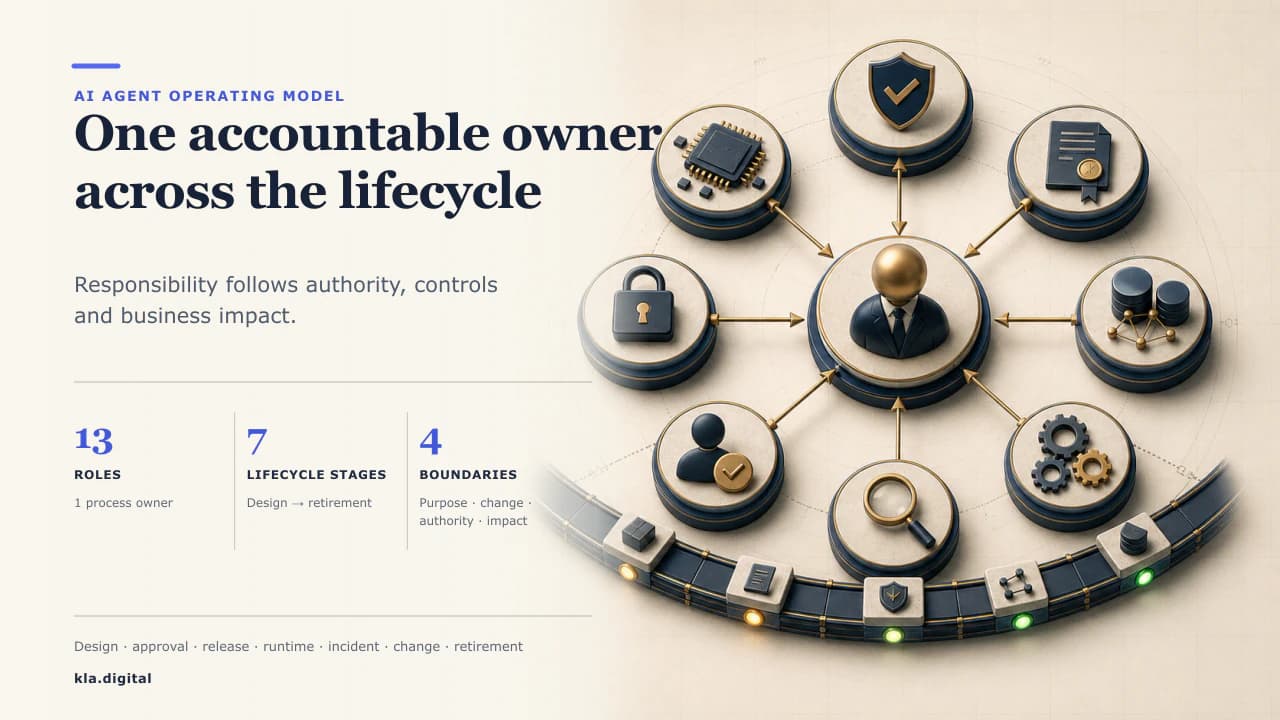
Die verantwortliche Partei für einen KI-Agenten ist die Person, die befugt ist, seinen Geschäftszweck zu genehmigen, seine Betriebsgrenzen festzulegen, seine Ergebnisse zu akzeptieren und seine Verwendung zu stoppen. In den meisten Unternehmen ist dies der verantwortliche Eigentümer des Geschäftsprozesses. Technische, Modell-, Daten-, Sicherheits-, Tool-, Richtlinien-, Genehmigungs-, Betriebs-, Compliance-, Audit- und Anbieterrollen haben definierte Verantwortlichkeiten rund um diesen Eigentümer. Die Verantwortung folgt der Autoritäts- und Kontrollgrenze bei jeder Aktion, jedem Release, jedem Vorfall, jeder Änderung und jeder externen Abhängigkeit.
Wer ist für einen KI-Agenten in der Produktion verantwortlich?
Weisen Sie einen verantwortlichen Geschäftsprozessverantwortlichen für die Produktionsnutzung und deren Ergebnisse zu. Der Executive Sponsor besitzt die Risikobereitschaft, die Finanzierung und die Eskalationsbefugnis des Unternehmens. Der Agent-Produkt- oder technische Eigentümer besitzt die technische Integrität und kontrollierte Releases. Jede andere Rolle besitzt eine bestimmte Entscheidung, Kontrolle, ein bestimmtes Artefakt oder eine unabhängige Schlussfolgerung. Ein Lieferantenvertrag ändert die Arbeitsverteilung, während der Unternehmenseigentümer die Verantwortung für den Prozess behält, der unter der Autorität des Unternehmens betrieben wird.
Verfolgen Sie die Verantwortlichkeit anhand von vier Grenzen: Wer autorisiert den Zweck, wer kann das System ändern, wer kann eine Aktion zulassen oder stoppen und wer akzeptiert die daraus resultierenden geschäftlichen Auswirkungen. Erfassen Sie jede Grenze mit einer benannten Person, delegierter Autorität, Entscheidungskriterien, Beweisquelle, Eskalationspfad und Wirksamkeitsdaten. Gemeinsame Ausschüsse können innerhalb einer Satzung beraten und genehmigen; Für jede Entscheidung ist weiterhin eine benannte verantwortliche Rolle erforderlich.
Verwenden Sie das Unternehmens-Framework für KI-Agenten-Audits, um diese Matrix als Teil des umfassenderen Produktionssystems zu testen. Die Bewertung der Audit-Bereitschaft von KI-Agenten prüft, ob Eigentum, Autorität, Kontrollen und Beweise für eine unabhängige Überprüfung bereit sind.
- Zweck und Ergebnisse: Der Eigentümer des Geschäftsprozesses genehmigt die beabsichtigte Verwendung, die betroffenen Personen, die Ergebnismaße, die Risikoakzeptanz und die Außerbetriebnahme.
- Erstellen und ändern: Technische, Modell-, Daten-, Identitäts-, Tool- und Richtlinieneigentümer genehmigen die Komponenten und Grenzen innerhalb ihrer Mandate.
- Handlungsbefugnis: Richtlinieneigentümer definieren Weiterleitungsregeln, benannte menschliche Genehmiger entscheiden über Folgefälle und Vorgänge können die Ausführung beinhalten.
- Sicherheit: Zweitlinienfunktionen stellen im Rahmen ihrer Mandate Herausforderungen dar, während die interne Revision ihren Umfang auswählt und eine unabhängige Schlussfolgerung liefert.
Standardmäßige KI-Agent-Verantwortungsmatrix über den gesamten Lebenszyklus
Verwenden Sie diese Standardmatrix, wenn ein Unternehmen einen Agenten innerhalb eines Geschäftsprozesses betreibt. Verantwortlich bedeutet die endgültige Entscheidungsbefugnis für die aufgeführte Aktivität. Verantwortlich bedeutet, den Betrieb und die Lieferung zu kontrollieren. Konsultierte Rollen bieten Fachwissen oder eine formelle Herausforderung. Informierte Rollen erhalten die Entscheidung und ihre Bedingungen. Jede Zeile hat eine verantwortliche Rolle für ihren definierten Entscheidungsbereich.
Die Matrix ist eine Startkontrolle. Die folgenden Betriebsmodellvarianten ersetzen spezifische Aufgaben, bei denen Architektur, Beschaffung, Werkzeugbesitz oder obligatorische menschliche Genehmigung die Autoritätsgrenzen ändern.
| Lebenszyklusphase | Verantwortlich | Verantwortlich | Konsultiert/herausgefordert von | Informiert | Nachweis der Verantwortung |
|---|---|---|---|---|---|
| Design | Verantwortlicher Geschäftsprozessinhaber | Agent Produkt/technischer Eigentümer; Modell- oder KI-Assurance-Inhaber; Daten, IAM/Sicherheit, Toolkatalog und Richtlinien-/Kontrollbesitzer | Compliance/Recht/Datenschutz; Eigentümer Dritter/Verkäufer; Operationen | Executive-Sponsor; Interne Revision durch das Audit-Universum | Zweck- und Grenzgenehmigung, Architektur, Auswirkungs- und Risikobewertungen, Rollencharta, Kontrollspezifikation |
| Genehmigung | Verantwortlicher Geschäftsprozessinhaber | Der Produkt-/technische Eigentümer des Agenten und der Eigentümer der Richtlinie/Kontrolle stellen das Entscheidungspaket zusammen | Modell- oder KI-Sicherung; Daten; IAM/Sicherheit; Compliance/Recht/Datenschutz; Operationen | Executive-Sponsor; betroffene Kontrollinhaber; Interne Revision durch Risikoberichterstattung | Entscheidung zur Produktionsnutzung, akzeptierte Bedingungen, Ausnahmen, Identität des Genehmigers, datierte Begründung |
| Freigeben | Agent Produkt/technischer Eigentümer | Verantwortliche für Technik, Modell, Daten, IAM/Sicherheit, Tools und Richtlinien/Kontrollen | Eigentümer des Geschäftsprozesses; Modell- oder KI-Sicherung; Operationen; Compliance/Recht/Datenschutz | Executive-Sponsor; benannte menschliche Genehmiger; Eigentümer Dritter/Verkäufer | Release-Manifest, Testergebnisse, Richtliniensimulation, Berechtigungsüberprüfung, Rollback-Ergebnis, Genehmigung |
| Laufzeit | Verantwortlicher Geschäftsprozessinhaber | Operationen; Richtlinien-/Kontrollinhaber; benannter menschlicher Genehmiger; Technik-, Daten-, Identitäts- und Werkzeugbesitzer | Modell- oder KI-Sicherung; Compliance/Recht/Datenschutz; Eigentümer Dritter/Verkäufer | Executive-Sponsor; Interne Revision durch vereinbarte Berichterstattung | Entscheidungsanfragen, Richtlinienurteile, Werkzeugbelege, Abstammungsaufzeichnungen, Ergebnisabstimmungen, Kontrollüberprüfungen |
| Vorfall | Einsatz- und Einsatzleiter | Technische, IAM-/Sicherheits-, Daten-, Tool-, Richtlinien-/Kontroll-, Anbieter- und Kommunikations-Responder | Eigentümer des Geschäftsprozesses; Compliance/Recht/Datenschutz; Modell- oder KI-Sicherung | Executive-Sponsor; benannte menschliche Genehmiger; Internes Audit gemäß Protokoll | Vorfallbefehlsaufzeichnung, betroffene Fallpopulation, Eindämmung, Benachrichtigungen, Wiederherstellung, Grundursache, erneuter Test |
| Ändern | Verantwortlicher Geschäftsprozessinhaber | Agent-Produkt-/technischer Eigentümer und jeder Eigentümer, dessen Grenzen sich ändern | Modell- oder KI-Sicherung; Operationen; Compliance/Recht/Datenschutz; Eigentümer Dritter/Verkäufer | Executive-Sponsor; benannte menschliche Genehmiger; Interne Revision durch Risikoberichterstattung | Änderungsklassifizierung, Abhängigkeitsunterschied, Neubewertung, Regressionsergebnisse, Bedingungen, Freigabegenehmigung |
| Ruhestand | Verantwortlicher Geschäftsprozessinhaber | Agent Produkt/technischer Eigentümer; Operationen; Daten-, Identitäts-, Tool-, Richtlinien- und Anbietereigentümer | Compliance/Recht/Datenschutz; Platteneigentümer; Modell- oder KI-Sicherung | Executive-Sponsor; Benutzer; Interne Revision durch das Audit-Universum | Rücktrittsentscheidung, Zugriffssperre, Schließung der Abhängigkeit, Datenverfügung, aufbewahrte Beweise, Ergebnisabgleich |
Rollenchartas für alle 13 KI-Agent-Governance-Rollen
Ein Rollenname wird nützlich, wenn er fünf vollständige Aufgaben umfasst: Entscheidungen, durchgeführte Kontrollen, erbrachte Beweise, Eskalationsereignisse und eine Grenze, die die Rolle beibehält. Tragen Sie für jede Zeile eine benannte Person, einen Delegierten, ein Datum des Inkrafttretens und eine Sicherung ein. Freie Stellen und sich überschneidende Zuweisungen sind Kontrollausnahmen, bis der verantwortliche Geschäftsprozessverantwortliche sie löst.
Eine Person kann in einer kleineren Organisation mehrere Rollen innehaben. Aus den Beweisen muss weiterhin hervorgehen, welche Rolle die Person bei der jeweiligen Entscheidung ausgeübt hat und wo Unabhängigkeitsgarantien gelten.
| Rolle | Entscheidungen, die ihnen gehören | Kontrollen, die sie bedienen | Beweise, die sie vorlegen müssen | Ereignisse, die eine Eskalation erfordern | Grenzen, die sie nicht wegdelegieren können |
|---|---|---|---|---|---|
| Geschäftsführender Sponsor | Risikobereitschaft des Unternehmens, Finanzierung, strategische Priorität, Ausnahmeobergrenze für Führungskräfte und Programmstopp | Executive-Governance-Forum, Risikoakzeptanzgrenzen, Ressourcenzuweisung und Vorstandsberichterstattung | Genehmigtes Mandat, Risikobereitschaft, Finanzierungsentscheidungen, Ausnahmeentscheidungen und Aktualisierungen der Leitungsgremien | Verletzung der Risikobereitschaft, materieller Schaden, Versagen der systemischen Kontrolle, ungeklärte Eigentumsverhältnisse oder unzureichende Ressourcen | Verantwortung der Geschäftsleitung für Mandat, Ressourcen und Eskalation innerhalb der Sponsorencharta |
| Verantwortlicher Geschäftsprozessverantwortlicher | Verwendungszweck, Produktionsgenehmigung, Ergebniskriterien, Betriebsbedingungen, Risikoakzeptanz, Sanierungspriorität und Stilllegung | Prozesskontrollen, Ergebnisüberprüfung, Nutzungsbeschränkungen, Ausnahmeregelung und Rezertifizierung des Eigentümers | Zweckerklärung, Prozesslandkarte, Genehmigung, Verantwortungsmatrix, Ergebnisüberprüfung, Risikoakzeptanz und Abschlussnachweise | Unerwartete Auswirkungen auf die betroffene Person, Schwellenwertüberschreitung, Kontrollumgehung, Zweckabweichung, Vorfall oder Leerstand des Eigentümers | Verantwortlichkeit für den Prozess, seine Entscheidungen, die Auswirkungen auf Kunden oder Mitarbeiter und den Einsatz von Lieferanten |
| Agent Produkt-/technischer Eigentümer | Architektur, genehmigte Komponenten, technische Abnahme, Release-Inhalt, Rollout-Bedingungen, Rollback-Empfehlung und technische Korrektur | Versionierung, Build- und Release-Gates, Integrationskontrollen, Konfigurationsmanagement, Beobachtbarkeit und technische Eindämmung | Architektur und Datenflüsse, Release-Manifest, Testergebnisse, Abhängigkeitsinventar, Runbook und Rollback-Datensatz | Nicht genehmigte Komponente, fehlgeschlagener Schwellenwert, instabiles Verhalten, versteckte Abhängigkeit, Beweislücke oder unsicherer Rollout | Technische Integrität, Bestandsgenauigkeit, Reproduzierbarkeit und wahrheitsgetreue Offenlegung von Einschränkungen |
| Modell- oder KI-Assurance-Inhaber | Bewertungsmethode, Datensätze, Schwellenwerte, Validierungsschlussfolgerung, Einschränkungen, Wiederholungstestumfang und Sicherheitsausnahme | Unabhängige Bewertung, Red Teaming, Untergruppen- und Regressionstests, Driftüberprüfung und Ergebnisnachverfolgung | Evaluierungsplan, Datensatz und Versionsdatensatz, Ergebnisse, Einschränkungen, Validierungsschlussfolgerung und Nachweise für erneute Tests | Schwellenwertfehler, Materialdrift, ungültiges Testdesign, neuer Fehlermodus, schwache Abdeckung oder ungelöste Einschränkung | Integrität, Umfang, Methoden, Einschränkungen und Unabhängigkeit der Prüfungsschlussfolgerung |
| Dateneigentümer | Genehmigte Quellen, zulässiger Zweck, Qualitätsschwellenwerte, Feldzugang, Abstammung, Aufbewahrung, Korrektur und Verfügung | Datenqualität, Herkunft, Datengrenzen, Minimierung, Aufbewahrung, Korrektur und Quellenabgleich | Quelleninventar, Datengenehmigung, Qualitätsergebnisse, Herkunft, Zugriffsdatensatz, Aufbewahrungsplan und Korrekturverlauf | Unautorisierte Quelle, Qualitätsverstoß, Herkunftslücke, Offenlegung sensibler Daten, veraltete Daten oder Löschkonflikt | Eignung, zulässige Nutzung, Herkunft und Lebenszyklus der Daten innerhalb der Eigentümerdomäne |
| IAM/Sicherheitseigentümer | Identitätsdesign, Delegationsmuster, effektiver Zugriff, Sicherheitsausnahmen, Lebenszyklus von Anmeldeinformationen, Widerruf und Notfallzugriff | Eindeutige Identitäten, geringste Privilegien, Authentifizierung, Autorisierung, Sitzungslimits, geheime Handhabung, Erkennung und Widerruf | Identitätsdatensätze, Berechtigungs-Snapshots, Zugriffsüberprüfungen, Bedrohungsmodell, Sicherheitstests, Ausnahmen und Sperrereignisse | Gemeinsame oder verwaiste Identität, Rechteausweitung, kompromittierte Anmeldeinformationen, toxische Gewährung, Umgehung oder aktiver Exploit | Integrität der Identität, delegierte Autorität, Sicherheitslage und rechtzeitiger Widerruf |
| Besitzer des Werkzeugkatalogs | Werkzeugzulassung, Eigentümerzuweisung, genehmigte Aktionen, Schnittstellen- und Versionsstatus, Beweisvertrag, Sperrung und Entfernung | Katalogvollständigkeit, Toolbescheinigung, Aktionsschemata, Berechtigungszuordnung, Versionsüberprüfung, Gesundheitsstatus und Deaktivierung | Werkzeugkatalogeintrag, Eigentümergenehmigung, Aktions- und Umfangsdefinition, Versionsverlauf, Testergebnis, Belege und Sperrdatensatz | Nicht registriertes Tool, freie Stelle des Besitzers, Schemaabweichung, nicht unterstützte Version, Quittungslücke, überschüssige Aktion oder unsichere Abhängigkeit | Vollständigkeit und aktueller Stand des verwalteten Werkzeugbestandes und seines Nachweisvertrages |
| Richtlinien-/Kontrollinhaber | Kontrollziel, Richtlinienregeln, Schwellenwerte, Entscheidungsweiterleitung, Ausnahmekriterien, Kontrolltest und Abhilfeakzeptanz | Richtlinienerstellung, Simulation, Genehmigungsworkflow, Laufzeitbewertung, Ausnahmeablauf, Kontrollüberwachung und Rezertifizierung | Kontrollspezifikation, Richtlinienversion, Simulationsergebnisse, Urteile, Ausnahmen, Überprüfungen und Abhilfetests | Richtlinienumgehung, veraltete Regel, widersprüchliche Regel, ungeklärtes Urteil, Ausnahmeablauf oder Kontrollfehler | Kontrollabsicht, Regelgenauigkeit, Entscheidungskriterien und vollständige Berücksichtigung von Ausnahmen |
| Benannter menschlicher Genehmiger | Genehmigen, verweigern, zurückgeben oder eskalieren Sie jede zugewiesene Folgeentscheidung im Rahmen dokumentierter Befugnisse | Beweisprüfung, Konfliktprüfung, Autoritätsprüfung, Begründungserfassung, Fristenabwicklung und Eskalation | Entscheidungsanfrage, vorgelegte Beweise, Momentaufnahme der Behörde, Entscheidung, Begründung, Zeitstempel und Eskalationsprotokoll | Unzureichende Beweise, Autoritätskonflikt, vermutete Manipulation, Richtlinienkonflikt, Terminrisiko oder Auswirkungen, die über das Mandat hinausgehen | Persönliche Urteilsausübung und die gleichzeitige Begründung der getroffenen Entscheidung |
| Einsatz- und Einsatzleiter | Laufzeiteingriff, Vorfallklassifizierung, Eindämmungssequenz, Serviceeinschränkung, Wiederherstellung und Wiederinbetriebnahme | Überwachung, Alarmeinstufung, Reaktion auf Abruf, Lösch- und Widerrufverfahren, Abstimmung betroffener Fälle, Wiederherstellung und Übungen | Betriebsüberprüfung, Alarmverlauf, Zeitleiste des Vorfalls, Befehlsentscheidungen, betroffene Bevölkerung, Wiederherstellungsnachweis und gewonnene Erkenntnisse | Uneingeschränkte Ausführung, wesentliche Auswirkung auf den Dienst oder das Ergebnis, wiederholte Warnung, Verlust von Beweismitteln, fehlgeschlagene Wiederherstellung oder Benachrichtigungsauslöser | Vorfallführung, Eindämmungsbuchhaltung, Wiederherstellungskriterien und genaue Statuskommunikation |
| Compliance/Recht/Datenschutz | Anwendbare Kriterien, Rechts- und Datenschutzlage, Bewertungsbedarf, vertragliche Garantien, Mitteilungspflichten und formelle Hinweise zur Einreichung | Regulatorische Bestandsaufnahme, Kontrollzuordnung, Datenschutz- und Auswirkungsprüfung, Überwachung rechtlicher Änderungen, Arbeitsablauf für Benachrichtigungen und Problembehebung | Kriteriennotiz, Bewertungen, Kontrollzuordnung, Vertragsbedingungen, Ratschläge, Benachrichtigungen, Einreichungen und Aufzeichnungen über rechtliche Änderungen | Gesetzes- oder Richtlinienänderungen, neue Gerichtsbarkeit oder neuer Zweck, Auswirkungen auf Rechte, Datenschutzvorfall, Kontakt mit Aufsichtsbehörden oder umstrittene Auslegung | Professionelle Beratung, formelle Mitteilungen, Privilegienentscheidungen und Eskalation innerhalb des übertragenen Mandats |
| Internes Audit | Prüfungsuniversum, Auftragsumfang, Kriterien, Stichprobe, Vertrauen, Ergebnisbewertung, Schlussfolgerung, Berichterstattung und Nachverfolgung | Unabhängige Planung, Beweisanfragen, Bevölkerungstests, Probenahme, Wiederholung, Überprüfung der Arbeitspapiere, Berichterstattung und Nachverfolgung | Risikobewertung, Prüfplan, Populations- und Probenaufzeichnung, Arbeitspapiere, Ausnahmen, Bericht und überprüfter Abschluss | Einschränkung des Geltungsbereichs, Außerkraftsetzung durch das Management, Versagen der Beweisintegrität, Materialfeststellung, Gefährdung der Unabhängigkeit oder überfällige Abhilfemaßnahmen | Unabhängiger und objektiver Prüfungsumfang, -verfahren, -schlussfolgerung und direkter Berichtsweg |
| Dritter/Verkäufer-Eigentümer | Lieferantenauswahl, Due Diligence, Vertragskontrollen, Serviceabnahme, Leistungsreaktion, Zugang zu Beweismitteln, Ausstieg und Ersatz | Lieferanteninventur, Due Diligence, Vertrags- und SLA-Überprüfung, Serviceüberprüfung, Problemverfolgung, Beweiserhebung und Ausgangstests | Due Diligence, Vertrags- und Verantwortungsplan, Serviceberichte, Vorfälle, Kontrollnachweise, Änderungsmitteilungen und Ausstiegsprotokolle | Versagen der Lieferantenkontrolle, undurchsichtiger Unterauftragsverarbeiter, Serviceänderung, Beweisverweigerung, Vorfall, SLA-Verstoß, Konzentrationsrisiko oder Kündigung | Geschäftsbeziehung, Vertragsdurchsetzung, Lieferantenverantwortung und ein ausführbarer Ausstiegspfad |
Variieren Sie die Matrix für vier KI-Agent-Betriebsmodelle
Ein universeller RACI verschleiert wesentliche Unterschiede in Kontrolle und Autorität. Zeichnen Sie eine szenariospezifische Überschreibung neben der Standardmatrix auf, identifizieren Sie jede geänderte Zelle und genehmigen Sie die Variation vor der Verwendung in der Produktion. Der verantwortliche Geschäftsprozessinhaber unterzeichnet die vollständige Version.
Die vier folgenden Muster decken gängige Produktionsgrenzen ab. Jedes Muster behält die benannte Verantwortlichkeit bei und verlagert gleichzeitig die technische, Werkzeug-, Lieferanten- oder Fallentscheidungsverantwortung auf die Rolle mit tatsächlicher Kontrolle.
| Betriebsmodell | Verantwortlichkeitsmuster | Die Verantwortung ändert sich | Erforderliche Nachweise | Grenze, die es zu bewahren gilt |
|---|---|---|---|---|
| Intern erstellter Agent | Der Eigentümer des Geschäftsprozesses ist für den Zweck und die Ergebnisse verantwortlich. Der Produkt-/technische Eigentümer des Agenten ist Eigentümer der Architektur und der Releases | Interne Modell-, Daten-, IAM-/Sicherheits-, Tool-, Richtlinien- und Betriebseigentümer betreiben den gesamten Kontrollstapel. Der Anbieterinhaber deckt nur externe Modelle oder Dienstleistungen ab | Quell- und Build-Herkunft, Architektur, Komponenteninventar, Tests, Release-Genehmigung, Berechtigungsmodell, Laufzeitaufzeichnungen und Rollback-Proof | Das Unternehmen behält die direkte Kontrolle über Design, Zugriff, Freigabe, Betrieb, Nachweis und Stilllegung |
| Anbieteragent eingebettet in einen Geschäftsprozess | Der Eigentümer des Geschäftsprozesses im Unternehmen ist Eigentümer der Nutzung und der Ergebnisse. Der Eigentümer der Lieferantenbeziehung ist der Eigentümer des Drittanbieters/Lieferanten. Der Anbieter ist Eigentümer des vertraglich vereinbarten Systemumfangs | Das Unternehmen konfiguriert Zweck, Daten, Zugriff, Tools, Richtlinien, menschliche Überprüfung, Überwachung, Vorfälle und Ausgang; Der Anbieter liefert vertraglich vereinbarte technische Kontrollen, Änderungsmitteilungen und Nachweise | Sachverhaltsspezifische Rollenbewertung, Verantwortungsplan, System- und Unterprozessorinventur, Konfigurationsaufzeichnung, Servicenachweise, Vorfälle, Änderungsmitteilungen und Beendigungstest | Das Unternehmen behält die Autorität über den Einsatz, die Entscheidungen der betroffenen Personen, die Betriebsbedingungen, die Eindämmung und die Lieferantenakzeptanz |
| Multi-Agent-Prozess mit mehreren Tool-Besitzern | Ein Geschäftsprozessinhaber ist Eigentümer des Endergebnisses. Ein Agent, Produkt-/technischer Eigentümer, ist Eigentümer der Orchestrierung. Jeder Werkzeugbesitzer besitzt seine Aktionsgrenze | Eigentümer von Sende- und Empfangsagenten sichern jede Übergabe; Toolkatalog- und IAM-/Sicherheitseigentümer gleichen Identitäten, Berechtigungen, Versionen, Belege und delegierte Grenzwerte im gesamten Diagramm ab | Abhängigkeitsdiagramm, Agent- und Tool-Besitzer, authentifizierte Übergaben, Zweckweitergabe, Autoritäts-Snapshots, Tool-Belege, Fehlereindämmung und End-to-End-Journey | Unteragenten und Tools erhalten begrenzte Autorität; Das Endergebnis stimmt mit jeder beitragenden Aktion und jedem Eigentümer überein |
| Folgeentscheidung mit zwingender menschlicher Zustimmung | Der Eigentümer des Geschäftsprozesses ist Eigentümer des Prozess- und Ergebnis-Frameworks. Der benannte menschliche Genehmiger ist für die individuelle Genehmigung, Ablehnung, Rückgabe oder Eskalation der Entscheidung verantwortlich | Der Richtlinien-/Kontrollinhaber leitet jeden in den Geltungsbereich fallenden Fall weiter. der technische Eigentümer verhindert die Ausführung vor einer gültigen Entscheidung; Operations überwacht Warteschlangen, Autorität, Ablauf und Umgehungsversuche | Entscheidungsanfrage, vorgelegte Beweise, Richtlinien- und Autoritätsversionen, Prüferidentität, Begründung, Zeitstempel, endgültige Aktionsquittung und Überschreibungsverlauf | Der benannte Genehmiger behält die Entscheidung über den Fall; Der Eigentümer des Geschäftsprozesses behält die Verantwortung für Richtlinien, Personal, Ergebnisqualität und Behebung |
Ausgearbeitetes Beispiel: Verantwortung für eine regulierte Kreditentscheidungsreise
Angenommen, eine Privatkundenbank in der EU nutzt einen Agenten, um Antragsdaten zusammenzustellen, ein Kreditrisikomodell aufzurufen, Kreditvergaberichtlinien anzuwenden, jede Empfehlung zur obligatorischen Genehmigung an einen Underwriter weiterzuleiten und das Endergebnis zu verfassen. Ein KI-System, das dazu bestimmt ist, die Kreditwürdigkeit einer natürlichen Person zu bewerten oder einen Kredit-Score zu ermitteln, ist in Anhang III Punkt 5(b) des EU-KI-Gesetzes aufgeführt und gilt gemäß Artikel 6(2) als hochriskant, vorbehaltlich der Vorschriften des Artikels 6(3); Profiling im Rahmen einer Annex-III-Nutzung bleibt weiterhin ein hohes Risiko.
In diesem Beispiel werden der Modell- und Agentenanbieter als Anbieter und die Bank als Bereitsteller behandelt, basierend auf den angegebenen Fakten. Die Tabelle folgt dem gleichen Journey, der auch im Unternehmensaudit-Framework verwendet wird, und ändert den Blickwinkel vom Auditverfahren auf die benannte Verantwortung. Jeder Schritt endet mit einem Artefakt und einer Eskalationsbedingung.
| Reiseschritt | Verantwortliche Entscheidung | Verantwortungsvolle Ausführung | Konsultiert/herausgefordert von | Beweise | Eskalationsbedingung |
|---|---|---|---|---|---|
| 1. Zweck und Grenze genehmigen | Der Geschäftsprozessinhaber genehmigt die Kreditverwendung, Kunden, Ergebnisse, Limits und obligatorische Genehmigungen | Der Produkt-/technische Eigentümer des Agenten dokumentiert die System- und Prozessgrenzen | Executive-Sponsor; Modellsicherung; Compliance/Recht/Datenschutz; Daten; IAM/Sicherheit | Zweckgenehmigung, Klassifizierungsbasis, Prozesslandkarte, Verantwortungsmatrix und Bedingungen | Unklarer Zweck, nicht unterstützte Klassifizierung, Auswirkungen auf Rechte, fehlender Eigentümer oder inakzeptables Restrisiko |
| 2. Akzeptieren Sie das Anbietersystem | Der Eigentümer Dritter/Verkäufer akzeptiert den Lieferanten im Rahmen der genehmigten kommerziellen Befugnisse | Der Verkäufereigentümer koordiniert die Due Diligence; Technische und Sicherheitsverantwortliche testen den Service | Eigentümer des Geschäftsprozesses; Compliance/Recht/Datenschutz; IAM/Sicherheit; Daten; Modellsicherung | Rollenbewertung, Due Diligence, Vertragsplan, Anbieternachweise, Unterauftragsverarbeiterliste und Ausstiegsplan | Beweisverweigerung, ungelöste Kontrolllücke, undurchsichtige Abhängigkeit, wesentliche Vertragslücke oder fehlgeschlagener Austrittstest |
| 3. Identität, Daten und Tools binden | Daten-, IAM-/Sicherheits- und Toolkatalogeigentümer genehmigen ihre jeweiligen Grenzen | Der technische Eigentümer konfiguriert die genehmigten Identitäten, Datengrenzen und Toolaktionen | Richtlinien-/Kontrollinhaber; Compliance/Recht/Datenschutz; Operationen | Identitäts- und Autoritäts-Snapshots, Datengenehmigung, Tool-Katalogeinträge, Versionen, Bereiche und Tests | Überschüssige Rechte, nicht genehmigte Quelle, nicht registriertes Werkzeug, fehlender Besitzer oder unvollständige Quittung |
| 4. Freigabe genehmigen | Der Produkt-/technische Eigentümer des Agenten genehmigt die technische Version | Ingenieure und Komponenteneigentümer erstellen, testen und stellen das Release bereit | Eigentümer des Geschäftsprozesses; Modellsicherung; Daten; IAM/Sicherheit; Werkzeug; Politik; Operationen | Release-Manifest, Evaluierung, Richtliniensimulation, Zugriffsüberprüfung, Beweisprüfung und Rollback-Ergebnis | Schwellenwert fehlgeschlagen, Zweck geändert, ungelöste Ausnahme, Beweislücke oder Rollback fehlgeschlagen |
| 5. Stellen Sie die Anwendung zusammen | Der Eigentümer des Geschäftsprozesses ist Eigentümer der Falleingabesteuerung | Technische und Dateneigentümer betreiben den Abruf innerhalb genehmigter Grenzen | IAM/Sicherheit; Compliance/Recht/Datenschutz; Operationen | Journey-ID, Quellverweise, Abfrage- und Quell-Hashes, Grenzversion und Schwärzungsdatensatz | Fehlender oder doppelter Fall, verbotene Daten, nicht übereinstimmende Grenzen, veraltete Quelle oder Herkunftslücke |
| 6. Modell aufrufen und Richtlinie anwenden | Der Richtlinien-/Kontrollinhaber ist Eigentümer des Routing-Urteils. Der technische Eigentümer besitzt die Ausführungsintegrität | Technik-, Modell-, Daten- und Werkzeugbesitzer führen genehmigte Versionen aus und erfassen Belege | Modellsicherung; IAM/Sicherheit; Eigentümer des Geschäftsprozesses | Modell- und Release-IDs, Eingabe- und Ausgabe-Hashes, Richtlinienversion, übereinstimmende Regeln, Urteil und Zeitstempel | Nicht genehmigte Version, Richtlinienumgehung, Regelkonflikt, übermäßige Tool-Aktion oder Schwellenwertverletzung |
| 7. Entscheiden Sie über den Folgefall | Der benannte menschliche Genehmiger ist für die Fallentscheidung verantwortlich. Der Eigentümer des Geschäftsprozesses ist Eigentümer des Ergebnis-Frameworks | Der Underwriter prüft Beweise und genehmigt, lehnt ab, gibt sie zurück oder eskaliert innerhalb der Behörde | Richtlinien-/Kontrollinhaber; Compliance/Recht/Datenschutz; Modellsicherung | Entscheidungsanfrage, vorgelegte Beweise, Momentaufnahme der Behörde, Entscheidung, Begründung und Entscheidungszeit | Unzureichende Beweise, Gutachterkonflikt, abgelaufene Autorität, Manipulationssignal oder Auswirkungen, die über das Mandat hinausgehen |
| 8. Verpflichten Sie sich und kommunizieren Sie das Ergebnis | Der Eigentümer des Geschäftsprozesses ist Eigentümer des endgültigen Prozessergebnisses | Besitzer von Betrieben und technischen Werkzeugen verfassen die genehmigte Entscheidung und geben die erforderliche Mitteilung heraus | Benannter menschlicher Genehmiger; Compliance/Recht/Datenschutz; Richtlinien-/Kontrollinhaber | Genehmigungsreferenz, Werkzeuganfrage und -antwort, Vorher- und Nachher-Status, Hinweis und Überprüfungsroute | Ergebniskonflikt, zusätzlicher Nebeneffekt, fehlgeschlagene Benachrichtigung, unterbrochene Überprüfungsroute oder fehlende Quittung |
| 9. Überwachen und reagieren | Der Einsatz- und Einsatzleiter ist für die Entscheidungen über Vorfälle zuständig | Betriebs-, Technik-, IAM-/Sicherheits-, Daten-, Tool-, Richtlinien- und Anbietereigentümer untersuchen und dämmen ein | Eigentümer des Geschäftsprozesses; Modellsicherung; Compliance/Recht/Datenschutz | Ergebnisüberwachung, Warnungen, Liste der betroffenen Fälle, Zeitleiste des Vorfalls, Eindämmung, Wiederherstellung und erneuter Test | Materialdrift, wiederholte Ausnahme, Auswirkungen auf Rechte, Offenlegung von Daten, unkontrolliertes Handeln oder Verlust von Beweismitteln |
| 10. Wechseln oder in den Ruhestand gehen | Geschäftsprozessinhaber genehmigt geänderte Nutzung oder Stilllegung; Der technische Eigentümer genehmigt die Freigabe | Technische und alle betroffenen Kontrolleigentümer führen eine Neubewertung, Freigabe, Widerrufung, Archivierung oder Außerbetriebnahme durch | Executive-Sponsor; Modellsicherung; Compliance/Recht/Datenschutz; Verkäuferinhaber; Operationen | Änderungsbewertung, neue Matrix, Tests, Genehmigung, Widerrufe, Datendisposition und aufbewahrte Beweise | Zweckänderung, wesentliche Änderung, Abhängigkeitsverlust, fehlgeschlagene Neubewertung oder unvollständiger Abschluss |
Provider- und Deployer-Verantwortung im Kreditbeispiel
Das EU-KI-Gesetz definiert Anbieter und Betreiber anhand von Fakten. Gemäß Artikel 3(3) entwickelt oder lässt ein Anbieter ein KI-System entwickeln und bringt es unter seinem eigenen Namen oder seiner eigenen Marke auf den Markt oder nimmt es in Betrieb. Gemäß Artikel 3(4) nutzt ein Betreiber ein ihm unterstelltes KI-System außerhalb persönlicher, nichtberuflicher Tätigkeiten. In diesem Beispiel ist der Anbieter der Anbieter und die Bank der Bereitsteller des bereitgestellten Systems und der angegebenen Verwendung.
Artikel 25 kann die Anbieterrolle für ein Hochrisikosystem verschieben, wenn ein Betreiber oder ein anderer Dritter seinen eigenen Namen oder seine eigene Marke verwendet, eine wesentliche Änderung vornimmt oder den beabsichtigten Zweck ändert, sodass das System zu einem Hochrisikosystem wird. Die Pflichten des Artikels 26 gelten für Betreiber von Systemen mit hohem Risiko und umfassen die weisungsgemäße Nutzung, die Beauftragung einer kompetenten und autorisierten menschlichen Aufsicht, die Betriebsüberwachung, Maßnahmen und Berichterstattung, wenn ein Risiko oder ein schwerwiegender Vorfall auftritt, sowie die Aufbewahrung automatisch generierter Protokolle unter der Kontrolle des Betreibers für mindestens sechs Monate, sofern nicht andere geltende Gesetze etwas anderes vorsehen.
| Grenze oder Ereignis | Anbieter als Anbieter in diesem Beispiel | Bank als Deployer in diesem Beispiel | Beweise, die es aufzubewahren gilt | Rechtsgrundlage |
|---|---|---|---|---|
| Rollenklassifizierung | Entwickelt oder lässt das System entwickeln und vertreibt es unter dem Namen oder der Marke des Herstellers | Nutzt für den Kreditprozess das bankautorisierte System | Rollenbewertung, Systemidentität, Verwendungszweck, Namen und Marken, Vertrag und Genehmigung | Artikel 3(3)–(4) |
| Anleitung und Betriebsbedingungen | Definiert den bereitgestellten Systemumfang, Anweisungen, deklarierte Einschränkungen und unterstützte Konfiguration | Benutzt das Hochrisikosystem gemäß den Anweisungen und dokumentiert alle Betriebsbedingungen oder Ausnahmen | Anweisungen und Version, Bankkonfiguration, Betriebsablauf, Ausnahmen und Genehmigung des Eigentümers | Artikel 26(1) |
| Menschliche Aufsicht | Bietet die Hochrisikosystemfähigkeit für eine effektive Überwachung innerhalb des bereitgestellten Designs | Überträgt die Aufsicht an Personen mit der erforderlichen Kompetenz, Schulung, Autorität und Unterstützung | Aufsichtsdesign, Rollenzuweisung, Schulung, Autorität, Entscheidungsanfragen, Begründungen und Außerkraftsetzungen | Artikel 14(1)–(4) und 26(2) |
| Überwachung, Risiko und schwerwiegender Vorfall | Entgegennahme und Bearbeitung von Bankberichten im Rahmen des Anbieters und des Vertragsumfangs | Überwacht den Betrieb und ergreift die erforderlichen Maßnahmen und Meldeschritte, wenn ein Risiko oder ein schwerwiegender Vorfall auftritt | Überwachungsüberprüfung, Risiko- und Vorfallaufzeichnungen, Lieferantenbenachrichtigung, Reaktion, Eindämmung und Nachverfolgung | Artikel 26(1)–(6) |
| Protokolle unter der Kontrolle jeder Partei | Behält automatisch generierte Hochrisiko-Systemprotokolle mindestens sechs Monate lang unter der Kontrolle des Anbieters, vorbehaltlich anderer anwendbarer Gesetze | Behält automatisch generierte Protokolle mindestens sechs Monate lang unter der Kontrolle des Betreibers, vorbehaltlich anderer anwendbarer Gesetze | Protokollinventar, Kontrollzuordnung, Aufbewahrungsplan, rechtliche Außerkraftsetzung, Zugriffsaufzeichnung und Löschnachweise | Artikel 19(1) und 26(6) |
| Umbenennung, wesentliche Änderung oder Zweckänderung | Die ursprüngliche Anbieterposition ändert sich systemspezifisch gemäß Artikel 25 Bedingungen und Kooperationsregeln | Die Bank kann Anbieter des Hochrisikosystems werden, wenn die Bedingungen des Artikels 25(1) erfüllt sind | Änderungsbewertung, Marken- und Zweckaufzeichnung, Änderungsanalyse, schriftliche Vereinbarung, technischer Zugriff und Genehmigung neuer Rollen | Artikel 25(1)–(5) |
Behalten Sie den aktuellen Rechtsstatus im Verantwortungsverzeichnis bei
Die Verordnung (EU) 2024/1689 ist geltendes Recht mit schrittweiser Anwendung. Das Digital Omnibus zur KI ändert es als Verordnung (EU) 2026/1744, die 2. Dezember 2027 für Artikel 6(2)/Anhang III eigenständige Hochrisikosysteme und 2. August 2028 für Artikel 6(1)/Anhang I produktintegriert festlegt Systeme.
Das Parlament billigte den Text am 16. Juni 2026, der Rat nahm ihn am 29. Juni 2026, an und der Rechtsakt wurde am 8. Juli 2026 unterzeichnet. Er wurde am 24. Juli 2026 im Amtsblatt veröffentlicht (ABl. L, 2026/1744, 24.7.2026) und tritt am 27. Juli 2026 in Kraft am dritten Tag nach Veröffentlichung. Tragen Sie beide Instrumente im Verantwortungsprotokoll ein und lesen Sie die geänderten Daten aus dem konsolidierten Text der Verordnung (EU) 2024/1689, bevor Sie sie in einer rechtlichen Schlussfolgerung verwenden.
Halten Sie die interne Revision unabhängig von der Verantwortung des Managements
Das IIA-Drei-Linien-Modell ordnet Risikoverantwortung und -management den First-Line-Rollen, Fachwissen, Unterstützung, Überwachung und Herausforderung den Second-Line-Rollen sowie unabhängige und objektive Sicherheit und Beratung der internen Revision zu. Die Zeilen beschreiben Rollen und können sich über mehrere Abteilungen erstrecken.
Das Management behält das Design, die Genehmigung, den Betrieb, die Kontrolleigentümerschaft, die Risikoakzeptanz und die Behebung des Agenten. Die interne Revision legt ihren eigenen Umfang, ihre eigenen Kriterien, Stichproben, Verfahren, Ergebnisbewertungen, Schlussfolgerungen, Berichterstattungswege und Folgemaßnahmen fest. Beratungstätigkeiten benötigen dokumentierte Absicherungen, wann immer sie Auswirkungen auf die spätere Unabhängigkeit haben könnten.
| Rollengruppe | Besitzt | Produziert | Grenze für die Abhängigkeit von der internen Revision |
|---|---|---|---|
| First-Line-Management | Geschäftsergebnisse, Agentenbetrieb, Kontrolldesign und -betrieb, Vorfälle, Risikoakzeptanz und Behebung | Genehmigungen, Laufzeitaufzeichnungen, Kontrollüberprüfungen, Vorfälle, Ergebnisse, Ausnahmen und Behebungsnachweise | Managementnachweise unterliegen einer Prüfung auf Vollständigkeit, Integrität und betriebliche Wirksamkeit |
| Zweitlinienrollen | Fachwissen, Standards, Unterstützung, Überwachung und Herausforderung im Rahmen von Risiko-, Compliance-, Sicherheits-, Datenschutz- und Modellsicherungsmandaten | Bewertungen, Herausforderungsaufzeichnungen, Überwachung, Ausnahmen, Meinungen und Eskalationen | Der Grad der Objektivität, der Kompetenz, des Umfangs, des Zeitraums und der Quellenverlässlichkeit bestimmt die Zuverlässigkeit |
| Internes Audit | Unabhängiger Prüfungsplan, Umfang, Kriterien, Verfahren, Schlussfolgerung, Berichterstattung und überprüfte Nachverfolgung | Populations- und Probenaufzeichnungen, Arbeitspapiere, Ergebnisse, Berichte und Abschlussüberprüfung | Die interne Revision wahrt die Unabhängigkeit und vermeidet die Genehmigung des Managements oder die Kontrollverantwortung für das zu prüfende System |
Ordnen Sie die Verantwortung den operativen Beweisen im KLA zu
Eine Verantwortungsmatrix wird funktionsfähig, wenn jeder benannte Eigentümer auf ein aktuelles Kontroll- und Quelle-der-Wahrheits-Artefakt verweisen kann. Die folgende Produktzuordnung verbindet die Eigentumsentscheidung, Laufzeitaktion, Rekonstruktionsaufzeichnung, laufende Überprüfung und aufbewahrte Beweise, ohne die zugrunde liegende Verantwortung zu ändern.
| Verantwortungsbedarf | KLA-Oberfläche | Betriebsprotokoll |
|---|---|---|
| Nennen Sie die Eigentümerschaft des Agenten, genehmigte Freigaben, den Status und den verantwortlichen Prozess | Agentenregister | Agenteneigentümer, Release-Verlauf, Genehmigungsstatus, Betriebsgrenzen und Ruhestandsstatus |
| Benennen Sie jeden Tool-Eigentümer und regeln Sie Aktionen, Bereiche, Versionen und Status | Werkzeugkatalog | Tool-Eigentümer, Aktionsvertrag, Berechtigungsgrenze, Version, Empfangsanforderung und Sperrstatus |
| Definieren Sie Kontrollziele, Regeln, Schwellenwerte, Routing und Ausnahmen | Richtlinien-Builder | Richtlinieneigentümer, genehmigte Version, Simulationsergebnisse, Regeln, Schwellenwerte und Ausnahmelebenszyklus |
| Leiten Sie Folgefälle an eine benannte Person mit aktueller Autorität weiter | Entscheidungsschalter | Entscheidungsantrag, vorgelegte Beweise, Autorität des Prüfers, Entscheidung, Begründung und Zeitstempel |
| Rekonstruieren Sie die Reise und überprüfen Sie die chronologische Kontrollaufzeichnung | Abstammungs-Explorer + Audit-Trail | Identität, Eingaben, Modell- und Toolaufrufe, Richtlinienurteile, menschliche Entscheidungen, Auswirkungen und korrelierte Ereignisse |
| Überprüfen Sie den Kontrollzustand, die Abweichung, die Ergebnisse, Warnungen und die Behebung | Assurance Center | Sicherheitsalarm, Eigentümerüberprüfung, betroffene Bevölkerung, Sanierungsplan, erneuter Test und Schließung |
| Behalten Sie überprüfbare Artefakte und unabhängig überprüfbare Pakete | Beweisraum | Verantwortungsmatrix, Genehmigungen, Bewertungen, Manifeste, Integritätsmetadaten, Berichte und aufbewahrte Fallbeweise |
Testen Sie, ob die Verantwortung der KI-Agenten real ist
Ein Vorstand, eine Regulierungsbehörde oder ein interner Prüfer kann diese Fragen stellen und für jede Antwort einen namentlich genannten Eigentümer sowie ein zeitgenössisches Artefakt verlangen. Allein ein Organigramm, ein Ausschussname oder eine Zuliefererbehauptung lässt die Verantwortung unbewiesen.
- 1. Ist ein benannter Geschäftsprozessinhaber für den Agentenzweck, die Produktionsnutzung, die Ergebnisse, Vorfälle, Änderungen und die Einstellung verantwortlich?
- 2. Kann dieser Eigentümer den Agenten stoppen, seine Betriebsgrenzen einschränken, Abhilfemaßnahmen finanzieren und jede akzeptierte Ausnahme erklären?
- 3. Verfügt jedes Release, jede Richtlinie, jede Datenquelle, jede Identität, jedes Tool und jede Anbieterabhängigkeit über einen aktuellen Eigentümer mit Genehmigungsberechtigung?
- 4. Kann die Organisation jede Folgehandlung auf den Agenten, den Auftraggeber, das Richtlinienurteil, die benannte menschliche Entscheidung, die Werkzeugwirkung und das Geschäftsergebnis zurückführen?
- 5. Erscheinen die vier relevanten Betriebsmodellvarianten in der genehmigten Matrix, wobei jede geänderte Zuweisung und beibehaltene Grenze dokumentiert wird?
- 6. Kann jeder benannte menschliche Genehmiger die aktuelle Autorität, die überprüften Beweise, den Konfliktstatus, die Entscheidung, die Begründung und den Zeitpunkt für den Fall nachweisen?
- 7. Kann der Einsatzleiter die gesamte betroffene Bevölkerung identifizieren, die Befugnis widerrufen, die Hinrichtung eindämmen, sich sicher erholen, die erforderlichen Parteien benachrichtigen und die erneute Durchführung von Tests nachweisen?
- 8. Löst jedes Materialmodell, jede Aufforderung, jede Richtlinie, jede Genehmigung, jedes Werkzeug, jede Daten-, jeder Prozess- oder Lieferantenänderung eine Neubewertung und eine neue Genehmigungsentscheidung aus?
- 9. Werden Anbieter- und Bereitstellerrollen anhand des tatsächlichen Namens, der Befugnis, des Zwecks, der Änderung und der Betriebsfakten dokumentiert, wobei Änderungen im Artikel 25 neu bewertet werden?
- 10. Hat die interne Revision unabhängigen Zugriff auf vollständige Populationen, Quelldatensätze, Spezialisten, Berichte an leitende Körperschaften und Nachverfolgungsnachweise?
Häufig gestellte Fragen
Wer ist verantwortlich, wenn ein KI-Agent einen Fehler macht?
Der verantwortliche Eigentümer des Geschäftsprozesses ist Eigentümer der Produktionsnutzung und des Geschäftsergebnisses. Der Einsatzleiter ist für Eindämmungs- und Wiederherstellungsentscheidungen verantwortlich, während die Verantwortlichen für Technik, Modell, Daten, Sicherheit, Tools, Richtlinien, Genehmigungen und Anbieter für ihre definierten Kontrollen verantwortlich sind. In der Vorfallaufzeichnung sollten die fehlerhafte Grenze, der verantwortliche Eigentümer, die betroffene Bevölkerung, die Abhilfemaßnahme und die Eskalation durch die Führungsebene angegeben werden.
Was ist der Unterschied zwischen Provider- und Deployer-Verantwortung?
Gemäß Artikel 3 des EU-KI-Gesetzes entwickelt ein Anbieter ein System oder lässt es entwickeln und bringt es unter seinem Namen oder seiner Marke auf den Markt oder nimmt es in Betrieb; Ein Betreiber nutzt ein ihm unterstelltes System außerhalb seiner persönlichen, nichtberuflichen Tätigkeit. Artikel 25 kann die Rolle des Anbieters nach einem Rebranding, einer wesentlichen Änderung oder einer Zweckänderung ändern, die das System einem hohen Risiko aussetzt. Artikel 26 weist Betreibern von Hochrisikosystemen bedingte Betriebspflichten zu.
Kann die Verantwortung für einen KI-Agenten an einen Anbieter delegiert werden?
Ein Anbieter kann vertragliche Verantwortung für Design, Service, Kontrolle, Vorfälle, Änderungen und Nachweise tragen. Der Eigentümer des Unternehmensgeschäftsprozesses trägt die Verantwortung für die Verwendung des Agenten innerhalb des Unternehmensprozesses, einschließlich der Betriebsbedingungen, der Entscheidungen der betroffenen Personen, der Ergebnisüberprüfung, der Eindämmungsbefugnis, der Lieferantenakzeptanz und des Ausstiegs. Tragen Sie beide Bereiche in den Vertrag und die interne Verantwortungsmatrix ein.
Was besitzt die interne Revision für KI-Agenten?
Die interne Revision ist Eigentümerin ihres Prüfungsuniversums, ihres Auftragsumfangs, ihrer Kriterien, Stichproben, Vertrauensentscheidungen, Verfahren, Feststellungen, Schlussfolgerungen, Berichte und Nachverfolgungsüberprüfungen. Das Management ist Eigentümer des Agenten, der Kontrollen, Genehmigungen, der Risikoakzeptanz, des Betriebs, der Vorfälle und der Behebung. Diese Trennung unterstützt die unabhängige und objektive Sicherungsrolle, die im IIA Three Lines Model beschrieben wird.
Wer genehmigt eine folgenschwere Entscheidung eines KI-Agenten?
Ein benannter menschlicher Genehmiger entscheidet über den Einzelfall im Rahmen der dokumentierten Befugnisse, wenn eine menschliche Genehmigung obligatorisch ist. Der Eigentümer des Geschäftsprozesses ist für den Entscheidungsrahmen, die Personalausstattung, die Ergebnisqualität und die Behebung verantwortlich. Der Richtlinien-/Kontrolleigentümer ist Eigentümer der Routingkriterien und der technische Eigentümer stellt sicher, dass die Ausführung auf einen gültigen Entscheidungsdatensatz wartet.
Wie soll Verantwortung in einem Multiagentensystem funktionieren?
Benennen Sie einen Geschäftsprozesseigentümer für das Endergebnis und einen technischen Eigentümer für die Orchestrierung. Weisen Sie jedem Agenten, jedem Tool, jeder Identität, jeder Datengrenze, jeder Richtlinie und jeder Anbieterabhängigkeit einen Eigentümer zu. Authentifizieren Sie jede Übergabe, geben Sie den Zweck und die delegierten Grenzwerte weiter, bewahren Sie Aktionsbelege auf, dämmen Sie kaskadierende Fehler ein und gleichen Sie die endgültige Journey mit jedem beitragenden Eigentümer und Effekt ab.
Die wichtigsten Erkenntnisse
Die Verantwortlichkeit von KI-Agenten wird vertretbar, wenn ein Geschäftsprozesseigentümer die Ergebnisautorität innehat und jede Lebenszyklusentscheidung, Laufzeitsteuerung, jedes Artefakt, jede Eskalation und jede beibehaltene Grenze einen benannten Eigentümer hat. Wenden Sie die szenariospezifische Variante an, verfolgen Sie eine Folgereise, dokumentieren Sie Fakten zu Anbietern und Bereitstellern und bewahren Sie die Unabhängigkeit der internen Revision. Verwenden Sie das Unternehmens-Framework für KI-Agenten-Audits für die vollständige Feldarbeit und die Bewertung der Audit-Bereitschaft von KI-Agenten, um fehlende Eigentumsrechte, Befugnisse, Kontrollen und Beweise zu identifizieren.