

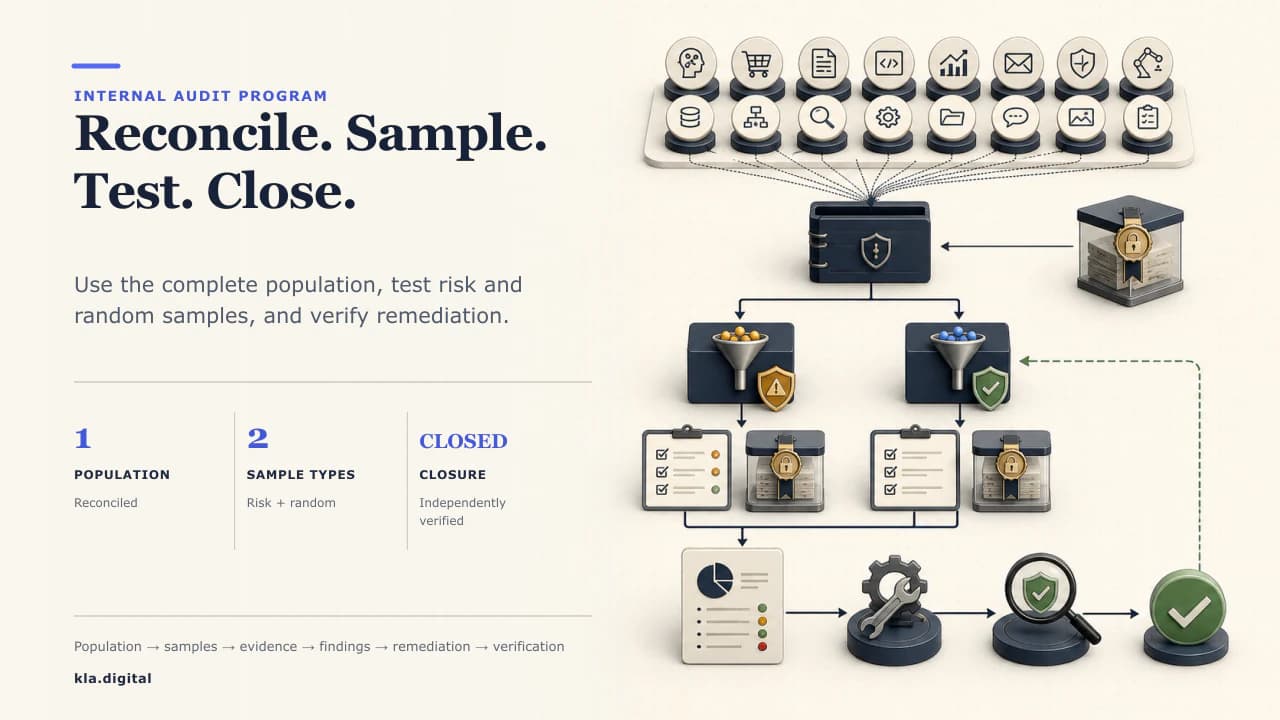
Ein wiederholbarer interner Audit-Auftrag für Planung, Feldarbeit, Probenahme, Beweisauswertung, Feststellungen und Nachverfolgung. Das Unternehmens-Framework definiert das breite 12-Domänen-Audit-Universum. Die AI-Audit-Checkliste stellt schnelle Kontrollfragen bereit und die Verantwortungsmatrix weist Rollen zu. Diese Seite ist für den Auftrag selbst zuständig: eine bereichsbezogene Prüfungsfrage, eine abgeglichene Grundgesamtheit, Risikobewertung, Design- und Betriebseffektivitätstests, reproduzierbare Stichproben, Evidenzbewertung, Berichterstattung und Abschluss. Die folgenden berechneten Zahlen beschreiben eine beispielhafte Kreditvergabeprüfung und können durch die abgeglichenen Zahlen aus einem Live-Engagement ersetzt werden.
1. Legen Sie das Engagement-Ziel und die Kriterien fest
Schreiben Sie eine Sicherheitsfrage, bevor Sie Nachweise anfordern: Wurden während des Prüfungszeitraums Folgemaßnahmen des Agenten genehmigt, durch genehmigte Kontrollen geregelt, im Geschäftssystem genau aufgezeichnet und durch ausreichende Beweise gestützt? Die Umfangserklärung legt dann den Geschäftsprozess, die Agenten- und Release-Population, die Umgebungen, den Zeitraum, die Entscheidungstypen, die Wesentlichkeit, Abhängigkeiten, Ausschlüsse und Kriterien fest. Jedes Feldforschungsverfahren muss einen Teil dieser Frage klären.
Halten Sie die Autorität jedes Kriteriums deutlich. Das IIA-Drei-Linien-Modell ordnet Risikomanagement den Rollen der ersten Linie, Fachwissen und Herausforderungen den Rollen der zweiten Linie und unabhängige und objektive Sicherheit der internen Revision zu. Das IIA Artificial Intelligence Auditing Framework ist eine veröffentlichte praktische Anleitung, die Prüfteams anpassen können, und das ISACA Artificial Intelligence Audit Toolkit ist ein kommerzielles Praktiker-Toolkit für Kontrolldesign und betriebliche Wirksamkeit. NIST AI RMF 1.0 ist ein endgültiges freiwilliges Rahmenwerk. Anwendbares Recht wird erst dann in den Kriterienkatalog aufgenommen, wenn die Organisation die Rolle des Betreibers, den beabsichtigten Zweck, die Klassifizierung und die Zuständigkeit dokumentiert.
Das folgende Programm trennt gesetzliche Verpflichtungen, Managementkontrollen, professionelle Anleitung und KLA-Empfehlungen. Die Stichprobengrößen und Bestehenskriterien sind Entscheidungen für die Engagementplanung. Eine Stellungnahme der Internen Revision befasst sich mit den genannten Kriterien für den definierten Umfang und Zeitraum. Es bietet keine Zertifizierung der Einhaltung gesetzlicher Vorschriften, der Systemsicherheit oder der zukünftigen Leistung.
| Planungsfeld | Erforderlicher Eintrag | Gearbeiteter Engagement-Eintrag | Planungsabnahme |
|---|---|---|---|
| Sicherheitsziel | Eine überprüfbare Frage zu Autorisierung, Kontrollbetrieb, Ergebnisgenauigkeit und Beweisen | Wurden im Zeitraum 1. April-30. Juni 2026, Folgemaßnahmen der Produktionskreditgeber genehmigt, durch geltende Richtlinien vorangestellt, zur erforderlichen menschlichen Entscheidung weitergeleitet, genau im Kreditsystem niedergeschrieben und durch vollständige Beweise gestützt? | Der Auditsponsor, der leitende Auditor und der verantwortliche Prozessverantwortliche genehmigen den genauen Wortlaut |
| Geschäftsprozess und Grenze | Startereignis, Endereignis, eingeschlossene Systeme, menschliche Rollen und Abhängigkeiten | Antragseingang durch Genehmigung, Ablehnung oder Weiterleitungsergebnis; umfasst Identitätsdienst, Abrufschicht, Kreditmodelldienst, KLA Policy Engine, Decision Desk, Kreditsystem und Evidence Room | Jede Komponente, die Autorität, Entscheidung, Handlung oder Beweise beeinflussen kann, wird benannt |
| Bevölkerung und Zeitraum | Agenten, Releases, Umgebungen, Aktionen und Datumsbereich | 8 Produktionsagenten; 27-Veröffentlichungen; 184,216-Aktionsdatensätze; nur Produktion; 1. April-30. Juni 2026 | Die Zählungen werden mit Bereitstellungs-, Identitäts-, Gateway-, Herkunftsdatensatz- und Geschäftssystemquellen abgeglichen |
| Entscheidungstypen im Geltungsbereich | Konsequente Ergebnisse von Zulassen, Verweigern, Eskalieren, Überschreiben, Zustandsänderungen und Wiederherstellung | Genehmigen, ablehnen, verweisen, Richtlinien verweigern, menschliche Überschreibung, Abruf von Bewerberdaten, Kreditabruf, Angebotserstellung, Rollback und Zugriffssperre | Jeder Materialentscheidungstyp verfügt über einen Populationseigentümer und ein Testverfahren |
| Materialität | Schwellenwerte für Finanzen, Rechte, Daten, Betrieb und Beweise | Alle negativen Ergebnisse für Bewerber; alle Zulassungen über EUR 25,000; sämtlicher Zugriff auf Sonderkategorie- oder Identitätsdaten; alle externen Schreibvorgänge; alle Vorfälle, Beinaheunfälle, Außerkraftsetzungen und Fehler bei der Beweisintegrität | Schwellenwerte werden vor der Stichprobenauswahl genehmigt und decken die qualitative Wirkung ab |
| Kriterienstapel | Richtlinie, Vertrag, Rahmenwerk und geltende rechtliche Kriterien mit Autorität und Version | Kreditrichtlinie LND-04 v6.2; Agentensteuerungsstandard ACS-02 v4.1; Aufbewahrungsplan RS-17; Lieferantenverträge; NIST AI RMF als freiwillige Anleitung; EU-KI-Gesetz Bestimmungen nur dann, wenn die dokumentierte Rolle und die Hochrisikoklassifizierung sie anwendbar machen | Jedes Kriterium ist versioniert, im Besitz, während des Zeitraums wirksam und einem Test zugeordnet |
| Rollen und Unabhängigkeit | Auftragssponsor, Prüfungsleiter, fachliche Unterstützung, Evidenzverantwortliche und Qualitätsprüfer | Sponsor des Prüfungsausschusses; Leiter der internen Revision; Kreditvergabe, IAM, Modellrisiko, Daten, Sicherheit und Unterstützung bei rechtlichen Themen; unabhängiger Audit-Qualitätsprüfer | Die interne Revision hat im geprüften Prozess keine Kontrollverantwortung oder Genehmigungsfunktion des Managements |
| Ausschlüsse und Leistungen | Begründete Ausschlüsse, Auswirkungen auf Prüfung, Bericht, Arbeitspapiere und Folgetermine | Entwicklungs-Sandboxes und anbieterinterne Modellschulungsvorgänge ausgeschlossen; Bericht fällig 31. Juli 2026; Antworten des Managements fällig 14. August; Erster erneuter Test 30. September | Jeder Ausschluss hat einen Eigentümer, eine Begründung, eine Risikoauswirkung und eine festgelegte Meinungsgrenze |
2. Beweisen Sie die Vollständigkeit der Grundgesamtheit, bevor Sie Stichproben auswählen
Die Vollständigkeit der Grundgesamtheit ist eine Prüfaussage. Stimmen Sie die Agentenregistrierung mit Produktionsbereitstellungen, nichtmenschlichen Identitäten, Modell- und Tool-Gateways, Herkunftsdatensätzen, Entscheidungsanfragen und nachgelagerten Geschäftsereignissen ab. Frieren Sie die abgeglichenen Extrakte mit Abfragetext, Filtern, Extraktionszeit, Zeilenanzahl und Hash ein. Unerklärte Unterschiede werden zu Ausnahmen oder zu einer Einschränkung des Umfangs, bevor mit der Probenahme begonnen wird.
NIST AI RMF 1.0 ist freiwillig und unterstützt die Verwaltung eines KI-Systeminventars unter GOVERN 1.6.. Eine Feldarbeitspopulation benötigt mehr Details: jeden Agenten, jedes Release, jedes Modell, jede Identität, jede temporäre Delegation, jedes Tool, jede Folgemaßnahme, jedes Richtlinienergebnis, jede menschliche Entscheidung, jeden Vorfall und jeden externen Effekt für den Zeitraum.
Suchen Sie nach Schattenagenten anhand von Modell-Gateway-Verkehr, Cloud-Service-Principals, Paket- und Plattformausgaben, Browsererweiterungen, Automatisierungsanmeldeinformationen, Tool-Gateway-Aufrufen und Geschäftsaufzeichnungen mit KI-generierter Herkunft. Gleichen Sie temporäre und delegierte Identitäten nach Erstellung, Ablauf, Widerruf, Sponsoring-Prinzipal und beobachteter Nutzung ab. Eine fehlende Identität oder Ausführungsquelle kann die Vollständigkeitsbehauptung für jede Downstream-Probe ungültig machen.
| Bevölkerungskomponente | Maßgebliche und bestätigende Quellen | Gearbeitete Zählung | Versöhnungsverfahren | Bestehenskriterium |
|---|---|---|---|---|
| Produktionsagenten | Agentenregister; Bereitstellungsmanifeste; Model-Gateway-Client-IDs | 8 | Treten Sie der Agenten-ID, der Umgebung, dem Eigentümer, dem Prozess und den aktiven Daten bei. Untersuchen Sie jeden Gateway-Client, der in der Registrierung fehlt | Alle bereitgestellten 8-Agenten werden in allen anwendbaren Quellen angezeigt. Keine ungeklärten Kunden |
| Releases und Rollouts | Agentenregister; unveränderliche Release-Artefakte; Bereitstellungscontroller; Tickets ändern | 27-Veröffentlichungen / 31-Rollouts | Passen Sie agent_release_id, Artefakt-Hash, Genehmigung, Bereitstellungszeit, Umgebung und Rollback-Verlauf an | Jedes Produktionsintervall führt zu einem genehmigten Release und Rollout |
| Persistente Agenten- und Dienstidentitäten | IAM-Verzeichnis; Geheimnisse Inventar; Bereitstellungsmanifeste; Gateway-Protokolle | 19 Identitäten | Ordnen Sie Eigentümer, Entitätstyp, Anmeldeinformationen, Umfang, Aktivierung, Ablauf und letzte Verwendung einem Agenten oder einer Abhängigkeit im Geltungsbereich zu | Keine geteilten, verwaisten, abgelaufenen oder nicht im Besitz befindlichen Identitäten |
| Temporäre Identitäten und Delegationen | Token-Dienst; Autoritäts-Schnappschüsse; Delegationsaufzeichnungen; Widerrufsereignisse | 31 temporäre Identitäten / 286 delegierte Reisen | Problem, Sponsor, Zweck, Umfang, Ablauf, Nutzung und Widerruf in Einklang bringen; Testen Sie die Verwendung vor der Ausgabe oder nach Ablauf | 100% entscheiden sich für einen anerkannten Sponsor und einen begrenzten Zweck; Keine Verwendung außerhalb des Fensters |
| Tools und externe Abhängigkeiten | Werkzeugkatalog; IAM-Zuschüsse; Ausgangs-Gateway; Lieferantenbestand; Verträge | 14-Tools, einschließlich 6 schreibfähig; 4 externe Abhängigkeiten | Vergleichen Sie registrierte Tools und Versionen mit beobachteten Endpunkten und effektiven Zuschüssen. Überprüfen Sie alle unbekannten Ziele | Jedes beobachtete Tool und jede beobachtete Abhängigkeit ist genehmigt, besitzt, hat eine Version und liegt innerhalb der Datengrenzen |
| Agent-Aktionsdatensätze | Abstammungsaufzeichnungen; politische Ereignisse; Tool-Gateway; Modell-Gateway | 184,216 | Verbinden Sie record_id, correlation_id, Ereigniszeit, Agent, Release, Richtlinie und Tooleffekt; Sequenz doppelter und fehlender IDs | Zählungen und Schlüssel versöhnen sich; Keine ungeklärten Lücken oder Duplikate |
| Folgegeschäftshandlungen | Ereignisse im Kreditsystem; Abstammungsaufzeichnungen; Werkzeugeffekte; Bewerberbenachrichtigungen | 14,903 | Gleichen Sie alle Genehmigungen, Ablehnungen, Empfehlungen, Kreditabzüge, Angebote und Statusänderungen in beide Richtungen ab | 100% bidirektionale Übereinstimmung durch external_reference oder effect_id; Betrag und Ergebnis stimmen überein |
| Kontroll- und Ausnahmeereignisse | Politische Ereignisse; 3,842 Entscheidungsanfragen; Vorfallsystem; Sicherheitswarnungen | 1,126 Ablehnungen; 214 überschreibt; 367-Anomalie oder Ereignisse mit geringem Vertrauen; 11 Vorfälle oder Beinaheunfälle | Gleichen Sie jedes Ereignis mit seiner Aktion, seinem Eigentümer, seiner Lösung, seinem nachgelagerten Effekt und seinem Beweisdatensatz ab | Jede Ausnahme hat eine Disposition; Alle betroffenen Aktionen verbleiben im Prüfuniversum |
| Shadow-Agent-Suchergebnisse | Modell-Gateway unbekannte Clients; Cloud-Prinzipale; ausgeben; Browsererweiterungen; Automatisierungstresor | 3-Kandidaten, 1 bestätigter Schattenagent | Verfolgen Sie jeden Kandidaten bis zum Eigentümer und Nutzer. Fügen Sie bestätigte Produktionsaktivitäten zum Umfang und zur Population hinzu | Alle Kandidaten haben sich entschieden; bestätigte Schattenaktivität wird eingedämmt, quantifiziert und gemeldet |
3. Ordnen Sie Agenten und Aktionstypen nach Risiko
Bewerten Sie den Aktionstyp während des Zeitraums mit der höchsten glaubwürdigen Autorität. Verwenden Sie 0-3 für Autonomie, Reversibilität, Datensensibilität, finanzielle oder rechtliche Auswirkungen, Tool-Autorität und Beweisqualität; Verwenden Sie 0-2 für externe Abhängigkeiten und den Vorfallverlauf. Für die Beweisqualität bedeutet 0 unabhängig überprüfbar und vollständig, während 3 materielle Lücken oder veränderliche Quellen bedeutet. Die Rubrik „22-Punkt bearbeitet“ verwendet „Kritisch“ 17-22, „Hoch“ 12-16, „Mittel“ 7-11, und „Niedrig“ 0-6.
Die Punktzahl ordnet die Feldarbeit und die Probenabdeckung an. Es ersetzt kein professionelles Urteil. Erhöhen Sie die Stufe für glaubwürdige katastrophale Auswirkungen, eine aktive Umgehung der Kontrolle, einen ungelösten Vorfall oder eine unvollständige Population, selbst wenn die Berechnung niedriger ist. Dokumentieren Sie die Nachweise und den Genehmiger für jede manuelle Anpassung.
| Aktionstyp des Agenten | Autonomie | Reversibilität | Datensensibilität | Auswirkungen auf Finanzen/Rechte | Werkzeugautorität | Externe Abhängigkeiten | Vorfallgeschichte | Beweisqualität | Gesamt / Stufe |
|---|---|---|---|---|---|---|---|---|---|
| Kreditrückgang | 2 | 3 | 3 | 3 | 2 | 2 | 2 | 2 | 19 / Kritisch |
| Kreditgenehmigung über EUR 25,000 | 1 | 3 | 3 | 3 | 3 | 2 | 1 | 2 | 18 / Kritisch |
| Maklerübergreifende Bewertungsdelegation | 3 | 2 | 2 | 2 | 3 | 2 | 2 | 2 | 18 / Kritisch |
| Ablehnung eines Ausweisdokuments | 2 | 2 | 3 | 3 | 2 | 2 | 1 | 1 | 16 / Hoch |
| Abruf von Kreditdaten durch Dritte | 3 | 1 | 3 | 2 | 3 | 2 | 1 | 1 | 16 / Hoch |
| Bewerberstatusbenachrichtigung | 3 | 0 | 1 | 1 | 1 | 1 | 0 | 1 | 8 / Moderat |
| Dokumentenklassifizierung ohne Statusänderung | 3 | 0 | 2 | 1 | 0 | 1 | 0 | 1 | 8 / Moderat |
4. Testkontrolldesign anhand der 12-Überwachungsdomänen
Bei einem Designtest wird gefragt, ob die angegebene Steuerung, wenn sie wie beschrieben durchgeführt wird, das identifizierte Risiko berücksichtigt. Überprüfen Sie Eigentum, Kontrollziel, Auslöser, Entscheidungslogik, Autorität, Beweiserfassung, Ausnahmebehandlung, Häufigkeit, Aufbewahrung und Eskalation. Gehen Sie einen Normalfall und einen Fehlerfall durch den Entwurf, bevor Sie die Zeitaufzeichnungen durchführen.
Die Tabelle verwendet die Taxonomie des Unternehmens-Framework wörtlich wieder. Es ist das kopierbare Audit-Testprogramm für Design. Fügen Sie lokale Arbeitspapierreferenzen und Ergebnisse hinzu, ohne die Domänennamen, Population, Verfahren, Beweise oder Bestehenskriterium zu ändern.
| Test-ID und Prüfdomäne | Designpopulation | Vorgehensweise | Beweise | Bestehenskriterium |
|---|---|---|---|---|
| D-01: 1. Inventar und Umfang | 8-Agenten, 27-Releases, 31-Rollouts, 14-Tools, 4 externe Abhängigkeiten | Überprüfen Sie das Inventarschema und die Abgleichskontrolle. Verfolgen Sie eine Hinzufügung, eine Änderung und eine Außerbetriebnahme durch Genehmigung und Produktionserkennung | Agentenregister, Prozesskarte, Inventarisierungsverfahren, Abstimmungsausgabe, Genehmigungsdatensatz | Erforderliche Objekte, Besitzer, Umgebungen, aktive Daten, Abhängigkeiten und Abgleichsquellen werden definiert; Unbekannte Produktionsaktivitäten lösen Eskalation aus |
| D-02: 2. Verantwortung und Rechenschaftspflicht | 8-Agenten und alle 12-Kontrollbesitzer | Ordnen Sie Ergebnisse, Risikoakzeptanz, Kontrollbetrieb, Vorfälle, Beweise und Behebungsentscheidungen benannten Rollen mit Befugnissen und Stellvertretern zu | Verantwortungsmatrix, Rollencharta, Ausschussmandat, Eskalationspfad | Es gibt einen verantwortlichen Prozessinhaber. Jede Kontrolle und Ausnahme hat einen autorisierten Eigentümer und eine Eskalationsroute |
| D-03: 3. Identität und Delegation | 19 persistente und 31 temporäre Identitäten; 286 delegierte Reisen | Überprüfen Sie die eindeutige Identität, den Sponsor, den Zweck, den Umfang, die Dauer, die Token-Ausgabe, den Ablauf und das Widerrufsdesign. Gehen Sie eine Delegation und einen Notfall widerrufen | IAM-Standard, Token-Ansprüche, Autoritäts-Snapshot, Delegierungs- und Widerrufsverfahren | Jeder Akteur und jede Delegation ist einzigartig, begrenzt, zuordenbar, gegebenenfalls zeitlich begrenzt und vor der weiteren Verwendung widerrufbar |
| D-04: 4. Berechtigungen, Tools und Datengrenzen | 14-Tools, 6 schreibfähige Tools, 19-Identitäten, 7-Aktionstypen | Vergleichen Sie den beabsichtigten Zweck mit effektiven Zuschüssen, Werkzeugkatalogaktionen, Ressourcenbereichen, Datengrenzen, Wertgrenzen und Durchsetzungspunkten | Zugriffsmodell, Gewährungen, Einträge im Werkzeugkatalog, Datengrenzen, Tests verweigern | Einschränkungen der geringsten Rechte werden zum Zeitpunkt der Aktion durchgesetzt; Nicht registrierte Tools, breite Platzhalter und direkte Umgehungspfade werden blockiert |
| D-05: 5. Risikoklassifizierung und Vorproduktionssicherung | 27-Releases und 9-Modell- oder Anbieteränderungen | Überprüfen Sie die Risikorubrik, die Folgenabschätzung, den Testplan, die Schwellenwerte, die Ausnahmegenehmigung und das Release-Gate. Verfolgen Sie einen fehlgeschlagenen Schwellenwert | Risikobewertungen, Modell- und Prozessbewertungen, Freigabekriterien, Freigaben, akzeptierte Ausnahmen | Jede Veröffentlichung ordnet wesentliche Risiken Tests und messbaren Schwellenwerten zu. Fehler blockieren die Freigabe, sofern keine autorisierte, begrenzte Ausnahme vorliegt |
| D-06: 6. Durchsetzung der Laufzeitrichtlinie | 184,216 Aktionsdatensätze und anwendbare Richtlinienversionen | Durchgehen Sie die Pfade „Zulassen“, „Verweigern“, „Eskalieren“ und „Ausnahmen“. Überprüfen Sie, ob die Richtlinie vor der Ausführung ausgewertet wird, und direkte Toolaufrufe verwenden dasselbe Gate | Policy Builder-Definition, KLA Policy Engine-Konfiguration, Simulationsergebnisse, Ereignissequenz | Jeder Folgeweg erfordert ein genehmigtes Urteil vor der Vollstreckung; Denial- und Stale-Policy-Zustände verhindern den Tool-Effekt |
| D-07: 7. Menschliche Zustimmung und Eskalation | 3,842-Entscheidungsanfragen und 214-Überschreibungen | Überprüfen Sie Weiterleitungsschwellenwerte, Prüferbefugnisse, vorgelegte Beweise, Konfliktbehandlung, Ablauf, Neuzuweisung, Begründung und Verhinderung verspäteter Entscheidungen | Decision Desk-Konfiguration, Prüfermatrix, Anforderungsschema, Eskalationstimer | Erforderliche menschliche Entscheidungen werden getroffen, bevor sie von einem autorisierten Prüfer unter Verwendung definierter Beweise und einer aufgezeichneten Begründung ausgeführt werden |
| D-08: 8. Ausführungsherkunft und Geschäftsergebnisse | 14,903 Folgemaßnahmen | Verfolgen Sie Absichten, Eingaben, abgerufene Daten, Toolaufrufe, Richtlinien, menschliche Entscheidungen, Vorher- und Nachher-Zustände, nachgelagerte Auswirkungen und die Benachrichtigung des Antragstellers | Abstammungsaufzeichnung, Reise, Werkzeugbeleg, Leihsystemaufzeichnung, Benachrichtigungsreferenz | Stabile Identifikatoren rekonstruieren jede wesentliche Aktion und das aufgezeichnete Ergebnis stimmt mit dem Geschäftssystem überein |
| D-09: 9. Kontinuierliche Sicherung und Änderungsmanagement | 27-Releases, 31-Rollouts, 9-Anbieter- oder Modelländerungen, 367-Warnungen | Überprüfen Sie die Änderungsklassifizierung, den Regressionsauslöser, die Genehmigung, die Überwachung der ersten Ausführung, die Alarmschwellenwerte, die Überprüfung durch den Eigentümer und die Verknüpfung zur Behebung | Release-Unterschiede, Testpläne, Rollout-Bedingungen, Assurance-Warnungen, Überprüfungsdatensätze | Jede wesentliche Änderung löst eine Neubewertung und Überwachung aus; Ausgefallene Signale führen zu eigener, zeitgebundener Behebung |
| D-10: 10. Reaktion auf Vorfälle, Widerruf und Rollback | 11 Zwischenfälle oder Beinaheunfälle; 19 Zugriffssperren; 4 Rollbacks | Geherkennung, Triage, Eindämmung, Abfrage der betroffenen Bevölkerung, Widerruf von Anmeldeinformationen, Rollback, Kommunikation, Wiederherstellung und gewonnene Erkenntnisse | Vorfallplan, Runbook, Widerruf- und Rollback-Tests, Schweregrad und Benachrichtigungsmatrix | Eigentümer können weitere Maßnahmen stoppen, betroffene Fälle identifizieren, die Genehmigung widerrufen, den sicheren Zustand wiederherstellen und Beweise innerhalb genehmigter Ziele aufbewahren |
| D-11: 11. Beweisintegrität, Aufbewahrung und unabhängige Überprüfung | 184,216-Datensätze in 91-Tagesbeweisbündeln | Überprüfen Sie die synchrone Erfassung, Manifesterstellung, Hashes, Signaturen, Aufbewahrung, Prüferzugriff, Aufbewahrung, rechtliche Aufbewahrung und Löschkontrollen | Beweisschema, Manifeste, Schlüsseldatensätze, Verwahrungsprotokoll, Aufbewahrungsplan, Prüfergebnis | Ein Prüfer kann Stichprobenaktionen abgleichen, validieren und erneut ausführen; Änderungen oder fehlende Datensätze sind erkennbar und werden eskaliert |
| D-12: 12. Multi-Agent- und Drittanbieter-Abhängigkeiten | 286 delegierte Journeys, 4 externe Abhängigkeiten, 9 Anbieter- oder Modelländerungen | Überprüfen Sie die authentifizierte Übergabe, die Weitergabe von Einschränkungen, das Fixieren von Versionen, Lieferantennachweise, Vorfallpflichten, Beendigung und Fallback | Übergabeschema, Gateway-Belege, Verträge, Sicherungsberichte, Abhängigkeitsinventar | Jeder beitragende Dienst und Agent ist zurechenbar, autorisiert, versioniert, eingeschränkt und durch Beweis- und Vorfallbedingungen abgedeckt |
5. Testen Sie die betriebliche Wirksamkeit über den Prüfungszeitraum
Beim Testen der Betriebseffektivität werden tatsächliche Periodenaufzeichnungen verwendet. Führen Sie deterministische Behauptungen für die gesamte Population durch, bei denen die Vollständigkeit der Quelle und die Feldsemantik nachgewiesen sind, und prüfen Sie dann die Stichprobenfälle auf Beurteilung, Kontext und Beweisqualität. Behalten Sie Abfragetext, Quell-Snapshots, Zeilenanzahlen, Ausnahmen, Prüfernotizen und Ergebnisse der erneuten Ausführung in den Arbeitspapieren bei.
Jede Ausnahme bleibt an ihren Nenner gebunden. Ein verspätetes politisches Urteil in 3 über 14,903-Folgemaßnahmen stellt eine andere Belastung dar als 3-Fälle in einer nicht versöhnten Bevölkerung. Quantifizieren Sie sowohl die beobachtete Rate als auch die Populationsbeschränkung und erweitern Sie dann die Tests, wenn der Fehler systembedingt sein könnte.
| Test-ID | Population und Selektion | Vorgehensweise | Beweise | Bestehenskriterium |
|---|---|---|---|---|
| OE-01: Aktionsdatensätze und Richtliniensequenz | Alle 184,216-Datensätze; separate 14,903 Folgehandlungen | Testen Sie Einzigartigkeit, erforderliche Felder, Zeitstempelreihenfolge, Richtlinienversion und Urteil vor der Ausführung; Identifizieren Sie abgelehnte Aktionen mit einem nachgeschalteten effect_id | Frozen Lineage Record und Auszüge aus Richtlinienereignissen; Abfrage; Ausnahmedatei | 100% eindeutig und zuordenbar; Für jede Folgemaßnahme gibt es ein anwendbares vorheriges Genehmigungs- oder Eskalationsergebnis. Null verweigerte Aktionen werden ausgeführt |
| OE-02: Ablehnungen durch Richtlinien | Alle 1,126-Ablehnungen analytisch; 40 Fälle, die nach Regel, Aktionstyp, Agent und Freigabe zur menschlichen Überprüfung ausgewählt wurden | Bestätigen Sie, dass die angeforderte Aktion gestoppt wurde, kein gleichwertiger Wiederholungsversuch die Regel umging, Benachrichtigung und Eskalation befolgten die Richtlinie und Beweise begründen die Entscheidung | Richtlinienergebnis, übereinstimmende Regeln, Wiederholungskette, Tool-Gateway, Benachrichtigung, Entscheidungsanfrage | Keine verbotenen Effekte oder gleichwertige Umgehungen; Jede einzelne Ablehnung ist korrekt, zeitgemäß und rekonstruierbar |
| OE-03: Menschliche Zulassungen | Alle 3,842 Entscheidungsanfragen analytisch; 60 stichprobenartig nach Risiko, Prüfer, Ergebnis und Monat | Testen Sie die Autorität des Prüfers zum Zeitpunkt der Entscheidung, die vorgelegten Beweise, den Zeitpunkt der Entscheidung, die Begründung, Konflikte, den Ablauf und die Übereinstimmung mit der ausgeführten Aktion | Decision Desk-Datensatz, IAM-Snapshot, Hash der vorgelegten Beweise, Tool-Empfang, Geschäftsergebnis | 100% erforderliche Genehmigungen gehen der Aktion voraus; Stichprobenentscheidungen verfügen über autorisierte Gutachter, ausreichende Beweise, Begründungen und übereinstimmende Auswirkungen |
| OE-04: Menschliche Überschreibungen | Alle 214 überschreiben analytisch; 50 wurde anhand des ursprünglichen Urteils, des Gutachters, des Ursachencodes, des Ergebnisses und der Veröffentlichung ausgewählt | Vergleichen Sie die Autorität und Begründung der Außerkraftsetzung mit der Richtlinie. Verfolgen Sie die ursprüngliche Entscheidung, die neue Entscheidung, die Wirkung des Werkzeugs, die Benachrichtigung und spätere Vorfälle oder Beschwerden | Ursprüngliche und außer Kraft gesetzte Entscheidungen, Autoritätsmomentaufnahme, Begründung, Abstammungsaufzeichnung, Ergebnis | Jede Außerkraftsetzung ist autorisiert, begründet, rechtzeitig, innerhalb der delegierten Grenzen und wird nachgelagert genau widergespiegelt |
| OE-05: Abstimmung zwischen Unternehmen und Status | Alle 14,903 Folgehandlungen analytisch; 60 wurde zur Quelleninspektion beprobt | Verknüpfen Sie angeforderte Maßnahmen, genehmigte Maßnahmen, Tool-Antworten, Vorher- und Nachher-Status-Hashes, Betrag, endgültigen Kreditstatus und Antragstellerbenachrichtigung | Werkzeugeingang, Leihsystemereignis, Benachrichtigung, before_state_hash, after_state_hash, external_reference | 100% Ergebnis- und Betragsvereinbarung; Die abgetasteten Quelldatensätze unterstützen den aufgezeichneten Vorher- und Nachher-Status |
| OE-06: Veröffentlichungen und Erstausführungen | Alle 27-Veröffentlichungen; erste und zweite Folgeausführung nach jedem Release, 54-Aktionen | Überprüfen Sie die Genehmigung, Artefakt- und Richtlinienversionen, Regressionsergebnisse, Bereitstellungszeit, erwartete Überwachung, Vollständigkeit der Nachweise und das Fehlen einer Ausführung vor der Genehmigung | Release-Manifest, Testergebnisse, Genehmigung, Rollout-Datensatz, erste Lineage-Datensätze | Jede Veröffentlichung wird vor der Verwendung genehmigt; Alle 54-Erstausführungen verwenden die vorgesehenen Versionen und bestehen die Kontroll- und Beweisprüfungen |
| OE-07: Zugriffssperren | Alle 19-Widerrufsereignisse und alle späteren Aktivitäten für betroffene Identitäten | Vergleichen Sie Anfrage, Genehmigung, effektive Zeit, Token-Ablauf, Gateway-Durchsetzung, verbleibende Sitzungen und nachfolgende abgelehnte oder erfolgreiche Anrufe | IAM- und Token-Ereignisse, Gateway-Protokolle, Autoritäts-Snapshots, Vorfall-Links | Der Widerruf erfüllt das genehmigte Ziel; Nach der Wirksamkeitszeit erfolgt keine erfolgreiche Nutzung |
| OE-08: Zwischenfälle und Beinaheunfälle | Alle 11-Ereignisse und die vollständige betroffene Aktionspopulation für jedes Ereignis | Schweregrad, Abfrage der betroffenen Bevölkerung, Eindämmung, Widerruf, Rollback, Benachrichtigung, Grundursache, Behebung und Schließungsgenehmigung erneut durchführen | Vorfalldatei, Abstammungsaufzeichnungen, Liste der betroffenen Fälle, Widerruf- und Rollback-Belege, Abschlussnachweise | Für jedes Ereignis gibt es eine vollständig betroffene Bevölkerung, eine rechtzeitige Eindämmung, eine genehmigte Wiederherstellung, gesicherte Beweise und eine verifizierte Sanierung |
| OE-09: Beweisintegrität und -aufbewahrung | Alle 91-Tagespaket-Manifeste; 30-Bundles für Signatur- und Kettenvalidierung ausgewählt; jede abgetastete Aktion | Berechnen Sie Manifest- und Datensatz-Hashes neu, validieren Sie Signaturen und Kettenreihenfolge, bestätigen Sie die Aufbewahrungsklasse und die gesetzliche Aufbewahrungsfrist und lösen Sie Datensätze durch einen unabhängigen Prüfer auf | Bundle-Manifeste, Signaturschlüssel, Verwahrungsprotokoll, Aufbewahrungsaufzeichnungen, Verifiziererausgabe | Alle Manifeste werden mit der Anzahl der Quellen abgeglichen. Alle 30-Validierungen und alle erfassten Datensätze bestehen Integritäts-, Aufbewahrungs- und Aufbewahrungstests |
| OE-10: Anbieter-, Modell- und Delegationsänderungen | Alle 9 Anbieter- oder Modelländerungen und 286 delegierten Journeys analytisch; 50 Reisen gesampelt | Testen Sie Änderungsgenehmigungen, Vertrags- und Nachweisbedingungen, authentifizierte Absender und Empfänger, propagierte Zwecke und Einschränkungen, Versionen, Subagenteneffekte und das Endergebnis | Änderungsdatensatz, Vertrag, Übergabebelege, Autoritäts-Snapshots, Komponentenversionen, Journey-Ergebnis | Jede Änderung wird vor der Verwendung genehmigt; Jede Stichprobenübergabe ist zuordenbar, begrenzt, versioniert und auf das Endergebnis rückverfolgbar |
6. Wählen Sie ein reproduzierbares Risiko und eine Zufallsstichprobe
Frieren Sie die Population vor der Auswahl ein. Notieren Sie die Quellabfragen, die Extraktionszeit, die Filter, den Zufallsstartwert, die Hash-Methode, den Probeneigentümer, die Duplikatbehandlung, die Ersetzungen und die endgültige Fallliste. Behalten Sie alle anwendbaren Stratum-Tags für einen ausgewählten Fall bei, sodass eine Aktion mehrere Abdeckungsziele erfüllen kann, ohne aus der Ausnahmeberichterstattung zu verschwinden.
Vollständige automatisierte Tests eignen sich für deterministische Behauptungen über strukturierte, abgeglichene Datensätze: Eindeutigkeit, erforderliche Felder, Zeitstempelreihenfolge, Richtlinien-vor-Aktion-Sequenz, Mengenübereinstimmung, abgelaufene Autorität, Ablehnung mit anschließender Ausführung und Hash-Validierung. Für Entscheidungsgründe, semantische Übereinstimmung mit dem Zweck, Relevanz der abgerufenen Daten, Qualität des Gutachterurteils, glaubwürdige nachgelagerte Schäden, Ausnahmen von der Lieferkette und undurchsichtige Beweise Dritter ist weiterhin eine menschliche Überprüfung erforderlich.
Die Auswahlzahlen unten sind KLA-Empfehlungen für diese erwerbstätige Bevölkerung. Sie sind ein vertretbarer Ausgangspunkt für die Engagementplanung. Dokumentieren Sie die erwartete Sicherheit, tolerierbare Abweichung, Populationsvariabilität, Vertrauensstrategie und Erweiterungsregeln, wenn für das Engagement statistische Schlussfolgerungen erforderlich sind.
| Erforderliche Schicht | Konkrete Bevölkerung | Auswahlmethode und Größe | Menschliches Verfahren | Beweise | Pass- und Erweiterungsregel |
|---|---|---|---|---|---|
| Aktionstypen mit hohem Risiko | 2,412 Ablehnungen der kritischen Stufe, Genehmigungen über EUR 25,000, und agentenübergreifende Bewertungsmaßnahmen | 60-Fälle: 20 mit dem höchsten Wert oder der höchsten Auswirkung, plus 40 verteilt auf Aktionstyp, Agent, Release und Monat | Führen Sie Autorität, Richtlinie, erforderliche menschliche Entscheidung, Werkzeugwirkung, Ergebnis und Beweisintegrität durchgängig durch | Herkunftsdatensatz, Autoritäts-Snapshot, Richtlinie, Entscheidungsanfrage, Werkzeugbeleg, Geschäftsstatus, Beweismanifest | Keine unbefugten oder nicht unterstützten Folgeeffekte; Ein solcher Fehler erstreckt sich auf den gesamten betroffenen Aktionstyp und das Release |
| Zufällige Bevölkerungsstichprobe | Grundgesamtheit der 184,216-Aktionsdatensätze; Die Auswahl schließt Fälle aus, die bereits für Pflichtschichten ausgewählt wurden | 80-Datensätze, ausgewählt durch aufsteigendes SHA-256 aus festem Startwert plus record_id; Behalten Sie den Startwert und die Abfrage | Überprüfen Sie die End-to-End-Vollständigkeit und vergleichen Sie den aufgezeichneten Zweck, die Aktion und das Ergebnis mit den Quelldatensätzen | Alle Mindestbeweisgruppen und maßgeblichen Quelldatensätze | Kein unerklärliches fehlendes oder inkonsistentes Feld; Eine systemische Schemalücke erstreckt sich auf alle Datensätze, die diese Schemaversion verwenden |
| Ausnahmen und Richtlinienverweigerungen | 1,126-Ablehnungen über 18-Richtlinienregeln hinweg | Vollständiger automatisierter Sequenztest; 40 menschliche Überprüfungen, die alle wesentlichen Regeln und alle 8-Agenten abdecken | Bestätigen Sie, dass der verweigerte Effekt gestoppt wurde, die Wiederholungspfade weiterhin kontrolliert wurden und die Eskalation oder Benachrichtigung mit der Richtlinie übereinstimmte | Richtlinienentscheidung, übereinstimmende Regeln, Wiederholungskette, Gateway-Datensatz, Entscheidungsanfrage, Benachrichtigung | Keine verweigerten Effekte; Jede Umgehung erstreckt sich auf alle Ausführungen, die Regeln, Agenten, Releases, Tools oder Wiederholungsmuster gemeinsam nutzen |
| Menschliche Überschreibungen | 214 wird von 23-Rezensenten überschrieben | Vollständiger Autoritäts- und Zeittest; 50 menschliche Bewertungen, einschließlich aller Prüfer mit 5 oder mehr Überschreibungen | Bewerten Sie die vorgelegten Beweise, die Begründung, die Autorität, den Konflikt, den Zeitpunkt, die ausgeführte Aktion und spätere Beschwerden oder Vorfälle | Ursprüngliche Entscheidung, Außerkraftsetzung, IAM-Snapshot, Begründung, Werkzeugwirkung, Ergebnisverlauf | Jede Außerkraftsetzung ist autorisiert, begründet, vor ihrer Wirksamkeit und begrenzt; Ein ungültiger Prüfer erstreckt sich auf alle Entscheidungen dieses Prüfers |
| Anomale oder geringe Konfidenzergebnisse | 367-Ereignisse aufgrund von Wiederholungsversuchen, Ausreißern, Abweichungen, Latenz, Datenqualität oder Regeln mit geringer Zuverlässigkeit | 60-Fälle: 10 aus jeder Anomaliefamilie, gewichtet nach kritischen und hohen Aktionen | Validieren Sie die Warnung, Untersuchung, Disposition, Entscheidungsroute, Wirkung und Abhilfe; Untersuchen Sie das Falsch-Negativ-Risiko im Bereich von Schwellenwerten | Assurance Alert, Modell- und Werkzeugaufzeichnungen, Prüferanalyse, Ergebnis, Sanierungsplan | Jede erfasste Warnung wird rechtzeitig und korrekt gelöst. Jede verpasste erforderliche Eskalation wird auf das Familien- und Schwellenwertfenster ausgeweitet |
| Erste Ausführungen nach einer Veröffentlichung | Erste und zweite Folgemaßnahme nach jeder der 27-Releases: 54-Aktionen | Testen Sie alle 54 | Passen Sie bereitgestellte Versionen, Genehmigungen, Regressionsergebnisse, Richtlinien, Berechtigungen, Überwachung, Ergebnisse und Beweisschema an | Release-Manifest, Rollout-Datensatz, erste Abstammungsdatensätze, Assurance-Warnungen | Alle 54 verwenden genehmigte Versionen und bestehen Kontrollen. Jeder Fehler erstreckt sich auf jede Aktion, bis er korrigiert oder zurückgesetzt wird |
| Agentenübergreifende Delegation | 286 Journeys, die mindestens eine Agent-zu-Agent-Übergabe enthalten | 50 Journeys über Absender, Empfänger, Tool, Risikostufe und Release; beinhalten jede Drei-Hop-Journey | Verfolgen Sie authentifizierte Parteien, delegierten Zweck, Umfang, Ablauf, Weitergabe von Einschränkungen, Nachrichtenintegrität, Tooleffekte und Endergebnis | Übergabebelege, Autoritäts-Snapshots, Komponentenherkunftsaufzeichnungen, Werkzeugbelege, Reiseergebnisse | Jede Übergabe ist zurechenbar und liegt innerhalb der delegierten Grenzen; Jede unterbrochene Kette erweitert sich auf die Kombination aus Sender, Empfänger und Version |
| Vorfälle und Beinaheunfälle | 7-Vorfälle und 4 Beinaheunfälle | Testen Sie alle 11 und jeweils die gesamte betroffene Aktionspopulation | Erkennung, Schweregrad, Eindämmung, Widerruf, Rollback, Benachrichtigung, Grundursache, Behebung und Schließung erneut durchführen | Vorfalldatei, Abfrage betroffener Fälle, Aktionsaufzeichnungen, Wiederherstellungsbelege, Abschlussnachweise | Vollständige und genaue betroffene Bevölkerung mit rechtzeitiger Reaktion und verifizierter Schließung; Bei jeder Auslassung wird die Veranstaltung erneut eröffnet |
| Anbieter- oder Modelländerungen | 9-Änderungen: 4-Modellversionen, 2-Abrufanbieter, 2-Tool-APIs, 1-Orchestrierungsdienst | Testen Sie alle 9-Änderungen und die ersten 3-Folgeaktionen nach jeder 27-Aktionsüberprüfung unter Beibehaltung der Überlappung | Überprüfen Sie Due Diligence, Vertrags- und Beweisbedingungen, Risikoneubewertung, Bewertung, Genehmigung, Versionsfixierung, Überwachung und Fallback | Änderungsgenehmigung, Vertrag, Bewertung, Manifest, Gateway-Datensätze, erste Ergebnisse | Jede Änderung wird vor der Verwendung genehmigt und getestet. Jede nicht genehmigte Verwendung erstreckt sich auf das gesamte Expositionsintervall |
7. Bewerten Sie die Evidenzgenügsamkeit für jede erfasste Aktion
Ein Beweis ist ausreichend, wenn er für die Behauptung relevant, zuverlässig, vollständig, zeitnah, für die Bevölkerung nachvollziehbar und vor unbemerkter Veränderung geschützt ist. Dokumentieren Sie den Produzenten, das maßgebliche System, die Extraktionsmethode, die Feldsemantik, die Aufbewahrung, den Integritätsmechanismus und die Produktkette. Führen Sie das Richtlinienergebnis erneut durch und gleichen Sie den nachgelagerten Effekt ab, wann immer die Beweise diese Verfahren stützen.
Identitätsnachweise müssen den Benutzer oder sponsernden Prinzipal, Agent, Dienstkontext, Delegierer und Genehmiger aufklären. Das Audit-Log-Schema für KI-Agenten stellt den gemeinsam genutzten herstellerneutralen Maschinenvertrag bereit. Dieses Prüfprogramm behält sponsoring_principal_id, agent_identity_id, authority_snapshot_id, delegated_by und reviewer_id als Arbeitspapier-Aliase bei; Verknüpfte IAM-Datensätze enthalten Akteurtyp, Anmeldeinformationslebenszyklus, effektive Zuschüsse und Dienstkontext. Behalten Sie diese Aliase bei, damit Beispiele ohne Übersetzung zwischen dem Unternehmens-Framework, Lineage Explorer und Evidence Room verschoben werden können.
Ein Screenshot, eine Dashboard-Gesamtsumme oder eine Managementdarstellung können einen Test bestätigen und nicht den zugrunde liegenden Periodendatensatz ersetzen. Wenn eine erforderliche Gruppe fehlt, klassifizieren Sie die Lücke, identifizieren Sie die betroffene Population, versuchen Sie ein gleichwertiges alternatives Verfahren und präzisieren Sie die Schlussfolgerung, wenn dieselbe Behauptung weiterhin nicht unterstützt wird.
| Anforderungs-ID und Feldgruppe | Genaue Mindestfelder | Angeforderte Quelle und Format | Ausreichend- und Bestehensprüfung |
|---|---|---|---|
| ER-01: Aufzeichnung und Korrelation | record_id, occurred_at, environment, tenant_id, process_id, journey_id, correlation_id | Unveränderlicher Abstammungsdatensatz-Extrakt plus Schema, Zeitzone, Abfrage, Zeilenanzahl und Extrakt-Hash | IDs sind eindeutig; Die Reihenfolge der Zeitstempel ist kohärent. Datensatz gleicht sich mit der eingefrorenen Bevölkerung ab und schließt die Reise ab |
| ER-02: Agent und Freigabe | agent_id, agent_release_id, model_id, model_version, orchestrator_version, prompt_template_version | Agentenregistrierung und signiertes Release-Manifest mit unveränderlichen Artefaktreferenzen | Jede Version wird in das unter occurred_at genehmigte und bereitgestellte Artefakt aufgelöst |
| ER-03: Auftraggeber und Delegation | agent_identity_id, sponsoring_principal_id, delegated_by, session_id, authority_snapshot_id, expires_at | IAM-, Token-, Sitzungs-, Delegations-, effektive Gewährungs-, Dienstkontext- und Sperrdatensätze | Benutzer oder Sponsor, Agent, Dienstkontext und Delegation sind für die Aktion zuordenbar, aktiv, bereichsgebunden, nicht abgelaufen und autorisiert |
| ER-04: Zweck und Risiko | purpose_code, decision_type, risk_tier, regulatory_classification, classification_basis_version | Genehmigter Prozesszweck, Entscheidungskatalog, Risikobewertung und Klassifizierungsaufzeichnung | Der aufgezeichnete Zweck und die Stufe stimmen mit der genehmigten Verwendung und der für die Freigabe gültigen Klassifizierung überein |
| ER-05: Datenherkunft | input_reference[], source_hash[], retrieval_query_hash, data_boundary_id, redaction_profile_id | Geschützte Eingaben oder auflösbare Referenzen, Abrufbestätigungen, Quellversionen, Datengrenzen und Schwärzungsdatensätze | Jedes eingegebene Material und jedes abgerufene Element wird in die zulässige Quelle, Zeit, Grenze und geschützte Darstellung aufgelöst |
| ER-06: Werkzeugaktion | tool_id, tool_version, action, resource_scope, requested_args_hash, response_hash, effect_id | Werkzeugkatalogeintrag, Gateway-Anfrage und -Antwort, effektiver Berechtigungskontext und Effektempfang | Die angeforderte Autorität, der tatsächliche Anruf, die Reaktion und die nachgelagerte Wirkung stimmen überein und bleiben innerhalb des genehmigten Umfangs |
| ER-07: Richtlinienentscheidung | policy_id, policy_version, policy_decision, matched_rule_ids[], exception_id, evaluated_at | Policy Builder-Artefakt, KLA Policy Engine-Ereignis, übereinstimmende Regeln, Ausnahmegenehmigung und Simulationseingaben | Der Auditor führt das gleiche Ergebnis aus; evaluated_at geht dem geregelten Werkzeugeffekt voraus |
| ER-08: Menschliche Entscheidung | decision_request_id, reviewer_id, reviewer_role, presented_evidence_hash, decision, rationale, decided_at | Decision Desk-Datensatz plus IAM-Schnappschuss des Prüfers und die zum Zeitpunkt der Entscheidung vorgelegten Beweise | Identität und Rolle des Genehmigers sind autorisiert; Beweise, Entscheidung, Begründung und Zeitpunkt stützen die ergriffenen Maßnahmen |
| ER-09: Ergebnis und Genesung | outcome, before_state_hash, after_state_hash, external_reference, incident_id, rollback_id, revocation_event_id | Maßgebliche Vorher- und Nachher-Geschäftsunterlagen, Benachrichtigungen, Vorfälle, Rollbacks und Widerrufsbelege | Der aufgezeichnete Zustand und die nachgelagerte Wirkung stimmen mit dem Geschäftssystem überein. Wiederherstellungsereignisse werden korrekt aufgelöst und sequenziert |
| ER-10: Integrität und Aufbewahrung | evidence_hash, previous_record_hash, bundle_manifest_hash, signature_key_id, sealed_at, retention_class, legal_hold_id | Versiegeltes Beweismittelpaket, Manifest, Unterschrift und Schlüsseldatensatz, Verwahrungsprotokoll, Aufbewahrungsplan und Aufzeichnung zur gesetzlichen Aufbewahrung | Hashes werden neu berechnet; Signatur- und Kettenvalidierung; die Versiegelung erfolgt rechtzeitig; Verwahrung, Aufbewahrung und Aufbewahrung decken die Probe ab |
8. Schreiben Sie Feststellungen auf und bilden Sie ein begrenztes Prüfungsurteil
Verwenden Sie ein vierstufiges Schweregradmodell. Kritisch bezeichnet eine aktive oder glaubwürdige unbefugte, irreversible Sicherheits-, Rechte- oder wesentliche finanzielle Gefährdung, die eine sofortige Eindämmung erfordert. Hoch bedeutet ein wesentliches oder systemisches Kontrollversagen, eine erhebliche betroffene Bevölkerung oder eine schwache Prävention von Folgemaßnahmen. Moderat bedeutet eine begrenzte Kontrollschwäche mit kompensierenden Kontrollen und begrenzter aktueller Exposition. Niedrig bedeutet eine isolierte Dokumentations- oder Prozessschwäche mit geringen direkten Auswirkungen. Erfassen Sie Wahrscheinlichkeit, Auswirkung, Geschwindigkeit, Erkennbarkeit, Population, kompensierende Kontrollen und die Risikoakzeptanz des Managements hinter der Bewertung.
Für jeden Befund sind eine Bedingung, ein Kriterium, eine Ursache, eine Konsequenz, eine betroffene Bevölkerung, Beweise, ein Eigentümer, eine Abhilfemaßnahme und ein Datum für die erneute Prüfung erforderlich. Trennen Sie eine Kontrollausnahme von einer Beweisbeschränkung. Wenn die Vollständigkeit der Grundgesamtheit, die Integrität der Beweise oder eine Abhängigkeit von Dritten das Verfahren verhindern, geben Sie die betroffene Behauptung und die verbleibende Unsicherheit in einer qualifizierten Schlussfolgerung an.
In der endgültigen Stellungnahme werden Umfang, Zeitraum, Kriterien, Sicherheitsniveau, getestete Domänen, zuverlässige Populationen, Ausnahmen und Einschränkungen genannt. Es gibt Auskunft darüber, ob die Kontrollen für den angegebenen Auftrag angemessen konzipiert und wirksam durchgeführt wurden. Es bietet keine Zertifizierung der Einhaltung gesetzlicher Vorschriften, der Systemsicherheit, der Richtigkeit individueller Entscheidungen außerhalb der getesteten Arbeit oder des zukünftigen Betriebs.
| Feld finden | Abgeschlossener Befund: IA-AGT-2026-04 |
|---|---|
| Titel und Schweregrad | Menschliche Außerkraftsetzungen wurden ohne vollständige zeitgleiche Genehmigungsnachweise durchgeführt: Hoch |
| Zustand | In der gesamten Population von 214-Menschenüberschreibungen hatten 37-Datensätze einen leeren rationale und 12-Zusatzdatensätze verwendeten einen reviewer_role, der nicht in die genehmigte Underwriter-Matrix bei decided_at aufgelöst wurde. Fünf dieser 12-Entscheidungen wurden nach dem damit verbundenen Effekt des schreibfähigen Tools aufgezeichnet. Die 49 eindeutig betroffenen Außerkraftsetzungen repräsentieren 22.9% der Gesamtheit der Außerkraftsetzungen. |
| Kriterium | Die Kreditvergaberichtlinie LND-04 v6.2, Abschnitt 7.3 und der Agent Control Standard ACS-02 v4.1-Kontrolle HAO-4 erfordern, dass ein autorisierter Versicherer die vorgelegten Beweise überprüft, eine Entscheidung und Begründung aufzeichnet und die Entscheidung abschließt, bevor eine Überschreibung das Kreditsystem erreicht. |
| Ursache | Bei der IAM-Migration im Juni wurde die Gruppe „Auftragnehmer-Versicherer“ aus der Rollenzuordnung „Decision Desk“ weggelassen. Das Override-API-Schema ließ auch eine leere Begründung zu, und das Tool-Gateway akzeptierte eine Override-Referenz, ohne decided_at mit der Wirkungszeit zu vergleichen. |
| Folge | Die Organisation kann kein gleichzeitiges, autorisiertes Urteil für 49-Überschreibungen nachweisen. Vor der aufgezeichneten Entscheidung traten fünf Kreditsystemeffekte auf, die zu einer direkten Kontrollumgehung führten. Betroffene Antragsteller haben möglicherweise Ergebnisse erhalten, die nicht durch die gespeicherten Genehmigungsdaten belegt werden können, und dem Management fehlen verlässliche Beweise für eine Beschwerde, eine Aufsichtsbehörde oder eine interne Überprüfung. |
| Betroffene Bevölkerung | 49 von 214 überschreibt zwischen 1. April und 30. Juni 2026: 31-Genehmigungen, 13-Ablehnungen und 5-Verweisungsänderungen für 6-Agenten und 4-Releases. Die fünf verspäteten Entscheidungen betrafen Anträge mit einem Gesamtbetrag von 286,000 EUR. |
| Beweis | Vollständige Abfrage IA-AGT-OE-04; eingefrorener Decision Desk-Extrakt-Hash 8d61…c4a2; IAM-Rollen-Snapshots; 49 Abstammungsaufzeichnungen; fünf Werkzeugbelege und Leihsystemereignisse; Richtlinie LND-04 v6.2; Kontrolle ACS-02 v4.1. Unabhängige Neudurchführung bestätigte die Zählungen und die Ereignisreihenfolge. |
| Eigentümer und Fälligkeitsdatum | Verantwortlicher Eigentümer: Leiter Kreditgeschäft. Unterstützende Eigentümer: IAM-Inhaber und technischer Agent-Inhaber. Die Sanierung ist fällig 15. September 2026. |
| Sanierung | rationale für jede Überschreibung obligatorisch machen; Synchronisieren Sie genehmigte Prüfergruppen aus IAM. verlangen, dass das Gateway vor einem Schreibvorgang die Prüferautorität und decided_at validiert; Überprüfen Sie alle von 49 betroffenen Fälle erneut. korrekte Antragsteller- und Darlehensunterlagen, sofern erforderlich; Bewahren Sie die ursprüngliche Lücke und die neue Überprüfung als separate Beweise auf. Überwachen Sie die Vollständigkeit der Überschreibung täglich für 30 Tage. |
| Retest- und Abschlusskriterium | Datum der erneuten Prüfung: 30. September 2026. Führen Sie Entwurfstests für Schema, Rollensynchronisierung und Gateway-Sequenzierung erneut durch. Testen Sie die vollständige 49-Fallbehebungspopulation und alle Überschreibungen ab 16-30. September. Schließen Sie nur, wenn für jeden betroffenen Fall eine genehmigte Verfügung vorliegt, für jede neue Außerkraftsetzung eine autorisierte vorherige Entscheidung und Begründung vorliegt und der 30-Tagesmonitor keine Fehler aufweist. |
| Meinungseffekt | Qualifizieren Sie die Schlussfolgerung zur betrieblichen Wirksamkeit für 7. menschliche Genehmigung und Eskalation und daraus resultierende Außerkraftsetzungen während des Prüfungszeitraums. Behalten Sie gesonderte Schlussfolgerungen für andere Bereiche bei, sofern diese durch ausreichende Beweise gestützt werden. |
9. Berichten, Follow-up und kontinuierliche Sicherheit schaffen
Verfolgen Sie jeden Befund anhand eines Behebungsplans mit Eigentümer, Maßnahmen, Fälligkeitsterminen, Abhängigkeiten, vorläufiger Risikobehandlung, Beweisen und Status. Die interne Revision prüft die fehlgeschlagene Behauptung erneut anhand des ursprünglichen Kriteriums und der Betriebsaufzeichnungen nach der Korrektur. Die Schließung erfordert ein verifiziertes Design, einen effektiven Betrieb für das definierte Beobachtungsfenster, eine vollständige Behandlung der betroffenen Population und eine Genehmigung gemäß der Audit-Methodik.
Führen Sie zwischen Audits wiederkehrende Analysen zu Populationsabgleich, Richtlinienverweigerungen mit anschließenden Auswirkungen, verspäteten Genehmigungen, Außerkraftsetzungen, abgelaufenen Berechtigungen, Release- und Modelländerungen, Anomaliedisposition, Schließung von Vorfällen, Vollständigkeit der Beweise und Signaturvalidierung durch. Das Management ist für diese Kontrollen und Überprüfungen verantwortlich. Die interne Revision validiert die Quelle, die Logik, die Schwellenwerte, die Überprüfungsnachweise und die Problemverfolgung, bevor sie sich auf die Analysen verlässt.
Lösen Sie Prüfungsarbeiten außerhalb des Zyklus für einen neuen Agenten mit großer Auswirkung, eine Materialfreigabe, einen Modell- oder Anbieteraustausch, eine Berechtigungserweiterung, ein neues schreibfähiges Tool, eine Prozess- oder Klassifizierungsänderung, einen Vorfall oder einen Beinaheunfall, eine unerklärliche Populationsvarianz, ein Versagen der Beweisintegrität, eine wiederholte Außerkraftsetzungs- oder Verleugnungsanomalie oder einen überfälligen kritischen oder hohen Befund aus. Verwenden Sie das Bewertung der Audit-Bereitschaft von KI-Agenten, um die Vorbereitung zu bewerten, und verwenden Sie dann das 12-Domain Unternehmens-Framework, um jede schwache Domäne in tiefere Verfahren zu erweitern.
- Abhilfeverfolgung: Aktualisieren Sie Eigentümer, Fälligkeitsdatum, Aktion, Abhängigkeit, vorläufige Kontrolle, Beweise und Risikoakzeptanz mindestens wöchentlich für kritische und hohe Ergebnisse.
- Erneutes Kontrolltesten: Wiederholen Sie den fehlgeschlagenen Entwurfsschritt, testen Sie die gesamte bekannte betroffene Population und überprüfen Sie ein definiertes Betriebsfenster nach der Korrektur.
- Abschlussbeweise: Behalten Sie die korrigierte Konfiguration, Genehmigungen, Dispositionen für betroffene Fälle, neue Periodendatensätze, Abfrageergebnisse, Prüferausgaben und die Freigabe des Audit-Abschlusses bei.
- Wiederkehrende Analysen: Leiten Sie Verstöße an eine Assurance-Warnung mit Eigentümer, Schweregrad, Fälligkeitsdatum, Abfrage der betroffenen Bevölkerung und Behebungsplan weiter.
- Außerhalb des Zyklus arbeiten: Öffnen Sie eine bereichsbezogene Prüfung, wenn ein Auslöser die Autorität, die Auswirkung, die Beweiszuverlässigkeit oder die Prüfungspopulation ändert.
| Abschnitt „Bericht“. | Erforderlicher Inhalt | Angehängtes Artefakt | Abschlusskriterium |
|---|---|---|---|
| 1. Zusammenfassung und Meinung | Prüfungsfrage, Schlussfolgerung, Schweregradprofil, Materialexposition, zuverlässige Bereiche und erforderliche Maßnahmen | Unterzeichnete Stellungnahme und Zusammenfassung des Problems | Die Schlussfolgerung ist an Kriterien, Umfang, Zeitraum, Population, Verfahren und Beweise gebunden |
| 2. Ziel, Umfang und Kriterien | Geschäftsprozess, Agenten, Freigaben, Termine, Entscheidungstypen, Wesentlichkeit, Ausschlüsse, Autorität jedes Kriteriums | Genehmigte Checkliste für die Engagement-Planung | Jeder Test basiert auf der Sicherheitsfrage und einem wirksamen Kriterium |
| 3. Systemgrenze und Population | Architektur, Besitzer, Identitäten, Tools, Abhängigkeiten, Zählungen, Abgleichsergebnisse und Schattenagentensuche | Bevölkerungsarbeitsblatt, Quellabfragen, Hashes und Varianzprotokoll | Die Grundgesamtheit ist vollständig oder die genaue Einschränkung und die betroffenen Aussagen sind angegeben |
| 4. Risikobewertung und Methodik | Risikorubrik, eingestufte Maßnahmen, Design- und Betriebseffektivitätsansatz, automatisierte Tests, Stichprobenmethode, Saatgut, Größen und Erweiterungsregeln | Risikoarbeitsblatt, Testprogramm und Stichprobenmatrix | Ein Prüfer kann die Auswahl reproduzieren und die Abhängigkeit jedes Verfahrens nachvollziehen |
| 5. Ergebnisse nach Prüfdomäne | Entwurfsschlussfolgerung, Betriebsschlussfolgerung, getestete Population, Ausnahmen, Raten und Beweisqualität für alle 12-Domänen | Arbeitspapierindex und Beweisanforderungs-Tracker | Jede Schlussfolgerung wird durch überprüfte Beweise und quantifizierte Ausnahmen gestützt |
| 6. Feststellungen und Verwaltungsmaßnahmen | Zustand, Kriterium, Ursache, Konsequenz, Population, Beweise, Schweregrad, Eigentümer, Maßnahme, Fälligkeitsdatum und Risikoakzeptanz | Suche nach Blättern und unterschriebenen Antworten des Managements | Die Maßnahmen gehen an die Grundursache und führen eine vollständige Behandlung der betroffenen Bevölkerung durch |
| 7. Einschränkungen und qualifizierte Schlussfolgerungen | Fehlende Beweise, gescheiterte Alternativen, nicht verfügbare Abhängigkeiten, Restunsicherheit und Meinungseffekt | Arbeitspapiere zur Umfangsbeschränkung und zu alternativen Verfahren | Der Leser kann jede Behauptung außerhalb der unterstützten Sicherheit identifizieren |
| 8. Nachverfolgung und kontinuierliche Sicherung | Behebungs-Governance, Plan für erneute Tests, Abschlusskriterien, Analysen, Eigentümer, Schwellenwerte, Trittfrequenz und Auslöser außerhalb des Zyklus | Behebungspläne, Analyseinventar und Folgekalender | Für jedes offene Problem und jedes wiederkehrende Signal gibt es einen Eigentümer, eine Beweisquelle, ein Fälligkeitsdatum und einen Eskalationspfad |
| 9. Anhänge | Definitionen, Kriterienversionen, detaillierte Populationen, Abfragen, Probenliste, Ausschlüsse, Evidenzindex und Schweregradrubrik | Referenzen zum Reproduzierbarkeitspaket und zum Sealed Evidence Bundle | Ein unabhängiger Prüfer kann Berichtsaussagen auf Arbeitspapiere zurückführen, ohne geschützte Daten preiszugeben |
Häufig gestellte Fragen
Was ist ein AI-Agent-Auditprogramm?
Es handelt sich um den wiederholbaren Arbeitsplan für eine Prüfungsaufgabe: Ziel, Kriterien, vollständige Population, Risikobewertung, Kontrolldesign und Verfahren zur Betriebswirksamkeit, Probenahme, Beweisprüfungen, Feststellungen, Meinung und Nachverfolgung. Das umfassendere 12-Domänen-Unternehmensframework definiert das Prüfuniversum.
Welchen Umfang sollte die interne Revision bei der Einbeziehung eines KI-Agenten haben?
Beginnen Sie mit dem Geschäftsprozess und der genauen Sicherheitsfrage. Benennen Sie die Agenten, Releases, Identitäten, Tools, Modelle, Abhängigkeiten, Entscheidungstypen, Zeitraum, Wesentlichkeit, nachgelagerte Effekte, Beweisspeicher, Ausschlüsse und Kriterien. Gleichen Sie die gesamte Grundgesamtheit ab, bevor Sie Stichproben auswählen.
Wie sollten Prüfer die Aktionen von KI-Agenten testen?
Kombinieren Sie eine reproduzierbare Zufallsbasislinie mit obligatorischen Risikoschichten: Aktionen mit hohem Risiko, Ablehnungen, Außerkraftsetzungen, Anomalien, Ergebnisse mit geringem Vertrauen, erste Ausführungen nach Freigaben, agentenübergreifende Delegation, Vorfälle, Beinaheunfälle und Anbieter- oder Modelländerungen. Behalten Sie die Bevölkerungsabfrage, den Startwert, die Auswahllogik und die Erweiterungsregeln bei.
Welche Beweise sind für die Aktion eines ausgewählten KI-Agenten erforderlich?
Der Datensatz sollte die Prinzipal- und Agentenidentitäten, den Delegations- und Servicekontext, den Agenten- und Modell-Release, Eingaben und Referenzen auf abgerufene Daten, den Tool- und Berechtigungskontext, das Richtlinienergebnis, die menschliche Entscheidung und Begründung, den Vorher- und Nachher-Status, den Downstream-Effekt, Zeitstempel, die Aufbewahrung, den Integritätsnachweis und die Aufbewahrungskette auflösen.
Können automatisierte Tests die Überprüfung menschlicher Proben ersetzen?
Automatisierte Tests können vollständige Populationen für deterministische Behauptungen wie Sequenz, erforderliche Felder, Ablauf der Autorität, Ergebnisabgleich und Hash-Validierung abdecken. Es ist weiterhin eine menschliche Überprüfung auf Begründung, Kontext, semantische Konsistenz, Urteilsqualität, glaubwürdigen Schaden und Evidenzbeschränkungen erforderlich.
Was soll im Prüfbericht stehen, wenn die Beweise unvollständig sind?
Klassifizieren Sie die Lücke, quantifizieren Sie die betroffene Population, versuchen Sie ein gleichwertiges alternatives Verfahren und geben Sie die nicht unterstützte Behauptung und die verbleibende Unsicherheit an. Qualifizieren Sie die relevante Domäne oder Meinungsgrenze und weisen Sie eine Behebung mit einem erneuten Testdatum zu.
Die wichtigsten Erkenntnisse
Ein nutzbares KI-Agenten-Auditprogramm beginnt mit einer präzisen Sicherheitsfrage und einer vollständigen Population. Es bewertet das Aktionsrisiko, testet das Steuerungsdesign und den tatsächlichen Betrieb, kombiniert vollständige Populationsanalysen mit reproduzierbaren Proben, wertet ein konsistentes Beweisschema aus, schreibt quantifizierte Ergebnisse und überprüft den Abschluss. Beginnen Sie mit der Bewertung der Audit-Bereitschaft von KI-Agenten, verwenden Sie das Unternehmens-Framework für tiefere Domänenkriterien und vergleichen Sie die Beweisanforderung mit dem Beweisraumbeispiel.