

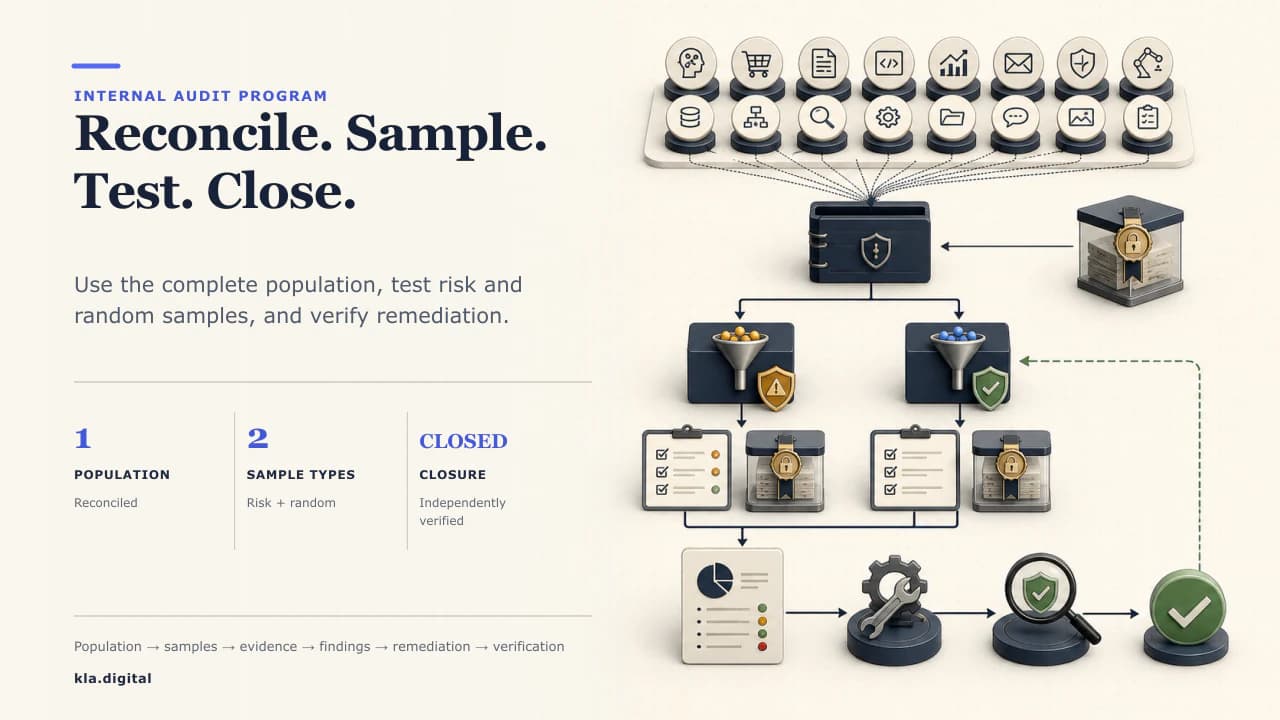
Un impegno ripetibile di audit interno per la pianificazione, il lavoro sul campo, il campionamento, la valutazione delle prove, i risultati e il follow-up. Il quadro aziendale definisce l'ampio universo di audit del dominio 12-. La lista di controllo dell'IA fornisce domande di controllo rapide e la matrice di responsabilità assegna i ruoli. Questa pagina contiene l'impegno stesso: una domanda di garanzia mirata, una popolazione riconciliata, valutazione del rischio, test di progettazione e di efficacia operativa, campioni riproducibili, valutazione delle prove, reporting e chiusura. Le cifre elaborate di seguito descrivono un audit illustrativo sull'erogazione del prestito e possono essere sostituite con i conteggi riconciliati derivanti da un impegno dal vivo.
1. Imposta l'obiettivo e i criteri di coinvolgimento
Scrivere una domanda di garanzia prima di richiedere prove: Durante il periodo di audit, le azioni consequenziali dell'agente sono state autorizzate, disciplinate da controlli approvati, accuratamente registrate nel sistema aziendale e supportate da prove sufficienti? La dichiarazione sull'ambito fissa quindi il processo aziendale, la popolazione di agenti e rilasci, gli ambienti, il periodo, i tipi di decisione, la materialità, le dipendenze, le esclusioni e i criteri. Ogni procedura di lavoro sul campo deve risolvere una parte di questa domanda.
Mantenere esplicita l'autorità di ciascun criterio. Il Modello a tre linee dell'IIA assegna la gestione del rischio ai ruoli di prima linea, le competenze e le sfide ai ruoli di seconda linea e la garanzia indipendente e obiettiva all'audit interno. L'IIA Artificial Intelligence Auditing Framework è una guida pratica pubblicata che i team di audit personalizzano e l'ISACA Artificial Intelligence Audit Toolkit è un kit di strumenti per professionisti commerciali che copre la progettazione del controllo e l'efficacia operativa. NIST AI RMF 1.0 è un quadro volontario finale. La legge applicabile entra nell'elenco dei criteri solo dopo che l'organizzazione ha documentato il ruolo dell'operatore, lo scopo previsto, la classificazione e la giurisdizione.
Il programma seguente separa gli obblighi legali, i controlli di gestione, l'orientamento professionale e le raccomandazioni dell'KLA. Le dimensioni del campione e i criteri di superamento sono scelte di pianificazione del coinvolgimento. Un parere di audit interno affronta i criteri stabiliti per l’ambito e il periodo definiti. Non fornisce alcuna certificazione di conformità normativa, sicurezza del sistema o prestazioni future.
| Campo di pianificazione | Inserimento obbligatorio | Voce dell'impegno lavorato | Accettazione della pianificazione |
|---|---|---|---|
| Obiettivo di garanzia | Una domanda verificabile riguardante l'autorizzazione, l'operazione di controllo, l'accuratezza dei risultati e le prove | Durante 1 aprile-30 giugno 2026, sono state autorizzate azioni consequenziali da parte degli agenti di origine dei prestiti di produzione, precedute dalla politica applicabile, indirizzate per la decisione umana richiesta, scritte accuratamente nel sistema di prestito e supportate da prove complete? | Lo sponsor dell'audit, il revisore capo e il responsabile del processo approvano la formulazione esatta |
| Processo aziendale e confini | Evento iniziale, evento finale, sistemi inclusi, ruoli umani e dipendenze | Ricezione della domanda tramite approvazione, rifiuto o referral dell'esito; include il servizio di identità, il livello di recupero, il servizio del modello di credito, il motore delle politiche KLA, il Decision Desk, il sistema di prestito e l'Evidence Room | Ogni componente in grado di influenzare l'autorità, la decisione, l'azione o l'evidenza viene nominato |
| Popolazione e periodo | Agenti, versioni, ambienti, azioni e intervallo di date | 8 agenti di produzione; Rilasci 27; Record di azioni 184,216; solo produzione; 1 aprile-30 giugno 2026 | I conteggi si riconciliano con la distribuzione, l'identità, il gateway, il Lineage Record e le origini del sistema aziendale |
| Tipi di decisione nell'ambito | Risultati consequenziali di autorizzazione, rifiuto, escalation, override, cambio di stato e ripristino | Approvazione, rifiuto, riferimento, rifiuto della policy, override umano, recupero dei dati del richiedente, pull di credito, emissione di offerte, rollback e revoca dell'accesso | Ogni tipo di decisione materiale ha un proprietario della popolazione e una procedura di test |
| Materialità | Soglie finanziarie, di diritti, di dati, operative e di prova | Tutti gli esiti negativi del richiedente; tutte le approvazioni superiori a EUR 25,000; tutti gli accessi a dati di categoria speciale o di identità; tutte le scritture esterne; tutti gli incidenti, i quasi incidenti, gli override e i fallimenti di integrità delle prove | Le soglie vengono approvate prima della selezione del campione e coprono l'impatto qualitativo |
| Stack di criteri | Politica, contratto, quadro normativo e criteri legali applicabili con autorità e versione | Politica di prestito LND-04 v6.2; Standard di controllo agente ACS-02 v4.1; programma di conservazione RS-17; contratti di vendita; NIST AI RMF come guida volontaria; Le disposizioni della Legge UE sull'AI solo laddove il ruolo documentato e la classificazione ad alto rischio le rendano applicabili | Ogni criterio è dotato di versione, di proprietà, efficace durante il periodo e mappato su un test |
| Ruoli e indipendenza | Sponsor dell'incarico, responsabile dell'audit, supporto in materia, proprietari delle prove e revisore della qualità | Sponsor del comitato di revisione; responsabile dell'audit interno; supporto per prestiti, IAM, rischio modello, dati, sicurezza e questioni legali; revisore indipendente della qualità dell'audit | L'audit interno non ha alcun ruolo di proprietà del controllo o di approvazione da parte della direzione nel processo sottoposto ad audit |
| Esclusioni e risultati finali | Esclusioni motivate, effetto su garanzia, rapporto, documenti di lavoro e date di follow-up | Sono esclusi i sandbox di sviluppo e le operazioni di formazione sui modelli interni del fornitore; rapporto dovuto 31 luglio 2026; risposte della direzione entro 14 agosto; primo nuovo test 30 settembre | Ogni esclusione ha un proprietario, una logica, un effetto di rischio e un limite di opinione dichiarato |
2. Dimostrare la completezza della popolazione prima di selezionare i campioni
La completezza della popolazione è un’asserzione di audit. Riconcilia il registro degli agenti con distribuzioni di produzione, identità non umane, gateway di modelli e strumenti, record di lineage, richieste di decisione ed eventi aziendali a valle. Blocca le estrazioni riconciliate con testo della query, filtri, tempo di estrazione, conteggio delle righe e hash. Le differenze inspiegabili diventano eccezioni o limitazioni dell'ambito prima dell'inizio del campionamento.
NIST AI RMF 1.0 è volontario e supporta il mantenimento di un inventario del sistema di intelligenza artificiale sotto GOVERN 1.6. Una popolazione di lavoro sul campo ha bisogno di maggiori dettagli: ogni agente, rilascio, modello, identità, delega temporanea, strumento, azione consequenziale, risultato politico, decisione umana, incidente ed effetto esterno per il periodo.
Cerca agenti ombra attraverso il traffico del gateway modello, i principali servizi cloud, la spesa per pacchetti e piattaforme, le estensioni del browser, le credenziali di automazione, le chiamate al gateway degli strumenti e i record aziendali con provenienza generata dall'intelligenza artificiale. Riconciliare le identità temporanee e delegate per creazione, scadenza, revoca, sponsor principale e utilizzo osservato. Un'identità o un'origine di esecuzione mancante può invalidare l'asserzione di completezza per ogni campione downstream.
| Componente della popolazione | Fonti autorevoli e confermanti | Conteggio lavorato | Procedura di riconciliazione | Criterio di superamento |
|---|---|---|---|---|
| Agenti di produzione | Registro degli agenti; manifesti di distribuzione; ID client del gateway modello | 8 | Partecipa all'ID dell'agente, all'ambiente, al proprietario, al processo e alle date attive; indagare su ogni client gateway assente dal registro | Tutti gli agenti distribuiti 8 compaiono in tutte le fonti applicabili; zero clienti inspiegabili |
| Versioni e implementazioni | Registro degli agenti; artefatti di rilascio immutabili; controllore di distribuzione; cambiare i biglietti | Rilasci 27 / Implementazioni 31 | Corrisponde a agent_release_id, hash dell'artefatto, approvazione, tempo di distribuzione, ambiente e cronologia di rollback | Ogni intervallo di produzione si risolve in un rilascio e un'implementazione approvati |
| Agente persistente e identità di servizio | directory IAM; inventario dei segreti; manifesti di distribuzione; registri del gateway | 19 identità | Abbina proprietario, tipo di entità, credenziale, ambito, attivazione, scadenza e ultimo utilizzo a un agente o a una dipendenza nell'ambito | Zero identità condivise, orfane, scadute o senza proprietario |
| Identità e delegazioni temporanee | Servizio gettoni; istantanee dell'autorità; registri delle delegazioni; eventi di revoca | 31 identità temporanee / 286 Viaggi delegati | Riconciliare questione, sponsor, scopo, ambito, scadenza, utilizzo e revoca; testare l'utilizzo prima dell'emissione o dopo la scadenza | 100% si impegna a favore di uno sponsor approvato e di uno scopo limitato; zero utilizzo fuori dalla finestra |
| Strumenti e dipendenze esterne | Catalogo degli strumenti; sovvenzioni IAM; gateway di uscita; inventario del venditore; contratti | Strumenti 14, incluso 6 con capacità di scrittura; 4 dipendenze esterne | Confrontare strumenti e versioni registrati con endpoint osservati e sovvenzioni effettive; ispezionare tutte le destinazioni sconosciute | Ogni strumento e dipendenza osservati è approvato, di proprietà, con versione e all'interno dei limiti dei dati |
| Registri delle azioni dell'agente | Documenti di lignaggio; eventi politici; portale degli strumenti; gateway del modello | 184,216 | Partecipa a record_id, correlation_id, ora dell'evento, agente, versione, policy ed effetto dello strumento; sequenza di ID duplicati e mancanti | Conti e chiavi si riconciliano; zero lacune o duplicati inspiegabili |
| Azioni commerciali consequenziali | Eventi del sistema di prestito; Documenti di lignaggio; effetti degli strumenti; notifiche del richiedente | 14,903 | Riconcilia ogni approvazione, rifiuto, riferimento, estrazione di credito, offerta e cambiamento di stato in entrambe le direzioni | Corrispondenza bidirezionale 100% tramite external_reference o effect_id; importo e risultato concordano |
| Eventi di controllo ed eccezione | Eventi politici; 3,842 Richieste di decisione; sistema degli incidenti; Avvisi di garanzia | 1,126 smentite; 214 prevale; 367 eventi di anomalia o di bassa confidenza; 11 incidenti o quasi incidenti | Riconciliare ogni evento con la sua azione, proprietario, risoluzione, effetto a valle e registrazione delle prove | Ogni eccezione ha una disposizione; tutte le azioni interessate rimangono nell'universo di controllo |
| Risultati della ricerca dell'agente ombra | Client sconosciuti del gateway modello; entità cloud; trascorrere; estensioni del browser; caveau di automazione | Candidati 3, agente ombra confermato 1 | Rintracciare ciascun candidato fino al proprietario e all'utilizzo; aggiungere l'attività produttiva confermata all'ambito e alla popolazione | Tutti i candidati hanno deciso; l'attività ombra confermata è contenuta, quantificata e segnalata |
3. Classifica gli agenti e i tipi di azione in base al rischio
Assegna un punteggio al tipo di azione secondo la sua massima autorità credibile durante il periodo. Utilizzare 0-3 per autonomia, reversibilità, sensibilità dei dati, impatto finanziario o sui diritti, autorità dello strumento e qualità delle prove; utilizzare 0-2 per le dipendenze esterne e la cronologia degli incidenti. Per la qualità delle prove, 0 significa verificabile e completo in modo indipendente, mentre 3 significa lacune materiali o fonti mutevoli. La rubrica 22-point utilizzata utilizza Critico 17-22, Alto 12-16, Moderato 7-11, e Basso 0-6.
Il punteggio ordina il lavoro sul campo e la copertura del campione. Non sostituisce il giudizio professionale. Aumentare il livello per un impatto catastrofico credibile, un bypass del controllo attivo, un incidente irrisolto o una popolazione incompleta anche quando il calcolo è inferiore. Documentare le prove e l'approvazione per ogni modifica manuale.
| Tipo di azione dell'agente | Autonomia | Reversibilità | Sensibilità dei dati | Impatto finanziario/diritti | Autorità dello strumento | Dipendenze esterne | Storia dell'incidente | Qualità delle prove | Totale/livello |
|---|---|---|---|---|---|---|---|---|---|
| Rifiuto del prestito | 2 | 3 | 3 | 3 | 2 | 2 | 2 | 2 | 19 / Critico |
| Approvazione del prestito superiore a EUR 25,000 | 1 | 3 | 3 | 3 | 3 | 2 | 1 | 2 | 18 / Critico |
| Delega valutazione tra agenti | 3 | 2 | 2 | 2 | 3 | 2 | 2 | 2 | 18 / Critico |
| Rifiuto documento di identità | 2 | 2 | 3 | 3 | 2 | 2 | 1 | 1 | 16 / Alto |
| Recupero dati creditizi da parte di terzi | 3 | 1 | 3 | 2 | 3 | 2 | 1 | 1 | 16 / Alto |
| Notifica sullo stato del richiedente | 3 | 0 | 1 | 1 | 1 | 1 | 0 | 1 | 8 / Moderato |
| Classificazione del documento senza cambio di stato | 3 | 0 | 2 | 1 | 0 | 1 | 0 | 1 | 8 / Moderato |
4. Testare la progettazione del controllo rispetto ai domini di audit 12
Un test di progettazione chiede se il controllo dichiarato, se gestito come scritto, affronta il rischio identificato. Ispezionare proprietà, obiettivo di controllo, trigger, logica decisionale, autorità, acquisizione delle prove, gestione delle eccezioni, frequenza, conservazione ed escalation. Analizza un caso normale e un caso di errore attraverso la progettazione prima di testare i record del periodo.
La tabella riutilizza la tassonomia enterprise framework alla lettera. È il programma di test di audit copiabile per la progettazione. Aggiungi riferimenti e risultati a documenti di lavoro locali senza modificare i nomi di dominio, la popolazione, la procedura, le prove o il criterio di superamento.
| Test ID e dominio di controllo | Progettare la popolazione | Procedura | Prova | Criterio di superamento |
|---|---|---|---|---|
| D-01: 1. Inventario e ambito | Agenti 8, versioni 27, implementazioni 31, strumenti 14, dipendenze esterne 4 | Ispezionare lo schema dell'inventario e il controllo della riconciliazione; tracciare un'aggiunta, una modifica e un ritiro tramite l'approvazione e l'individuazione della produzione | Registro agenti, mappa dei processi, procedura di inventario, output di riconciliazione, record di approvazione | Vengono definiti gli oggetti richiesti, i proprietari, gli ambienti, le date attive, le dipendenze e le origini di riconciliazione; un'attività di produzione sconosciuta innesca un'escalation |
| D-02: 2. Responsabilità e responsabilità | Agenti 8 e tutti i proprietari di controllo 12 | Mappare i risultati, l'accettazione del rischio, le operazioni di controllo, gli incidenti, le prove e le decisioni di riparazione in base ai ruoli nominati con autorità e delegati | Matrice di responsabilità, carte dei ruoli, mandato del comitato, percorso di escalation | Esiste un proprietario responsabile del processo; ogni controllo ed eccezione ha un proprietario autorizzato e un percorso di escalation |
| D-03: 3. Identità e delega | identità 19 persistenti e 31 temporanee; 286 Viaggi delegati | Ispezionare l'identità univoca, lo sponsor, lo scopo, l'ambito, la durata, l'emissione del token, la scadenza e il design della revoca; camminare una delega e una revoca di emergenza | Standard IAM, attestazioni di token, snapshot di autorità, procedure di delega e revoca | Ogni attore e delega è unico, limitato, attribuibile, limitato nel tempo ove applicabile e revocabile prima di ulteriore utilizzo |
| D-04: 4. Autorizzazioni, strumenti e limiti dei dati | Strumenti 14, strumenti 6 con funzionalità di scrittura, identità 19, tipi di azione 7 | Confronta lo scopo previsto con le sovvenzioni effettive, le azioni del Catalogo degli strumenti, gli ambiti delle risorse, i confini dei dati, i limiti di valore e i punti di applicazione | Modello di accesso, sovvenzioni, voci del catalogo degli strumenti, confini dei dati, test di negazione | Le restrizioni sui privilegi minimi vengono applicate al momento dell'azione; gli strumenti non registrati, i caratteri jolly generici e i percorsi di bypass diretto vengono bloccati |
| D-05: 5. Classificazione del rischio e garanzia pre-produzione | Rilasci 27 e modifiche del modello o del fornitore 9 | Ispezionare la rubrica dei rischi, la valutazione dell'impatto, il piano di test, le soglie, l'approvazione delle eccezioni e il cancello di rilascio; tracciare una soglia non superata | Valutazioni del rischio, valutazioni di modelli e processi, criteri di rilascio, approvazioni, eccezioni accettate | Ciascuna versione mappa i rischi materiali rispetto a test e soglie misurabili; gli errori bloccano il rilascio a meno che non esista un'eccezione limitata e autorizzata |
| D-06: 6. Applicazione dei criteri di runtime | Record di azioni 184,216 e versioni delle policy applicabili | Percorri i percorsi di autorizzazione, negazione, escalation ed eccezione; verificare che la politica valuti prima dell'esecuzione e le chiamate dirette allo strumento utilizzino lo stesso gate | Definizione del generatore di policy, configurazione del motore delle policy KLA, risultati della simulazione, sequenza di eventi | Ogni percorso consequenziale necessita di un verdetto pre-esecutivo approvato; Gli stati di negazione e di politica stantia impediscono l’effetto strumento |
| D-07: 7. Approvazione umana ed escalation | 3,842 Richieste di decisione e override 214 | Ispezionare le soglie di instradamento, l'autorità del revisore, le prove presentate, la gestione dei conflitti, la scadenza, la riassegnazione, la logica e la prevenzione delle decisioni tardive | Configurazione del Decision Desk, matrice del revisore, schema di richiesta, timer di escalation | Le decisioni umane richieste vengono prese prima dell'esecuzione da parte di un revisore autorizzato utilizzando prove definite e una motivazione registrata |
| D-08: 8. Linea di esecuzione e risultati aziendali | 14,903 azioni consequenziali | Tracciamento di intenti, input, dati recuperati, chiamate a strumenti, policy, decisione umana, stato prima e dopo, effetto a valle e notifica del richiedente | Scheda di lignaggio, viaggio, ricevuta dello strumento, scheda del sistema di prestito, riferimento della notifica | Gli identificatori stabili ricostruiscono ogni azione materiale e il risultato registrato concorda con il sistema aziendale |
| D-09: 9. Garanzia continua e gestione del cambiamento | Rilasci 27, implementazioni 31, modifiche al fornitore o al modello 9, avvisi 367 | Ispezionare la classificazione delle modifiche, l'attivazione della regressione, l'approvazione, il monitoraggio della prima esecuzione, le soglie di avviso, la revisione del proprietario e il collegamento della correzione | Differenze di rilascio, piani di test, condizioni di implementazione, avvisi di garanzia, record di revisione | Ogni cambiamento materiale innesca una rivalutazione e un monitoraggio; i segnali non riusciti creano soluzioni correttive proprietarie, con limiti di tempo |
| D-10: 10. Risposta all'incidente, revoca e rollback | 11 incidenti o quasi incidenti; 19 revoche di accesso; 4 Rollback | Rilevamento delle passeggiate, valutazione, contenimento, query sulla popolazione interessata, revoca delle credenziali, rollback, comunicazione, recupero e lezioni apprese | Piano degli incidenti, runbook, test di revoca e rollback, gravità e matrice di notifica | I proprietari possono interrompere ulteriori azioni, identificare i casi interessati, revocare l'autorità, ripristinare lo stato sicuro e preservare le prove entro gli obiettivi approvati |
| D-11: 11. Integrità, conservazione e verifica indipendente delle prove | Record 184,216 in pacchetti di prove giornaliere 91 | Esamina l'acquisizione sincrona, la creazione di manifest, gli hash, le firme, la custodia, l'accesso del verificatore, la conservazione, la conservazione a fini giudiziari e i controlli di eliminazione | Schema delle prove, manifesti, record chiave, registro di custodia, programma di conservazione, risultato del verificatore | Un revisore può riconciliare, convalidare e rieseguire le azioni campionate; le alterazioni o i record mancanti sono rilevabili e intensificati |
| D-12: 12. Dipendenze multi-agente e di terze parti | 286 percorsi delegati, dipendenze esterne 4, modifiche al fornitore o al modello 9 | Esamina il trasferimento autenticato, la propagazione dei vincoli, il blocco della versione, le prove del fornitore, i doveri degli incidenti, la cessazione e il fallback | Schema di trasferimento, ricevute del gateway, contratti, rapporti di garanzia, inventario delle dipendenze | Ogni servizio e agente che contribuisce è attribuibile, autorizzato, con versione, vincolato e coperto da prove e termini di incidente |
5. Testare l'efficacia operativa durante il periodo di audit
Il test dell'efficacia operativa utilizza i record del periodo effettivo. Esegui asserzioni deterministiche sull'intera popolazione in cui sono dimostrate la completezza della fonte e la semantica del campo, quindi esamina i casi campionati per verificarne il giudizio, il contesto e la qualità delle prove. Conserva il testo delle query, le istantanee di origine, i conteggi delle righe, le eccezioni, le note del revisore e i risultati delle nuove prestazioni nei documenti di lavoro.
Ogni eccezione rimane legata al suo denominatore. Un verdetto politico tardivo in 3 su azioni consequenziali 14,903 ha un'esposizione diversa rispetto ai casi 3 in una popolazione non riconciliata. Quantificare sia il tasso osservato che la limitazione della popolazione, quindi espandere i test quando il fallimento può essere sistemico.
| Prova d'identità | Popolazione e selezione | Procedura | Prova | Criterio di superamento |
|---|---|---|---|---|
| OE-01: record di azioni e sequenza di policy | Tutti i record 184,216; azioni consequenziali 14,903 separate | Testare l'unicità, i campi obbligatori, l'ordine del timestamp, la versione della policy e il verdetto pre-esecuzione; identificare le azioni negate con uno effect_id downstream | Frozen Lineage Record ed estratti di eventi politici; interrogare; file di eccezione | 100% unico ed attribuibile; ogni azione consequenziale ha un risultato di autorizzazione o escalation preventiva applicabile; vengono eseguite zero azioni negate |
| OE-02: Politica smentita | Tutte le 1,126 smentite analiticamente; 40 casi selezionati tra regola, tipo di azione, agente e rilascio per revisione umana | Confermare che l'azione richiesta è stata interrotta, che nessun tentativo equivalente ha ignorato la regola, che la notifica e l'escalation hanno seguito la policy e che le prove spiegano la decisione | Risultato della policy, regole corrispondenti, catena di tentativi, gateway degli strumenti, notifica, richiesta di decisione | Zero effetti vietati o bypass equivalenti; ogni smentita campionata è corretta, puntuale e ricostruibile |
| OE-03: Approvazioni umane | Tutte le richieste di decisione 3,842 analiticamente; 60 campionato per rischio, revisore, risultato e mese | Testare l'autorità del revisore al momento della decisione, le prove presentate, i tempi della decisione, la logica, i conflitti, la scadenza e la corrispondenza con l'azione eseguita | Record del Decision Desk, snapshot IAM, hash delle prove presentate, ricevuta dello strumento, risultato aziendale | 100% le approvazioni richieste precedono l'azione; le decisioni campionate hanno revisori autorizzati, prove sufficienti, motivazione ed effetti di corrispondenza |
| OE-04: Sostituzioni umane | Tutti gli 214 sovrascrivono analiticamente; 50 campionato in base al verdetto originale, al revisore, al codice motivo, al risultato e alla liberatoria | Confrontare l’autorità e la logica di override con la politica; tracciare la decisione originale, la nuova decisione, l'effetto dello strumento, la notifica e l'incidente o reclamo successivo | Decisioni originali e di sostituzione, istantanea dell'autorità, logica, record di lineage, risultato | Ogni intervento è autorizzato, motivato, tempestivo, entro i limiti delegati e rispecchiato accuratamente a valle |
| OE-05: Riconciliazione impresa-stato | Tutte le azioni consequenziali 14,903 analiticamente; 60 campionato per l'ispezione della fonte | Partecipa all'azione richiesta, all'azione approvata, alla risposta dello strumento, agli hash di stato prima e dopo, all'importo, allo stato finale del prestito e alla notifica del richiedente | Ricezione utensili, evento sistema prestito, notifica, before_state_hash, after_state_hash, external_reference | 100% accordo sull'esito e sull'importo; I record di origine campionati supportano lo stato registrato prima e dopo |
| OE-06: Rilasci e prime esecuzioni | Tutte le versioni 27; prima e seconda esecuzione consequenziale dopo ogni Release, azioni 54 | Verificare l'approvazione, le versioni degli artefatti e delle policy, i risultati della regressione, i tempi di distribuzione, il monitoraggio previsto, la completezza delle prove e l'assenza di esecuzione pre-approvazione | Manifesto di rilascio, risultati dei test, approvazione, record di implementazione, primi record di lineage | Ogni Release viene approvata prima dell'uso; tutte le prime esecuzioni di 54 utilizzano le versioni previste e superano il controllo e le verifiche delle prove |
| OE-07: Revoche di accesso | Tutti gli eventi di revoca 19 e tutte le attività successive per le identità interessate | Confronta richiesta, approvazione, tempo di validità, scadenza del token, applicazione del gateway, sessioni residue e successive chiamate rifiutate o riuscite | Eventi IAM e token, log del gateway, snapshot delle autorità, collegamenti agli incidenti | La revoca soddisfa l'obiettivo approvato; zero utilizzi riusciti si verificano dopo il tempo effettivo |
| OE-08: Incidenti e quasi incidenti | Tutti gli eventi 11 e l'intera popolazione interessata dall'azione per ciascuno | Rieseguire la gravità, la query sulla popolazione interessata, il contenimento, la revoca, il rollback, la notifica, la causa principale, la riparazione e l'approvazione della chiusura | File dell'incidente, record di discendenza, elenco dei casi interessati, ricevute di revoca e rollback, prove di chiusura | Ogni evento prevede una popolazione colpita completa, contenimento tempestivo, recupero approvato, prove conservate e bonifica verificata |
| OE-09: Integrità e conservazione delle prove | Tutti i manifesti del pacchetto giornaliero 91; Pacchetti 30 selezionati per la convalida della firma e della catena; ogni azione campionata | Ricalcola gli hash dei manifest e dei record, convalida le firme e l'ordine della catena, conferma la classe di conservazione e la conservazione legale e risolvi i record tramite un verificatore indipendente | Manifesti dei pacchetti, chiavi di firma, registro di custodia, record di conservazione, output del verificatore | Tutti i manifest si riconciliano con i conteggi delle fonti; tutte le convalide 30 e tutti i record campionati superano i test di integrità, custodia e conservazione |
| OE-10: modifiche a fornitore, modello e delega | Tutte le modifiche al fornitore o al modello 9 e i percorsi delegati 286 in modo analitico; 50 Viaggi campionati | Testare l'approvazione della modifica, i termini del contratto e delle prove, mittente e destinatario autenticati, scopo e vincoli propagati, versioni, effetti del sub-agente e risultato finale | Modifica record, contratto, ricevute di trasferimento, istantanee dell'autorità, versioni dei componenti, esito del viaggio | Ogni modifica viene approvata prima dell'uso; ogni trasferimento campionato è attribuibile, delimitato, versionelizzato e riconducibile al risultato finale |
6. Selezionare un rischio riproducibile e un campione casuale
Congelare la popolazione prima della selezione. Registra le query di origine, il tempo di estrazione, i filtri, il seed casuale, il metodo hash, il proprietario del campione, il trattamento duplicato, le sostituzioni e l'elenco dei casi finali. Conserva tutti i tag di strato applicabili su un caso selezionato in modo che un'azione possa soddisfare diversi obiettivi di copertura senza scomparire dalla segnalazione delle eccezioni.
I test automatizzati su tutta la popolazione funzionano per asserzioni deterministiche su record strutturati e riconciliati: unicità, campi obbligatori, ordine timestamp, sequenza policy prima dell'azione, corrispondenza importo, autorità scaduta, rifiuto seguito dall'esecuzione e convalida hash. La revisione umana rimane necessaria per la logica decisionale, la coerenza semantica con lo scopo, la pertinenza dei dati recuperati, la qualità del giudizio del revisore, il danno credibile a valle, le eccezioni alla catena di custodia e le prove opache di terze parti.
I conteggi di selezione riportati di seguito sono raccomandazioni dell'KLA per questa popolazione lavorata. Costituiscono un punto di partenza difendibile per la pianificazione del coinvolgimento. Documentare la garanzia prevista, la deviazione tollerabile, la variabilità della popolazione, la strategia di affidamento e le regole di espansione quando il coinvolgimento necessita di inferenza statistica.
| Strato richiesto | Popolazione concreta | Metodo di selezione e dimensione | Procedura umana | Prova | Regola del passaggio e dell'espansione |
|---|---|---|---|---|---|
| Tipi di azioni ad alto rischio | 2,412 Rifiuti del livello critico, approvazioni superiori a EUR 25,000, e azioni di valutazione tra agenti | Casi 60: 20 valore più alto o impatto più elevato, più 40 ripartiti tra tipo di azione, agente, rilascio e mese | Rieseguire l'autorità, la politica, la decisione umana richiesta, l'effetto dello strumento, il risultato e l'integrità delle prove dall'inizio alla fine | Record di discendenza, istantanea dell'autorità, policy, richiesta di decisione, ricevuta di strumenti, stato aziendale, manifest delle prove | Zero effetti consequenziali non autorizzati o non supportati; qualsiasi errore di questo tipo si estende all'intero tipo di azione e rilascio interessato |
| Campione casuale della popolazione | Popolazione base di record di azioni 184,216; la selezione esclude i casi già scelti per gli strati obbligatori | Record 80 selezionati ascendendo SHA-256 del seme fisso più record_id; conservare il seme e interrogare | Ispeziona la completezza end-to-end e confronta lo scopo, l'azione e il risultato registrati con i record di origine | Tutti i gruppi di prove minime e i record di fonti autorevoli | Nessun campo mancante o incoerente inspiegabile; un divario nello schema sistemico si espande a tutti i record che utilizzano quella versione dello schema |
| Eccezioni e rifiuti derivanti dalle norme | Rifiuti 1,126 attraverso le regole dei criteri 18 | Test di sequenza automatizzato su tutta la popolazione; 40 revisioni umane che coprono ogni regola materiale e tutti gli agenti 8 | Confermare che l'effetto negato sia stato interrotto, che i percorsi dei nuovi tentativi siano rimasti governati e che l'escalation o la notifica corrispondano ai criteri | Decisione politica, regole corrispondenti, catena di tentativi, record gateway, richiesta di decisione, notifica | Zero effetti negati; qualsiasi bypass si espande a tutte le esecuzioni che condividono regole, agenti, versioni, strumenti o modelli di tentativi |
| Sostituzioni umane | 214 sostituisce i revisori 23 | Autorità a popolazione intera e test temporale; 50 revisioni umane, inclusi tutti i revisori con 5 o più sostituzioni | Valutare le prove presentate, la motivazione, l'autorità, il conflitto, la tempistica, l'azione eseguita e il successivo reclamo o incidente | Decisione originale, override, snapshot IAM, logica, effetto dello strumento, cronologia dei risultati | Ogni deroga è autorizzata, motivata, preventiva alla sua efficacia e delimitata; un revisore non valido si espande a tutte le decisioni di quel revisore |
| Risultati anomali o con scarsa confidenza | 367 eventi derivanti da nuovi tentativi, valori anomali, deriva, latenza, qualità dei dati o regole di bassa confidenza | Casi 60: 10 per ciascuna famiglia di anomalie, ponderati in base alle azioni Critiche e Alte | Convalidare l'avviso, l'indagine, la disposizione, il percorso decisionale, l'effetto e la riparazione; ispezionare il rischio di falsi negativi attorno alle soglie | Avviso di garanzia, record di modelli e strumenti, analisi del revisore, risultati, piano di riparazione | Ogni avviso campionato viene risolto tempestivamente e correttamente; qualsiasi escalation richiesta mancata si espande alla finestra della famiglia e della soglia |
| Prime esecuzioni dopo un Release | Prima e seconda azione consequenziale dopo ciascuno dei 27 Rilasci: azioni 54 | Prova tutti gli 54 | Abbina versioni distribuite, approvazione, risultati di regressione, policy, autorizzazioni, monitoraggio, risultati e schema di prova | Manifesto di rilascio, record di implementazione, primi record di lineage, avvisi di garanzia | Tutti gli 54 utilizzano versioni approvate e superano i controlli; qualsiasi errore si estende a ogni azione fino alla correzione o al rollback |
| Delega tra agenti | 286 Journey contenenti almeno un trasferimento da agente ad agente | 50 Percorsi tra mittente, destinatario, strumento, livello di rischio e versione; includere ogni viaggio da tre salti | Traccia parti autenticate, scopo delegato, ambito, scadenza, propagazione dei vincoli, integrità del messaggio, effetti dello strumento e risultato finale | Ricevute di trasferimento, istantanee dell'autorità, record di discendenza dei componenti, ricevute degli strumenti, esito del viaggio | Ogni passaggio di consegne è attribuibile e nei limiti delegati; qualsiasi catena interrotta si espande nella combinazione mittente-destinatario-versione |
| Incidenti e quasi incidenti | Incidenti 7 e quasi incidenti 4 | Testare tutti gli 11 e la popolazione completa delle azioni interessate per ciascuno | Rieseguire il rilevamento, la gravità, il contenimento, la revoca, il rollback, la notifica, la causa principale, la riparazione e la chiusura | File dell'incidente, query sul caso interessato, record delle azioni, ricevute di recupero, prove di chiusura | Popolazione colpita completa e accurata con risposta tempestiva e chiusura verificata; qualsiasi omissione riapre l'evento |
| Modifiche al fornitore o al modello | Modifiche 9: versioni del modello 4, fornitori di recupero 2, API dello strumento 2, servizio di orchestrazione 1 | Testare tutte le modifiche 9 e le prime azioni consequenziali 3 dopo ciascuna revisione delle azioni 27 mantenendo la sovrapposizione | Ispezionare la due diligence, i termini del contratto e delle prove, la rivalutazione del rischio, la valutazione, l'approvazione, il blocco della versione, il monitoraggio e il fallback | Approvazione modifiche, contratto, valutazione, manifest, record gateway, primi risultati | Ogni modifica viene approvata e testata prima dell'utilizzo; qualsiasi uso non approvato si estende all'intervallo di esposizione completo |
7. Valutare la sufficienza delle prove per ogni azione campionata
Le prove sono sufficienti quando sono rilevanti per l’asserzione, affidabili, complete, tempestive, tracciabili per la popolazione e protette da cambiamenti non rilevati. Documentare il produttore, il sistema autorevole, il metodo di estrazione, la semantica del campo, la conservazione, il meccanismo di integrità e la catena di custodia. Rielaborare il risultato della politica e riconciliare l’effetto a valle ogni volta che le prove supportano tali procedure.
La prova dell'identità deve risolvere l'utente o l'entità sponsor, l'agente, il contesto del servizio, il delegante e l'approvatore. Lo schema del registro di controllo dell'agente AI fornisce il contratto della macchina condivisa indipendente dal fornitore. Questo programma di controllo mantiene sponsoring_principal_id, agent_identity_id, authority_snapshot_id, delegated_by e reviewer_id come alias del foglio di lavoro; I record IAM collegati riportano il tipo di attore, il ciclo di vita delle credenziali, le sovvenzioni effettive e il contesto del servizio. Conserva questi alias in modo che gli esempi possano spostarsi tra enterprise framework, Lineage Explorer ed Evidence Room senza traduzione.
Uno screenshot, un totale del dashboard o una rappresentazione gestionale possono corroborare un test e non possono sostituire il record del periodo sottostante. Laddove manca un gruppo richiesto, classificare il divario, identificare la popolazione interessata, tentare una procedura alternativa equivalente e qualificare la conclusione quando la stessa affermazione rimane non supportata.
| Richiedi ID e gruppo di campi | Campi minimi esatti | Sorgente e formato richiesti | Sufficienza e superamento della prova |
|---|---|---|---|
| ER-01: registrazione e correlazione | record_id, occurred_at, environment, tenant_id, process_id, journey_id, correlation_id | Estratto di record di derivazione immutabile più schema, fuso orario, query, conteggio di righe ed hash di estrazione | Gli ID sono univoci; l'ordine del timestamp è coerente; il record si riconcilia con la popolazione congelata e completa il viaggio |
| ER-02: Agente e rilascio | agent_id, agent_release_id, model_id, model_version, orchestrator_version, prompt_template_version | Registro dell'agente e manifesto di rilascio firmato con riferimenti agli artefatti immutabili | Ogni versione si risolve nell'artefatto approvato e distribuito in occurred_at |
| ER-03: Preside e delegazione | agent_identity_id, sponsoring_principal_id, delegated_by, session_id, authority_snapshot_id, expires_at | Record IAM, token, sessione, delega, concessione effettiva, contesto del servizio e revoca | L'utente o lo sponsor, l'agente, il contesto del servizio e la delega sono attribuibili, attivi, con ambito, non scaduti e autorizzati per l'azione |
| ER-04: Scopo e rischio | purpose_code, decision_type, risk_tier, regulatory_classification, classification_basis_version | Scopo del processo approvato, catalogo delle decisioni, valutazione del rischio e registro della classificazione | Lo scopo e il livello registrati corrispondono all'uso approvato e alla classificazione effettiva per la Rilascio |
| ER-05: Provenienza dei dati | input_reference[], source_hash[], retrieval_query_hash, data_boundary_id, redaction_profile_id | Input protetti o riferimenti risolvibili, ricevute di recupero, versioni di origine, confini dei dati e record di redazione | Ogni input materiale e ogni elemento recuperato si risolve nella fonte, nel tempo, nel confine e nella rappresentazione protetta consentiti |
| ER-06: Azione strumento | tool_id, tool_version, action, resource_scope, requested_args_hash, response_hash, effect_id | Voce del catalogo degli strumenti, richiesta e risposta del gateway, contesto di autorizzazione effettivo e ricezione dell'effetto | L'autorità richiesta, la chiamata effettiva, la risposta e l'effetto a valle concordano e rimangono nell'ambito approvato |
| ER-07: decisione politica | policy_id, policy_version, policy_decision, matched_rule_ids[], exception_id, evaluated_at | Artefatto del generatore di politiche, evento del motore delle politiche di KLA, regole corrispondenti, approvazione delle eccezioni e input di simulazione | Il revisore esegue nuovamente lo stesso risultato; evaluated_at precede l'effetto dello strumento governato |
| ER-08: Decisione umana | decision_request_id, reviewer_id, reviewer_role, presented_evidence_hash, decision, rationale, decided_at | Il record del Decision Desk più l'istantanea IAM del revisore e le prove presentate al momento della decisione | L'identità e il ruolo dell'approvatore sono autorizzati; prove, decisione, logica e tempistica supportano l’azione intrapresa |
| ER-09: Risultato e recupero | outcome, before_state_hash, after_state_hash, external_reference, incident_id, rollback_id, revocation_event_id | Autorevole prima e dopo le registrazioni aziendali, le notifiche, gli incidenti, il rollback e le ricevute di revoca | L’effetto statale e downstream registrato corrisponde al sistema aziendale; gli eventi di ripristino si risolvono e vengono sequenziati correttamente |
| ER-10: Integrità e fidelizzazione | evidence_hash, previous_record_hash, bundle_manifest_hash, signature_key_id, sealed_at, retention_class, legal_hold_id | Pacchetto di prove sigillate, manifest, firma e record della chiave, registro di custodia, programma di conservazione e record di conservazione legale | Gli hash vengono ricalcolati; firma e convalida della catena; la sigillatura è tempestiva; custodia, conservazione e trattenuta coprono il campione |
8. Scrivere i risultati e formulare un giudizio di audit circoscritto
Utilizzare un modello di gravità a quattro livelli. Critico indica un'esposizione finanziaria attiva o credibile, non autorizzata, irreversibile, relativa alla sicurezza, ai diritti o materiale che richiede un contenimento immediato. Alto indica un fallimento materiale o sistemico del controllo, una popolazione colpita significativa o una prevenzione debole rispetto ad azioni consequenziali. Moderato indica una debolezza di controllo limitata con controlli compensativi ed esposizione corrente limitata. Basso indica una documentazione isolata o una debolezza del processo con un impatto diretto basso. Registrare la probabilità, l'impatto, la velocità, la rilevabilità, la popolazione, i controlli compensativi e l'accettazione del rischio da parte della gestione dietro la valutazione.
Ogni risultato necessita di condizione, criterio, causa, conseguenza, popolazione interessata, prove, proprietario, riparazione e data di ripetizione del test. Separare un'eccezione di controllo da una limitazione delle prove. Laddove la completezza della popolazione, l’integrità delle prove o la dipendenza da terzi impediscano la procedura, indicare l’asserzione interessata e l’incertezza residua in una conclusione con riserva.
Il parere finale indica l'ambito, il periodo, i criteri, il livello di garanzia, i settori testati, le popolazioni affidabili, le eccezioni e le limitazioni. Riporta se i controlli sono stati adeguatamente progettati e gestiti in modo efficace per l'incarico indicato. Non fornisce alcuna certificazione di conformità legale, sicurezza del sistema, correttezza delle decisioni individuali al di fuori del lavoro testato o funzionamento futuro.
| Campo di ricerca | Risultato completato: IA-AGT-2026-04 |
|---|---|
| Titolo e gravità | Le sostituzioni umane sono state eseguite senza prova completa di approvazione contemporanea: Alta |
| Condizione | Nell'intera popolazione di sostituzioni umane 214, i record 37 avevano un rationale vuoto e i record aggiuntivi 12 utilizzavano un reviewer_role che non si risolveva nella matrice del sottoscrittore approvata in decided_at. Cinque di queste decisioni 12 sono state registrate dopo il relativo effetto dello strumento con capacità di scrittura. Gli 49 unici override interessati rappresentano 22.9% della popolazione di override. |
| Criterio | La politica di prestito LND-04 v6.2 sezione 7.3 e lo standard di controllo dell'agente ACS-02 v4.1 controllo HAO-4 richiedono che un sottoscrittore autorizzato esamini le prove presentate, registri una decisione e una motivazione e completi la decisione prima che qualsiasi override raggiunga il sistema di prestito. |
| Causa | La migrazione IAM di giugno ha omesso il gruppo appaltatore-sottoscrittore dalla mappatura dei ruoli del Decision Desk. Lo schema API di override consentiva anche una logica vuota e il gateway dello strumento ha accettato un riferimento di override senza verificare decided_at rispetto all'ora dell'effetto. |
| Conseguenza | L'organizzazione non può dimostrare un giudizio contemporaneo e autorizzato per gli override di 49. Cinque effetti del sistema di prestito si sono verificati prima della decisione registrata, creando un bypass del controllo diretto. I richiedenti interessati potrebbero aver ricevuto risultati che non possono essere supportati dal registro di approvazione conservato e la direzione non dispone di prove affidabili per reclami, autorità di regolamentazione o revisione interna. |
| Popolazione interessata | 49 di 214 sostituisce tra 1 aprile e 30 giugno 2026: approvazioni 31, rifiuti 13 e modifiche dei referral 5 tra agenti 6 e versioni 4. Le cinque decisioni tardive hanno interessato domande che richiedevano un totale di EUR 286,000. |
| Prova | Query a popolazione completa IA-AGT-OE-04; hash di estrazione Decision Desk congelato 8d61…c4a2; Snapshot del ruolo IAM; Documenti di lignaggio 49; cinque ricevute di strumenti ed eventi del sistema di prestito; politica LND-04 v6.2; controllo ACS-02 v4.1. La nuova esecuzione indipendente ha confermato i conteggi e l'ordine degli eventi. |
| Proprietario e data di scadenza | Proprietario responsabile: Responsabile delle operazioni di prestito. Proprietari di supporto: proprietario IAM e proprietario tecnico dell'agente. Risanamento dovuto 15 settembre 2026. |
| Risanamento | Rendere rationale obbligatorio per ogni override; sincronizzare i gruppi di revisori approvati da IAM; richiedere al gateway di convalidare l'autorità del revisore e decided_at prima di una scrittura; riesaminare tutti i casi interessati da 49; correggere i record del richiedente e del prestito ove richiesto; preservare il divario originale e la nuova revisione come prove separate; monitorare quotidianamente la completezza dell'override per 30 giorni. |
| Criterio di ripetizione e chiusura | Data del nuovo test: 30 settembre 2026. Eseguire nuovamente i test di progettazione per schema, sincronizzazione dei ruoli e sequenziamento del gateway; testare l'intera popolazione di riparazione 49-case e tutte le sostituzioni da 16-30 settembre. Chiudi solo quando ogni caso interessato ha una disposizione approvata, ogni nuova sostituzione ha una decisione e una motivazione preventiva autorizzata e il monitor 30-day non ha errori. |
| Effetto opinione | Qualificare la conclusione sull'efficacia operativa per 7. Approvazione umana ed escalation e conseguenti override durante il periodo di audit. Conservare conclusioni separate per altri ambiti in cui prove sufficienti le supportano. |
9. Segnalare, seguire e stabilire una garanzia continua
Tieni traccia di ogni risultato attraverso un piano di riparazione con il proprietario, le azioni, le date di scadenza, le dipendenze, il trattamento temporaneo del rischio, le prove e lo stato. L'audit interno ritesta l'asserzione fallita utilizzando il criterio originale più i record operativi post-correzione. La chiusura richiede una progettazione verificata, un funzionamento efficace per la finestra di osservazione definita, un trattamento completo della popolazione interessata e l’approvazione secondo la metodologia di audit.
Esegui analisi ricorrenti tra gli audit su riconciliazione della popolazione, rifiuti di policy seguiti da effetti, approvazioni tardive, sostituzioni, autorità scaduta, modifiche a versioni e modelli, disposizione delle anomalie, chiusura degli incidenti, completezza delle prove e convalida delle firme. La direzione è proprietaria di questi controlli e revisioni. L'audit interno convalida la fonte, la logica, le soglie, le prove di revisione e il follow-through dei problemi prima di fare affidamento sull'analisi.
Attivare il lavoro di audit fuori ciclo per un nuovo agente ad alto impatto, rilascio materiale, sostituzione di modello o fornitore, espansione di autorizzazioni, nuovo strumento con funzionalità di scrittura, modifica di processo o classificazione, incidente o quasi incidente, varianza inspiegabile della popolazione, errore di integrità delle prove, anomalia ripetuta di override o rifiuto o risultato critico o elevato scaduto. Utilizza la valutazione della preparazione all'audit dell'agente per valutare la preparazione, quindi utilizza il 12-domain enterprise framework per espandere qualsiasi dominio debole in procedure più profonde.
- Tracciamento delle soluzioni: aggiorna proprietario, data di scadenza, azione, dipendenza, controllo temporaneo, prove e accettazione del rischio almeno settimanalmente per i risultati critici e elevati.
- Ripeto test di controllo: ripetere la fase di progettazione non riuscita, testare l'intera popolazione interessata nota e ispezionare una finestra operativa post-correzione definita.
- Evidenza della chiusura: conserva la configurazione corretta, le approvazioni, le disposizioni dei casi interessati, i nuovi record del periodo, i risultati delle query, l'output del verificatore e l'approvazione della chiusura dell'audit.
- Analisi ricorrenti: indirizzano le violazioni a un avviso di garanzia con proprietario, gravità, data di scadenza, query sulla popolazione interessata e piano di riparazione.
- Lavoro fuori ciclo: apre una revisione mirata quando un trigger modifica l'autorità, l'impatto, l'affidabilità delle prove o la popolazione dell'audit.
| Sezione resoconti | Contenuti richiesti | Artefatto allegato | Criterio di completamento |
|---|---|---|---|
| 1. Sintesi e parere esecutivo | Domanda di garanzia, conclusione, profilo di gravità, esposizione materiale, aree affidabili e azione richiesta | Parere firmato e sintesi della questione | La conclusione è limitata a criteri, ambito, periodo, popolazione, procedure e prove |
| 2. Obiettivo, ambito e criteri | Processo aziendale, agenti, rilasci, date, tipi di decisione, materialità, esclusioni, autorità di ciascun criterio | Lista di controllo approvata per la pianificazione del coinvolgimento | Ogni test riconduce alla domanda di garanzia e ad un criterio efficace |
| 3. Confini del sistema e popolazione | Architettura, proprietari, identità, strumenti, dipendenze, conteggi, risultati di riconciliazione e ricerca di agenti ombra | Foglio di lavoro della popolazione, query di origine, hash e registro della varianza | La popolazione è completa o vengono indicati i limiti esatti e le asserzioni interessate |
| 4. Valutazione e metodologia del rischio | Rubrica del rischio, azioni classificate, approccio alla progettazione e all'efficacia operativa, test automatizzati, metodo di campionamento, seed, dimensioni e regole di espansione | Foglio di lavoro sui rischi, programma di test e matrice di campionamento | Un revisore può riprodurre la selezione e comprendere la dipendenza da ogni procedura |
| 5. Risultati per dominio di controllo | Conclusione del progetto, conclusione operativa, popolazione testata, eccezioni, tassi e qualità delle prove per tutti i domini 12 | Indice dei documenti di lavoro e tracker delle richieste di prove | Ogni conclusione è supportata da prove esaminate ed eccezioni quantificate |
| 6. Rilievi e azioni gestionali | Condizione, criterio, causa, conseguenza, popolazione, evidenza, gravità, proprietario, azione, data di scadenza e accettazione del rischio | Reperimento fogli e risposte firmate della direzione | Le azioni affrontano la causa principale e completano il trattamento della popolazione colpita |
| 7. Limitazioni e conclusioni qualificate | Evidenze mancanti, alternative fallite, dipendenze non disponibili, incertezza residua ed effetto opinione | Documenti di lavoro sulla limitazione dell'ambito e sulla procedura alternativa | Il lettore può identificare ogni affermazione al di fuori della garanzia supportata |
| 8. Follow-up e garanzia continua | Governance della riparazione, piano di ripetizione del test, criteri di chiusura, analisi, proprietari, soglie, cadenza e trigger fuori ciclo | Piani di riparazione, inventario di analisi e calendario di follow-up | Ogni problema aperto e segnale ricorrente ha un proprietario, una fonte di prova, una data di scadenza e un percorso di escalation |
| 9. Appendici | Definizioni, versioni dei criteri, popolazioni dettagliate, query, elenco di campioni, esclusioni, indice di evidenza e rubrica di gravità | Riferimenti al pacchetto di riproducibilità e al pacchetto di prove sigillate | Un revisore indipendente può rintracciare le dichiarazioni del rapporto nei documenti di lavoro senza esporre dati protetti |
Domande frequenti
Che cos'è un programma di controllo degli agenti AI?
È il piano di lavoro ripetibile per un incarico di garanzia: obiettivo, criteri, popolazione completa, valutazione del rischio, progettazione del controllo e procedure di efficacia operativa, campionamento, test di evidenza, risultati, parere e follow-up. Il più ampio 12-domain enterprise framework definisce l'universo di audit.
In che modo l'audit interno dovrebbe definire l'ambito del coinvolgimento di un agente di intelligenza artificiale?
Inizia con il processo aziendale e la domanda di garanzia esatta. Nominare agenti, versioni, identità, strumenti, modelli, dipendenze, tipi di decisione, periodo, materialità, effetti a valle, archivi di prove, esclusioni e criteri. Riconciliare l'intera popolazione prima di selezionare i campioni.
In che modo gli auditor dovrebbero campionare le azioni degli agenti IA?
Combina una linea di base casuale riproducibile con strati di rischio obbligatori: azioni ad alto rischio, rifiuti, sostituzioni, anomalie, risultati con scarsa certezza, prime esecuzioni dopo i rilasci, delega tra agenti, incidenti, quasi incidenti e modifiche a fornitori o modelli. Conserva la query di popolazione, il seed, la logica di selezione e le regole di espansione.
Quali prove sono richieste per un'azione dell'agente AI campionata?
Il record dovrebbe risolvere le identità del principale e dell'agente, la delega e il contesto del servizio, l'agente e la versione del modello, gli input e i riferimenti ai dati recuperati, il contesto degli strumenti e delle autorizzazioni, il risultato della politica, la decisione e la logica umana, lo stato prima e dopo, l'effetto a valle, i timestamp, la conservazione, la prova di integrità e la catena di custodia.
I test automatizzati possono sostituire la revisione dei campioni umani?
I test automatizzati possono coprire popolazioni complete per asserzioni deterministiche come sequenza, campi obbligatori, scadenza dell'autorità, riconciliazione dei risultati e convalida dell'hash. La revisione umana è ancora necessaria per la logica, il contesto, la coerenza semantica, la qualità del giudizio, il danno credibile e le limitazioni delle prove.
Cosa dovrebbe indicare la relazione di audit quando le prove sono incomplete?
Classificare il divario, quantificare la popolazione interessata, tentare una procedura alternativa equivalente e dichiarare l'affermazione non supportata e l'incertezza residua. Qualificare il dominio pertinente o il limite dell'opinione e assegnare la riparazione con una data di ripetizione.
Punti chiave
Un programma di audit degli agenti IA utilizzabile inizia con una domanda di garanzia precisa e una popolazione completa. Classifica il rischio d'azione, testa la progettazione del controllo e il funzionamento effettivo, combina l'analisi dell'intera popolazione con campioni riproducibili, valuta uno schema di prove coerente, scrive risultati quantificati e verifica la chiusura. Inizia con la valutazione della preparazione all'audit dell'agente, utilizza il framework aziendale per criteri di dominio più approfonditi e confronta la richiesta di prove con l'esempio di Evidence Room.